

Altiorem Weekly - 21 September 2026
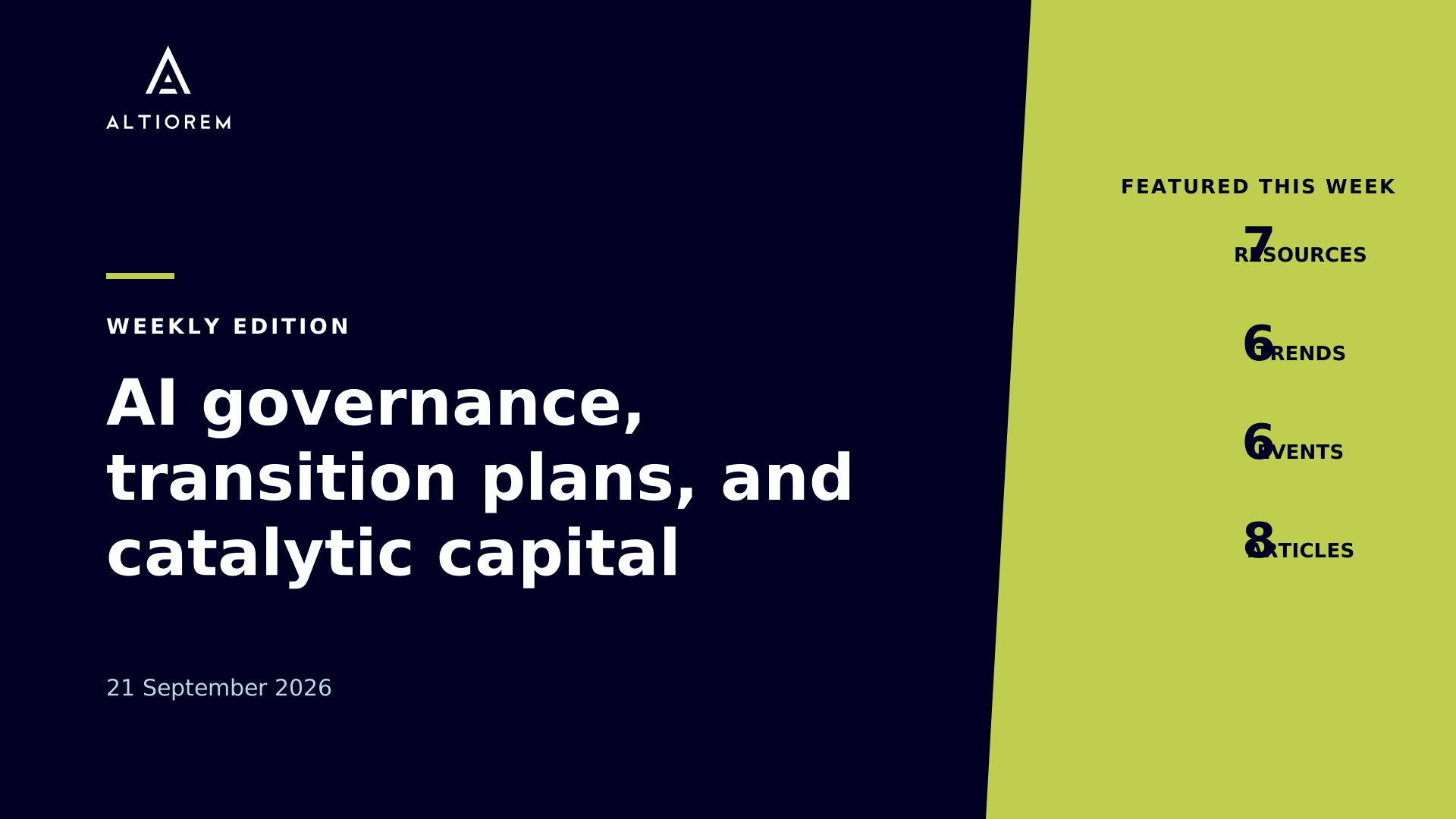
Research from the Transition Plan Taskforce provides a framework for climate transition disclosures, while studies from the US Census Bureau and Columbia University analyse the impact of AI and automation on workforce dynamics. The issue highlights the World Bank mobilising $22 billion in private capital for Africa and examines the health impacts of industrial pollution from Sasol’s Secunda operations. Additional insights cover why agricultural finance should recognise healthy soil as a financial asset and the legal implications of forestry debris for directors’ duties.

Dear friends and supporters of Altiorem.
From the ancient to the new, the emergence of better futures.
Last week I travelled from Australia's capital city to a farm more than 500 kms north in an area called Monkerai. Despite wearing a suit at one and pair of gardening gloves at the other, I saw the seeds of better futures in both.
In Canberra, the Australian-Built event organised by the green tech hub Climate Salad, showcased innovative Australian companies developing the solutions for a more resilient, zero carbon economy. From MGA Thermal, Allegro and Sicona who are creating innovative energy storage technologies, to MCi Carbon and Samsara Eco who are turning pollution to valuable products, to Amber Electric whose energy market software is empowering consumers to maximise the value of their solar and batteries while supporting grid resilience and demand response.
What these diverse businesses have in common is driven, purposeful and passionate leaders, an ability to see problems as opportunities and a need for investment to get to the next stage in their development. This is not unique to Australia, many countries boast dynamic innovative companies developing the new materials, technologies and services we need to reshape the economy and yet they are seldom heard about.
The next day in Monkerai, I had the opportunity to experience the most ancient 'technology' of all, photosynthesis, harnessed with the philosophy of the world's longest continuous culture and farming practices that have the potential to revolutionise our sick and unsustainable food system. The trip, organised by Finding Nature at Djanaba Farm, is one I wish all people could experience.
On Djanaba, the inspiring founder of First Australian's Capital, Jocelyn King, is implementing a farming technique called syntropic agroforestry to create a food forest. A community of plants that work together in ways that build and fertilise soil, deter pests, and grow abundant healthy food. An approach that was developed by a Swiss Farmer in Brazil, successfully deployed around the world, is being pioneered in Australia by a Bundjalung women using Indigenous plants and principles of caring for country. It was inspiring, grounding and deeply affecting to get our hands dirty, connect with likeminded people and support this incredible project.
Whether lab coats or garden gloves, this is how change for the better happens. But these companies require investment and support to grow. As a sustainable finance sector, the requirements for scale, liquidity and short-term benchmark-based returns, blind and bind us in ways that allocate capital to destructive and risky businesses because they appear in an index and away from the ones that can save us from ecological and therefor economic collapse.
Allocators of capital require the same type of innovation and drive as these founders and to see these barriers in the finance system as opportunities, whether through aggregation, intermediation, blended finance or total portfolio investing, we can redirect the flow of capital to where it is most needed. It too is happening, whether Cairncross capital's work to build funds that invest in impact managers at scale or Catherine Brown's work at Melbourne Uni to develop a clean energy aggregator, better investment and finance is possible but it needs you, it needs all of us, if it is to match the scale of the problems/opportunities before us.
Until next week,
Pablo
New in the library
Pablo’s handpicked highlights from Altiorem last week:
Environmental
| Transition Plan Taskforce Resources
These resources provide a definitive framework for companies and financial institutions to develop and disclose high-quality climate transition plans. The guidance helps organizations move beyond high-level pledges toward actionable strategies that align with a net-zero future. Industry standards and guidanceStrategy and Organisational change
|
Social
| The microstructure of AI diffusion: Evidence from firms, business functions, and worker tasks
U.S. Census Bureau, University of Maryland, College Park
This research examines how artificial intelligence is being adopted across different business functions and worker tasks. It provides empirical evidence on the specific microstructure of AI integration, offering insights into how firms are transforming their operations and workforce requirements. Issue/sector focused researchStrategy and Organisational change
|
Governance
| Automation, learning, and career dynamics
Columbia University, Federal Reserve Bank of Atlanta, University of Texas at Austin, The University of Chicago Booth School of Business
This study investigates the long-term impact of automation on worker learning and career trajectories. By analyzing career dynamics, the authors highlight how technological shifts influence skill acquisition and the evolving nature of professional development in an increasingly automated economy. Fixing financial and economic systemsIssue/sector focused research
|
| The green central banking scorecard series
This series evaluates the progress of central banks in integrating climate and environmental considerations into their monetary policy and supervisory frameworks. It provides a comparative analysis of global performance, highlighting leaders and areas where further policy action is required. Fixing financial and economic systemsLaws and regulationsStakeholder engagement and advocacy
|
| Reuters Institute digital news report series
This comprehensive series tracks the changing landscape of digital news consumption globally. It explores trends in trust, misinformation, and the financial sustainability of journalism, providing essential context for understanding the information environment in which investors and companies operate. Issue/sector focused researchProduct development and trends
|
| Unlocking catalytic capital in Australia
This report explores the potential for catalytic capital to bridge the investment gap for high-impact projects in Australia. It identifies barriers and opportunities for using flexible, risk-tolerant capital to mobilize broader private investment toward social and environmental goals. Fixing financial and economic systemsIndustry standards and guidanceProduct development and trends
|
| Hot summer economics: Economic effects of the hot European summer of 2026
This analysis models the potential economic consequences of extreme heat events in Europe. By examining the 2026 summer, it quantifies the impacts on productivity, health, and infrastructure, underscoring the urgent need for climate adaptation and resilient economic planning. Fixing financial and economic systemsIssue/sector focused research
|
To see all of the resources added this week visit Altiorem’s website: Altiorem Articles: Insightful Reads & Expert Knowledge
This week in ESG trends
Africa & Middle East
| World Bank $22 Billion Private Capital Mobilization for Africa
18 September 2026
The World Bank Group reported on September 17, 2026, that it mobilized a record $22 billion in private capital for Africa during the 2026 fiscal year. This figure represents a nearly 150 percent increase from the $9 billion mobilized in fiscal year 2022. The mobilization was achieved through internal reforms designed to integrate public and private sector arms and expand the use of financial guarantees. [Published: 17 Sep 2026] 📖 Global Innovation Lab for Climate Finance: Portfolio📖 Beyond the illusion of innovative climate finance at scale in Africa: A market-informed blueprint for Kenya’s just and resilient climate transition |
| Industrial Pollution Health Impact Assessment
18 September 2026
A new health impact assessment released by the Centre for Research on Energy and Clean Air on September 10, 2026, has linked air pollution from Sasol Ltd’s Secunda operations to approximately 1,000 deaths and R19 billion in annual economic losses. The study estimates that emissions from the coal-to-liquids complex contributed to over 2,000 asthma-related emergency room visits and hundreds of cases of childhood asthma in the 2024/25 financial year. Concurrently, South Africa’s Department of Forestry, Fisheries and the Environment is preparing to reintroduce a criminal case against Sasol in late September 2026 regarding alleged hazardous chemical dumping. [Published: 11 Sep 2026] 📖 The thematic assessment report on the interlinkages among biodiversity, water, food and health📖 The (climate) Health Attribution Library |
Americas (North, Central & South America)
| Sustainable Fund Outperformance in the Americas
17 September 2026
A report from the Morgan Stanley Institute for Sustainable Investing revealed that sustainable investment funds in the Americas outperformed traditional counterparts during the first half of 2026. The median sustainable fund in the region achieved returns of 8.8%, compared to 5.5% for traditional funds. Globally, sustainable assets under management reached a record $4.2 trillion by the end of the second quarter of 2026. [Published: 16 Sep 2026] 📖 Global sustainable investment review series📖 Sustainable signals: Individual investors series |
Asia
| Regulator Corporate Wildfire Investigations
14 September 2026
The Indonesian National Police (INP) and the Ministry of Environment are currently investigating eight corporations for their alleged involvement in illegal land clearing and forest fires that have burned over 280,000 hectares across Kalimantan and Sumatra. As of September 11, 2026, authorities have identified 139 suspects and are assessing criminal charges against an additional 60 companies whose operating licenses were recently suspended or revoked. The environmental group WALHI is scheduled to submit a detailed report on 262 linked corporate entities to President Prabowo Subianto on September 14, 2026. [Published: 12 Sep 2026] 📖 Global Forest Review📖 Environmental crime: From blind spot to business risk |
UK/Europe
| Railpen AI Governance Benchmark
16 September 2026
Railpen, the £36 billion UK railway workers’ pension fund, launched a new benchmarking tool on September 11, 2026, to assist institutional investors in evaluating corporate artificial intelligence governance. Developed in partnership with Chronos Sustainability, the tool translates Railpen’s existing AI Governance Framework into actionable metrics to assess how portfolio companies manage AI risks and strategic opportunities. The launch followed a Railpen assessment of its active equity holdings which found that corporate governance practices are currently lagging behind the rapid implementation of AI technology. [Published: 11 Sep 2026] 📖 Artificial intelligence and the future of finance: A framework for structural change📖 Firm data on AI |
| UK Corporate Reporting Reform Consultation
16 September 2026
The UK Department for Business, Innovation, Science and Trade (BIST) launched a public consultation on September 7, 2026, titled "Modernising Corporate Reporting to support long-term economic growth," which proposes a fundamental reset of the national reporting framework. Key proposals include removing mandatory non-financial reporting requirements from core company law and instead requiring them only where financially material, alongside the introduction of a "very large" company threshold to simplify compliance obligations. This initiative seeks to reduce the administrative burden on UK companies by 25% while refocusing ESG disclosures on data that is directly relevant to investor decision-making. [Published: 14 Sep 2026] 📖 ShareAction policy paper: Defending and strengthening the AGM as a forum for corporate accountability📖 FCLT Gold Standard: Information and resources |
To see all of the daily trends follow us on LinkedIn: Altiorem on LinkedIn
Webinars and events
Environmental
| New York Climate Week
New York Climate Week · 20 September 2026 · New York · in_person
Annual week-long climate action event with multiple sessions and stakeholder engagement activities. Stakeholder engagement and advocacy
|
| IGCC Summit 2026
Investor Group on Climate Change · 24 November 2026 · Sydney, Australia · in_person
The premier annual climate finance event for Australian and New Zealand institutional investors to engage with pathways, policies, and opportunities for net zero investment. ESG Integration and analysis
|
Governance
| RIAA Conference Aotearoa NZ 2026
Responsible Investment Association Australasia (RIAA) · 22 September 2026 · Auckland, New Zealand · in_person
A responsible investment conference for the New Zealand market focusing on leadership recognition and thought exchange. Stakeholder engagement and advocacy
|
| Fiduciary Investors Symposium at the University of Oxford
Conexus Financial · 17 November 2026 · University of Oxford · in_person
A global symposium bringing together asset owners to discuss investment frameworks and fiduciary responsibilities. Governance and directors’ duties
|
| The Politicisation of Responsible Investment
Investors for Purpose · 15 October 2026 · Online · webinar
A webinar exploring the political backlash against ESG and responsible investment in the US and Europe and what it means for long-term asset allocators. ESG Integration and analysis
|
| PRI Summit 2026
Principles for Responsible Investment (PRI) · 13 October 2026 · Online · webinar
Global gathering of responsible investment practitioners in Amsterdam. Industry Standards and Guidance
|
To see all of the resources added this week visit Altiorem’s website: Webinars & Events – Altiorem
From the community
Environmental
| Healthy soil is a financial asset. Agricultural finance should price it that way.
ImpactAlpha
An analysis of why agricultural finance systems must evolve to recognize and price the resilience and value created by healthy soil as a financial asset. Fixing financial and economic systems
|
| Biodiversity is rising on the corporate agenda, but accountability is lagging behind
Stockholm Resilience Centre
A study of 180 large corporations reveals that while 79% have made biodiversity pledges, only 13% have commitments detailed enough for accountability. Impact measurement and verification
|
Social
| How to talk about wealth inequality
LSE Blogs
Advice for how to engage the public on topics like wealth inequality, extreme wealth and wealth taxes on social media. Effective communication and greenwash
|
| Modern slavery reporting laws are coming. Will they make a difference?
The Post
An exploration of New Zealand’s proposed modern slavery legislation and its potential impact on supply chain transparency and worker outcomes. Laws and regulations
|
Governance
| Banks? What are they good for?
Positive Money
A short video exploring the role of banks in the economy and their impact on climate change and social issues. Fixing financial and economic systems
|
| Concentration and dependence are two AI issues asset owners should fear
Top1000funds.com
Stanford professor Andy Hall discusses the risks posed by concentrated ownership of AI models and the lack of government oversight, emphasizing the implications for asset owners. ESG Integration and analysis
|
| Climate change, fiduciary duties, and geopolitical uncertainty: A conversation with veteran pension lawyer, Randy Bauslaugh
Canada Climate Law Initiative
An interview exploring the evolving relationship between pension fiduciaries, climate change, legal accountability, and long-term value creation in Canada. Governance and directors’ duties
|
| Forestry Slash and Directors’ Duties: When Environmental Risk Becomes Personal
Institute of Directors
An analysis of personal liability for directors regarding environmental risks, based on a case study of forestry debris cleanup. Governance and directors’ duties
|


