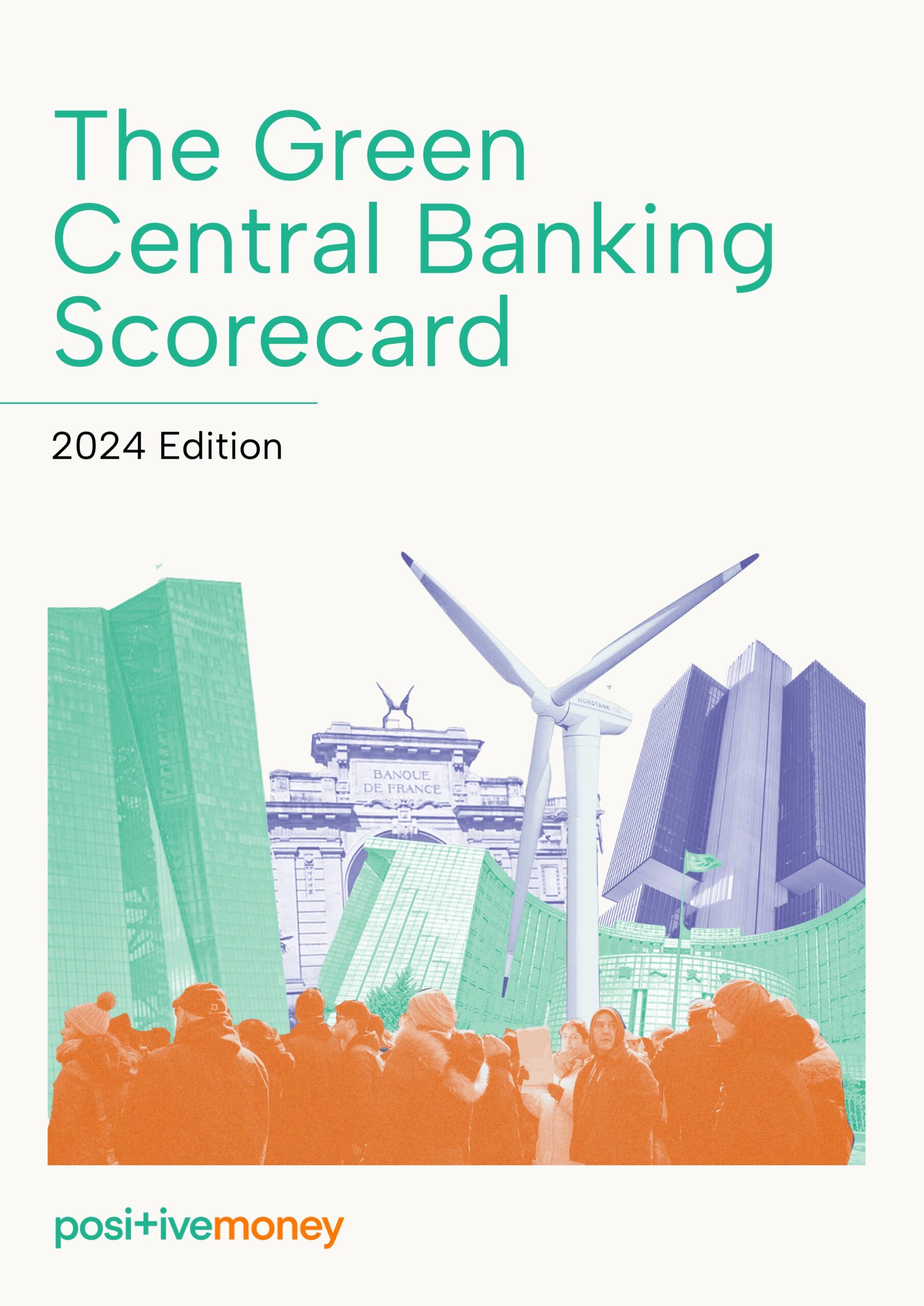
The green central banking scorecard series
The Green Central Banking Scorecard is a benchmark series that ranks G20 central banks and financial regulators on their progress in integrating environmental considerations into their operations. It assesses institutions across research and advocacy, monetary policy, financial policy, and leading by example categories to encourage a just green transition.
Please login or join for free to read more.

OVERVIEW
Overview
The Green Central Banking Scorecard is a benchmark series produced by Positive Money that evaluates and ranks the central banks and financial supervisory institutions of G20 member nations. The 2024 edition is the third in the series, assessing progress since the previous 2022 report. It covers institutions across four primary pillars: Research and Advocacy, Monetary Policy, Financial Policy, and Leading by Example. The report provides a comparative analysis of how major economies are incorporating climate and environmental considerations into their core operations.
Purpose
This benchmark series exists to influence central bank policy at a global level by highlighting gaps between environmental rhetoric and concrete action. It is designed to inform policymakers, regulators, and civil society about the efficacy of green policies in the financial sector. The report aims to challenge traditional notions of market neutrality and advocate for a ‘double materiality’ approach, where central banks recognise their role in both managing climate risks and influencing environmental outcomes. It specifically identifies ‘laggard’ institutions and encourages them to accelerate efforts towards a just green transition.
Methodology
The assessment is carried out using a quantitative scoring framework with a total possible score of 130 points, distributed as follows:
- Research and Advocacy (10 points)
- Monetary Policy (50 points)
- Financial Policy (50 points)
- Leading by Example (20 points)
Scoring is based on literature reviews, expert consultations, and bilateral interactions with the ranked institutions. The 2024 methodology was updated to include expiration times for research reports (two years), revised weighting for leadership roles within the Network for Greening the Financial System (NGFS), and specific awards for adopting a double materiality framework. The report assesses 20 G20 entities, representing the G20 countries and the European Union collectively.
Use for finance professionals
Finance professionals can utilise this report to gauge the regulatory trajectory of central banks in major global markets. It serves as a tool for assessing climate-related transition risks and anticipating future financial regulations, such as mandatory transition plans, adjusted capital requirements for fossil fuel exposures, and the implementation of ‘green’ lending schemes. By identifying ‘top achievers’ like France, Germany, and Italy, and ‘laggards’ such as the Federal Reserve, professionals can better understand the regional disparities in financial supervision and align their investment strategies with the evolving standards of green central banking.