
Library | Sustainable Finance Practices
Laws and regulations
Government policies, legislation, and regulatory frameworks that shape sustainable finance practice, including mandatory disclosure rules, climate law, financial regulation, and ESG-related requirements.

Refine
310 results
REFINE
SHOW: 16


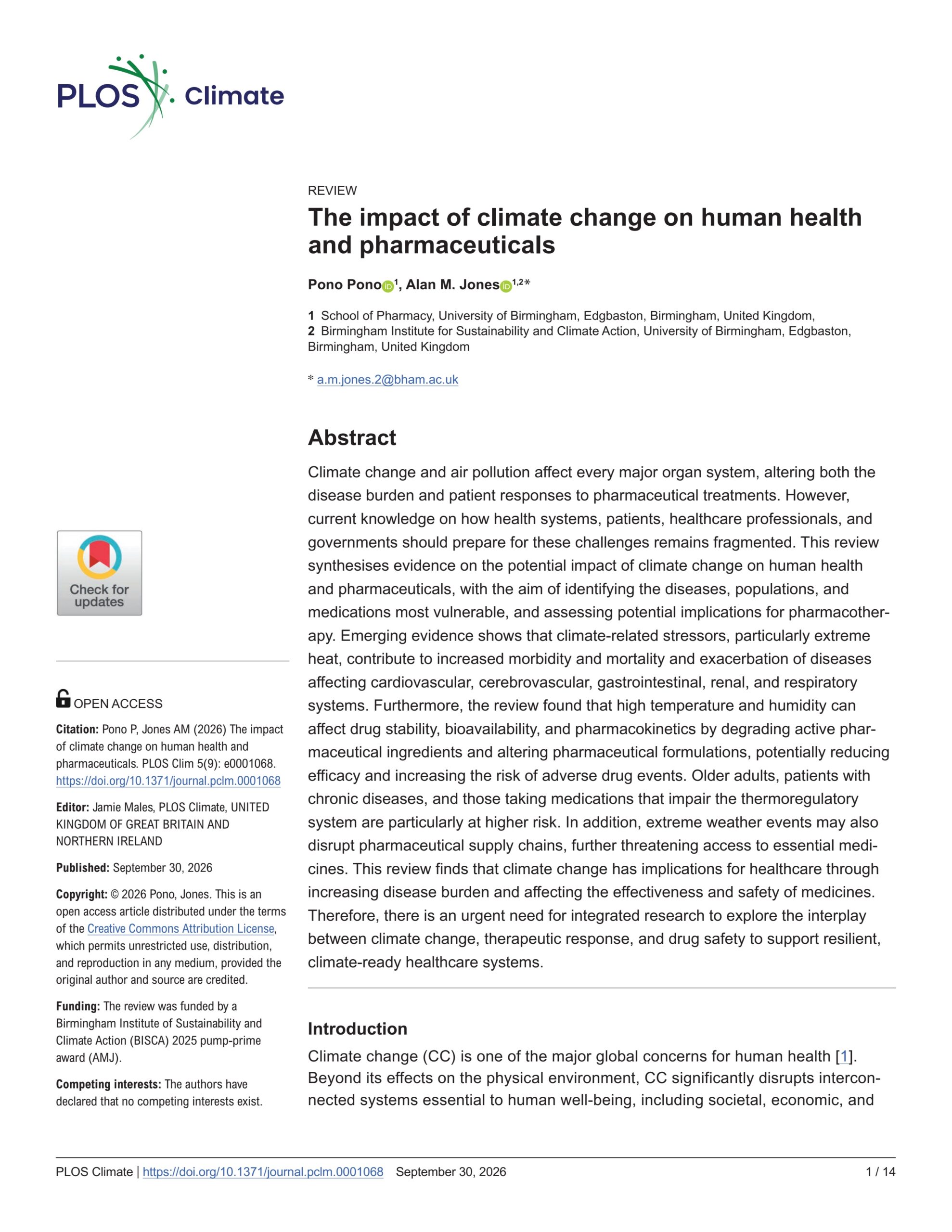
The impact of climate change on human health and pharmaceuticals
This research review examines how climate change and extreme weather increase morbidity across major organ systems. It highlights how rising temperatures and humidity compromise pharmaceutical stability and efficacy, particularly for vulnerable populations. The report calls for updated clinical guidelines and climate-resilient pharmaceutical regulations to safeguard public health.

Poison plastics: How chemicals in everyday plastics are harming your health
This Environmental Justice Foundation report examines the health risks associated with chemicals in everyday plastics. It reveals that 92.8% of assessed chemicals pose high risks, including cancer and hormone disruption. The document calls for a Global Plastics Treaty to reduce production and eliminate hazardous substances through a precautionary approach.
Climate-related risks, opportunities and impacts – Identification to quantification: An approach for identifying and assessing climate-related risks and opportunities and their associated anticipated impacts and anticipated financial impacts
This guidance for New Zealand climate reporting entities details a five-phase framework to identify and assess climate-related risks and opportunities. It provides a structured approach for moving from qualitative impact assessment to the quantification of financial impacts, supporting compliance with climate standards and strengthening strategic resilience.
Manufactured consent: Stopping the harm from manipulative lead generation
Lead generation in Australia's digital economy has become a significant source of consumer harm, involving the harvesting of contact details for sales pitches. This report examines manipulative practices that manufacture consent to avoid consumer protections, highlighting the $1 billion loss from the First Guardian and Shield Master Funds collapse.
State of sustainable business 2026
This 2026 research identifies a shift toward a pragmatic era in corporate sustainability, dominated by regulatory compliance. Key findings reveal a disconnect between sustainability teams and executives, stagnant budgets, and a focus on direct operations. AI adoption is rising for reporting, though formal governance remains nascent.
Oil spill 2: How fossil fuel interests are polluting the US's carbon market rulemaking
This report investigates the influence of fossil fuel companies and trade associations on US carbon market regulations. It details extensive lobbying in California and representative roles at the federal level, arguing that these efforts maintain low-quality credits to delay genuine decarbonisation and enable greenwashing.
Corruption perceptions index series
The Corruption Perceptions Index is a global benchmark series assessing perceived public sector corruption levels across 182 countries and territories. Produced by Transparency International, the index draws on independent data to provide comparative scores, assisting stakeholders in identifying governance risks and evaluating the effectiveness of anti-corruption reforms and institutional integrity.

Futureproofing industry: Investor priorities for a reformed Safeguard Mechanism
This report outlines investor priorities for reforming Australia's Safeguard Mechanism during the 2026-27 review. It recommends a seven per cent annual decline rate to align with 2035 climate targets, expanding scheme coverage, and implementing financial supports to incentivise on-site abatement over carbon offsets to ensure long-term industrial competitiveness.
ESG ratings and the French Duty of Vigilance Law
An analysis of the 2017 French Duty of Vigilance Law’s impact on corporate ESG and financial performance. Using difference-in-differences analysis, the study finds a significant negative association with social and environmental ESG scores, suggesting the law reduces rating "gaming" or prompts the production of more realistic risk disclosures.
Putting climate coalitions into practice: A common framework for balancing competitiveness and equity
This technical report proposes a framework for international climate coalitions, focusing on emissions-intensive industries such as steel and aluminium. Modelling indicates that coordinated carbon price floors could reduce annual emissions by up to 584 million metric tons. It introduces an 'effective carbon cost' metric to balance global competitiveness and equity.
Taskforce on official standards and the Green Bond Principles. Phase 1: Comparison of the Green Bond Principles and the European Green Bond Standard
This report compares the voluntary Green Bond Principles with the regulatory European Green Bond Standard. It identifies high proximity and synergy between the frameworks, providing guidance on how issuers can navigate both sets of requirements to enhance transparency and facilitate global investor recognition in the sustainable finance market.
The Omnibus I Directive and the EU sustainable finance trilemma: Sustainability, simplification and harmonization
This research analyses Directive (EU) 2026/470 (Omnibus I Directive), which simplifies the Corporate Sustainability Reporting Directive and Corporate Sustainability Due Diligence Directive. It examines how narrowing regulatory scope and removing substantive obligations impacts the balance between sustainability, simplification, and harmonisation within the European Union's financial framework.
Liability and pricing of dual-use AI
This research analyses AI provider liability for dual-use models enabling both cyberattacks and defence. It demonstrates that while liability can improve welfare by reducing contest resources through higher prices, it may increase harm by weakening precautions. Market competition and guardrail incentives significantly influence optimal liability shares.
Economics of demand-side and supply-side climate policies
This research evaluates demand-side and supply-side climate policies, recommending a portfolio that combines carbon use and extraction pricing to mitigate emissions leakage. It emphasises transmission reform, innovation support, and green industrial policies while analysing the domestic and global distributional consequences for low-income and major fossil fuel producing nations.
Government announced increases in carbon pricing and their implications for corporate valuations
This report explores global corporate environmental costs, finding that unpriced carbon emissions represent a material risk to valuations. Analysing approximately 20,000 companies, it illustrates how projected carbon price increases in jurisdictions like Norway and Canada could significantly erode enterprise values, especially within the aviation and maritime sectors.
Public finance in the digital era: Emerging themes 2026
This report explores emerging themes in digital-era public financial management (PFM) for 2026. It examines the integration of artificial intelligence, digital public infrastructure, and earth observation to improve fiscal oversight, tax administration, and public welfare, while highlighting risks from declining international aid and proprietary software lock-in.


