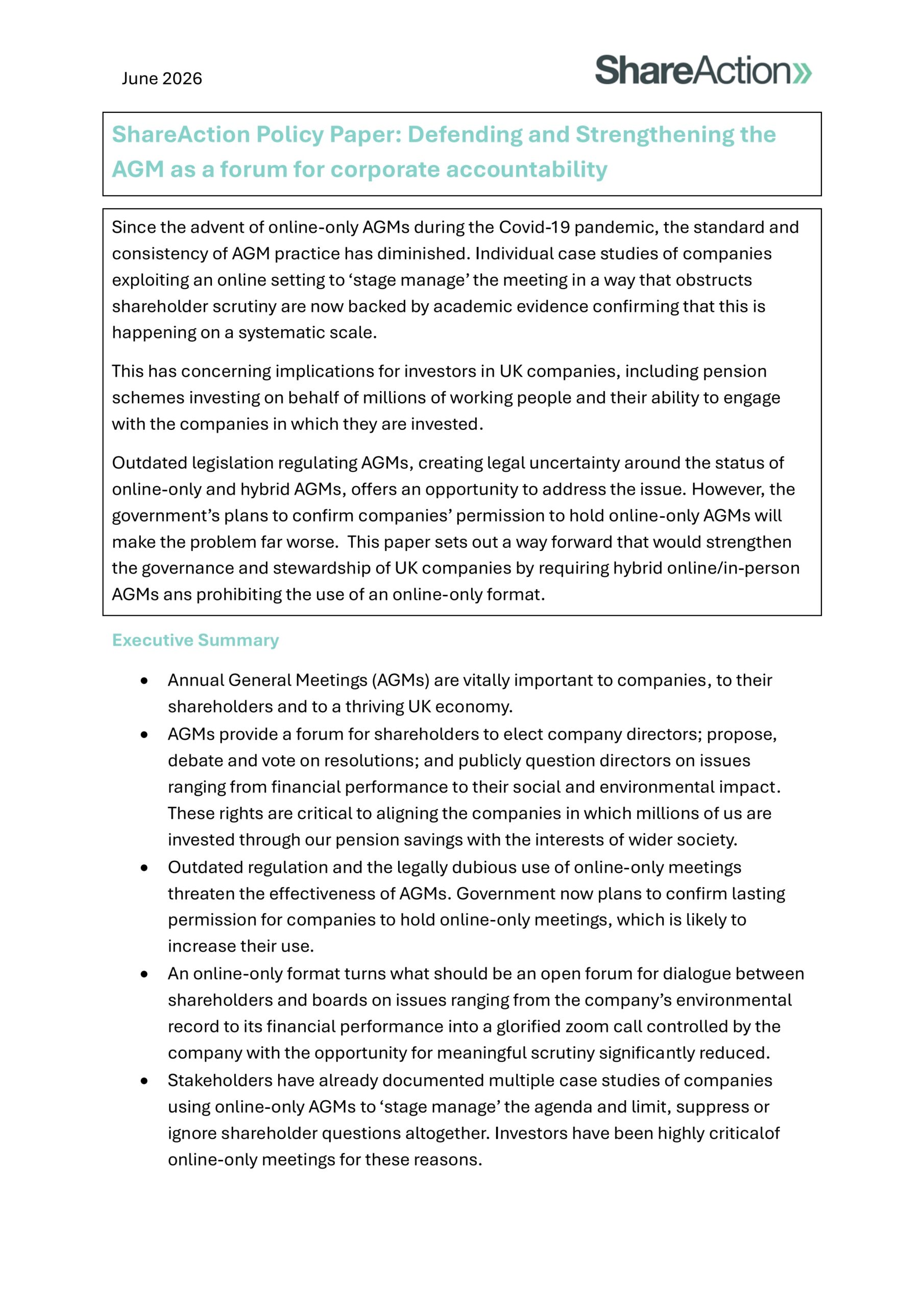
ShareAction policy paper: Defending and strengthening the AGM as a forum for corporate accountability
This ShareAction report advocates for mandatory hybrid AGMs to ensure corporate accountability. It argues that online-only formats diminish shareholder scrutiny and enable management to stage-manage proceedings. The document recommends amending the 2006 Companies Act and provides case studies of poor virtual AGM practices across several major companies.
Please login or join for free to read more.

OVERVIEW
The ShareAction policy paper highlights the diminishing standards of Annual General Meeting (AGM) practices since the adoption of online-only formats during the pandemic. Academic evidence confirms that companies systematically exploit online settings to ‘stage manage’ meetings, obstructing shareholder scrutiny and the ability of investors, including pension schemes, to engage with their investments.
Background: Why AGMs are critical to good corporate governance
Publicly-listed companies in the United Kingdom are required to hold AGMs where shareholders can question the board of directors and vote on key governance issues. These include the election of directors, remuneration, and approval of annual reports. AGMs give shareholders the power to ensure directors exercise fiduciary responsibilities appropriately. They are critical for aligning companies with the interests of wider society, particularly for millions invested through pension savings.
Current policy context: There is a need to clarify outdated AGM regulations
During the 2020 pandemic, AGMs moved to online formats with legal permission from the Corporate Insolvency and Governance Act 2020. This permission expired in 2021, yet many companies continued with online or hybrid meetings using flexible interpretations of the 2006 Companies Act. The Government now plans to confirm permission for online-only AGMs through public consultation, a move that ShareAction argues threatens the effectiveness of these forums.
Stakeholder perspectives: Stakeholder experiences highlight the major governance risk posed by online-only AGMs
Hybrid AGMs are generally welcomed for improving accessibility, but online-only formats allow boards to filter questions and avoid meaningful scrutiny. Schroders has stated online-only formats should be reserved for ‘genuine emergencies,’ while the Investment Association suggests they remove accountability. The ‘Governance for Growth’ coalition, representing over £150 billion in assets for 11 million UK savers, also opposes the format. Notably, a proposal by BP to enable online-only AGMs was rejected by a majority of shareholders at its 2026 meeting.
Box 1: The cost of AGMs.
Arguments for online-only AGMs often focus on cost savings regarding venue hire and security. While this may have merit for smaller companies, larger firms with multi-billion pound turnovers should find the expense minor compared to the benefits of enhanced stewardship. Technology should be used to expand access via hybrid formats without removing the accountability benefits of in-person elements.
Academic evidence: Research shows that online-only AGMs are used to undermine shareholder scrutiny, good governance and corporate accountability
Analysis by the European Corporate Governance Institute of over 2,500 meeting transcripts and 767 questions identified four recurrent constraint methods: ignoring questions, preventing shareholders from using their own words, restricting topics to proposals, and reporting only pass/fail outcomes. These tactics are substantially more prevalent in online-only formats and are likelier when firms anticipate shareholder criticism.
International context: Other markets are also reviewing their AGM models
The European Union is currently reviewing its Shareholder Rights Directive, with investors expressing serious reservations about online-only meetings. Organisations such as the European Fund and Asset Management Association (EFAMA) and the International Corporate Governance Network (ICGN) have advocated for hybrid formats to maintain accountability across different jurisdictions.
Recommendations: The UK government should require companies to offer an AGM in both hybrid and in-person form, and work to strengthen AGMs as a mechanism for good governance and accountability in the longer-term
ShareAction recommends amending the 2006 Companies Act to require UK listed companies to hold hybrid AGMs by the 2027 season. This should include a requirement for directors seeking re-election to attend in-person. Furthermore, the Government should develop statutory guidance on a ‘comply or explain’ basis by Summer 2027, covering safety, information provision, meeting administration, and equitable treatment for online participants.