
Library | Finance relevance
Investment managers / asset managers
Refine
1394 results
REFINE
SHOW: 16


Corporate Climate Targets Database and Dashboard
A longitudinal database tracking voluntary climate commitments and greenhouse gas targets for U.S. public companies in the Russell 3000 index from 2000 to 2024.
Anti-woke corporate governance
This research explores the emergence of partisan corporate governance, focusing on Texas as a conservative competitor to Delaware. It examines legislative changes to limit shareholder litigation and influence, the regulation of proxy advisors, and the resulting legal and political risks for corporations navigating an increasingly politicised regulatory environment.
Asset manager capture
This research examines "reverse capture", where government actors pressure large asset managers to advance political agendas. It analyses how expanding presidential power and market concentration enable this dynamic, using the ESG retreat as an illustration. The authors recommend narrowing fiduciary duties to insulate investment stewardship from political interference.
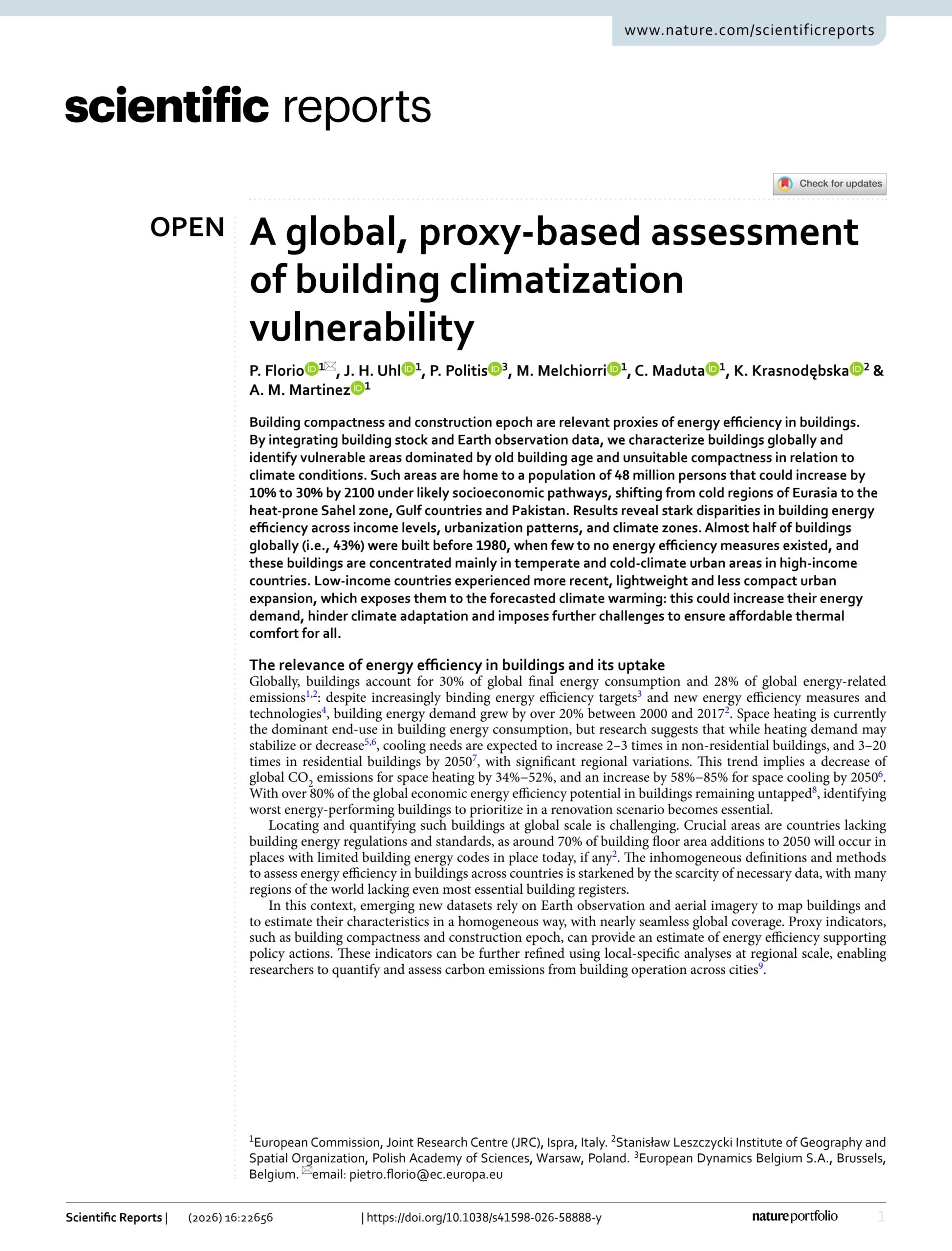
A global, proxy-based assessment of building climatization vulnerability
This research assesses global building energy efficiency, identifying vulnerable populations living in aged or poorly shaped structures. It reveals that 48 million people are currently at risk, with vulnerability likely shifting towards heat-prone regions by 2100. Disparities in building codes and income levels significantly affect global climate adaptation efforts.
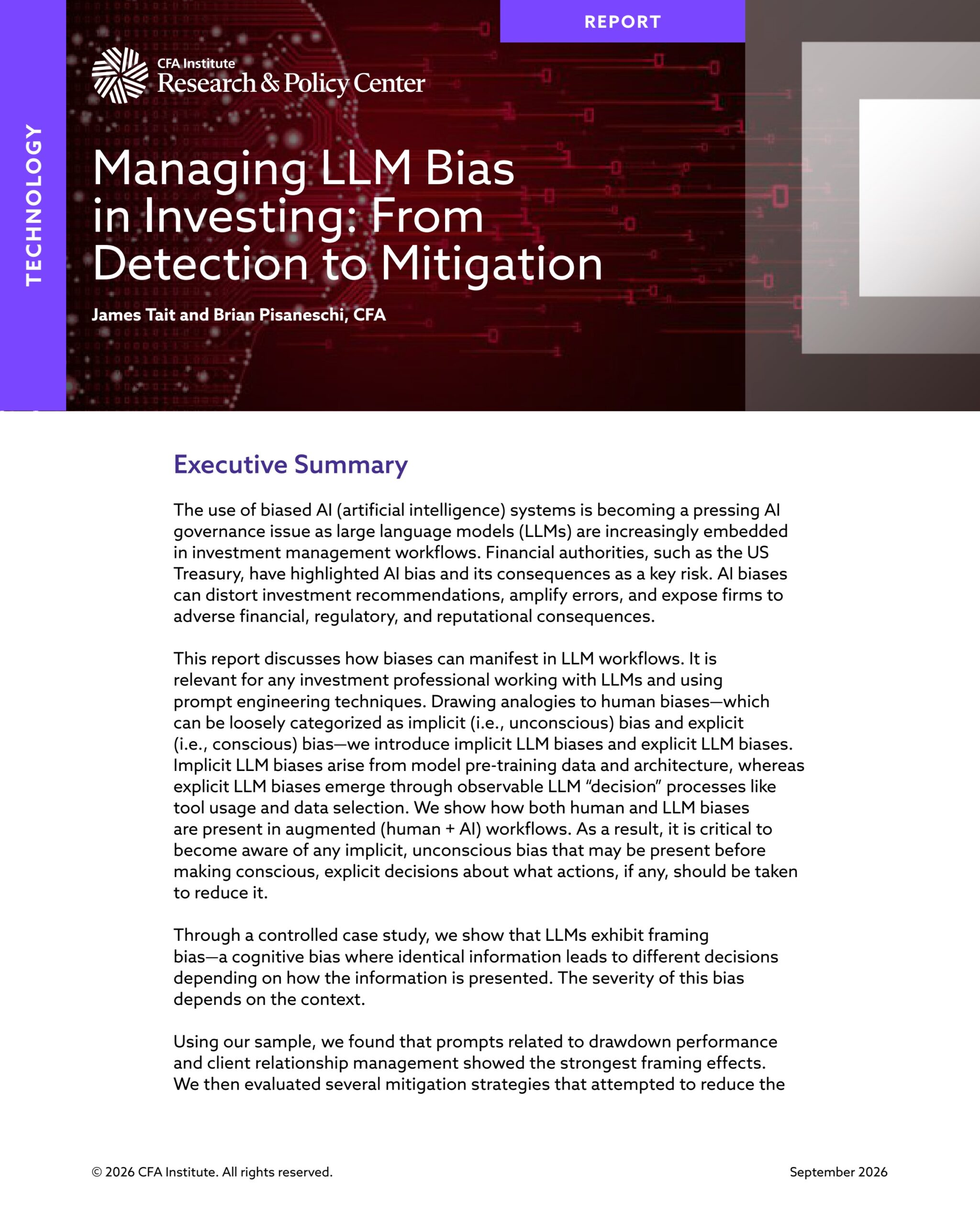
Managing LLM bias in investing: From detection to mitigation
This report examines implicit and explicit LLM biases in investment management. Through a case study on framing bias across nine OpenAI models, it identifies significant sensitivities in drawdown and client retention scenarios. It concludes that manual prompt restructuring and human-in-the-loop protocols are the most effective mitigation strategies.
Survey of Aotearoa New Zealand investors: Climate policies and actions series
This benchmark series examines the climate-related investment policies and actions of institutional investors in Aotearoa New Zealand. It monitors progress in embedding climate risks into financial decision-making, target setting, and investment in climate solutions, providing transparency and accountability across the local investment sector.
Breaking the bottleneck: How advance market commitments can bridge the supply-demand gap in recycled materials
This research evaluates advance market commitments to bridge the supply-demand imbalance for recycled materials. It identifies opportunities in mixed plastic, textile waste, and paper-based alternatives, advocating for binding financial agreements to incentivise investment in recycling capacity and support global sustainability targets.
The illusion of resilience in a degrading supply chain
Senior UK food executives warn that environmental degradation and climate change pose significant financial risks to supply chains. Current industry focus on short-term growth masks structural vulnerabilities. Investors are urged to challenge board capabilities and demand long-term resilience strategies to secure future profitability and food security.

Three ways to move a company: A typology of best-practice investor engagement
This research examines three distinct models of investor engagement through case studies of BP, Honeywell and Bâloise. It highlights how financial-materiality framing and structural shifts in stewardship, including the fragmentation of 'Big Three' voters and SEC regulatory changes, are reshaping corporate governance and activist strategies for 2026 and 2027.
The GIIN Climate Solutions Investing Framework: A resource for asset owners to move from ambition to allocation
This research provides a framework for asset owners to evaluate climate mitigation investment strategies. It outlines foundational concepts and four criteria for selection: identifying climate theses, quantifying decarbonisation contributions, understanding prioritisation, and managing uncertainties. The resource aims to help investors transition from climate ambition to effective capital allocation.
Impact of an Enterprise Template 1.3
A structured Excel-based template from Impact Frontiers used to measure and report enterprise impact performance using the five dimensions of impact and the ABC classification system.
Charting the path: Foundations for a scalable First Nations investment market in Australia
This research outlines foundations for a scalable First Nations investment market in Australia. It identifies systemic barriers and proposes a theory of change focused on representation, systems alignment, and capital flows. The report recommends embedding cultural authority into governance and utilising blended finance to support First Nations economic self-determination.
Ocean investment protocol: A multi-stakeholder plan to enable funding for the sustainable ocean economy
This report outlines a multi-stakeholder framework to accelerate funding for a sustainable ocean economy. It provides specific recommendations for financial institutions, insurers, and governments to manage systemic risks and mobilise the estimated one trillion dollars in additional finance required by 2030 to meet global climate and biodiversity targets.

A practitioner's guide to impact vehicle structuring
This guide provides a six-step roadmap for designing and structuring impact investment vehicles. It offers practical frameworks for assessing market gaps, establishing partnerships, and defining investment and impact strategies. Featuring seventeen global case studies, the report emphasises mobilising domestic capital and using blended finance to address underserved social and environmental needs.
Manufactured consent: Stopping the harm from manipulative lead generation
Lead generation in Australia's digital economy has become a significant source of consumer harm, involving the harvesting of contact details for sales pitches. This report examines manipulative practices that manufacture consent to avoid consumer protections, highlighting the $1 billion loss from the First Guardian and Shield Master Funds collapse.
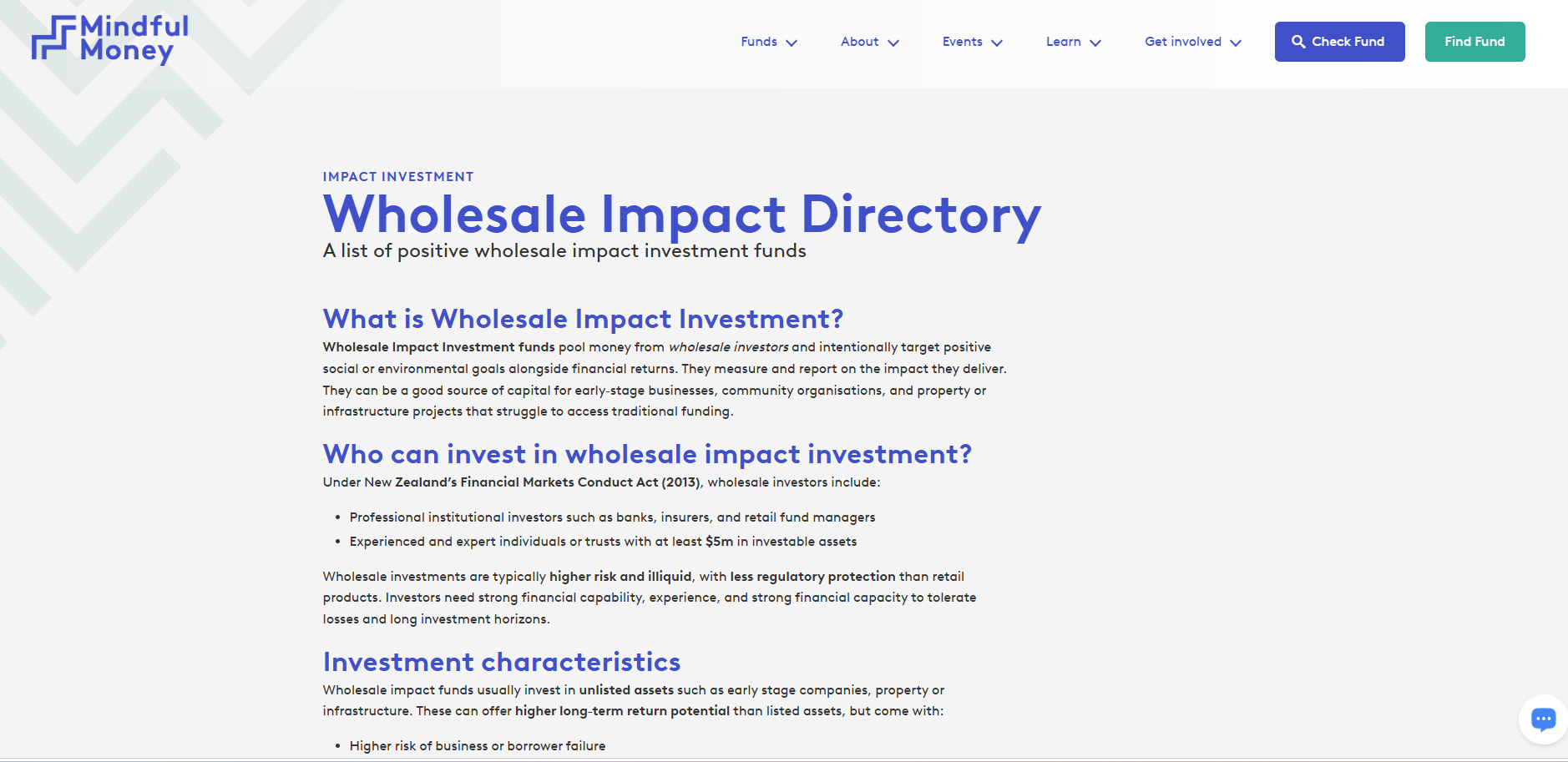
Wholesale Impact Funds Directory
A directory of New Zealand wholesale impact investment funds targeting social and environmental goals. It identifies specialist managers across climate solutions, affordable housing and renewable infrastructure.


