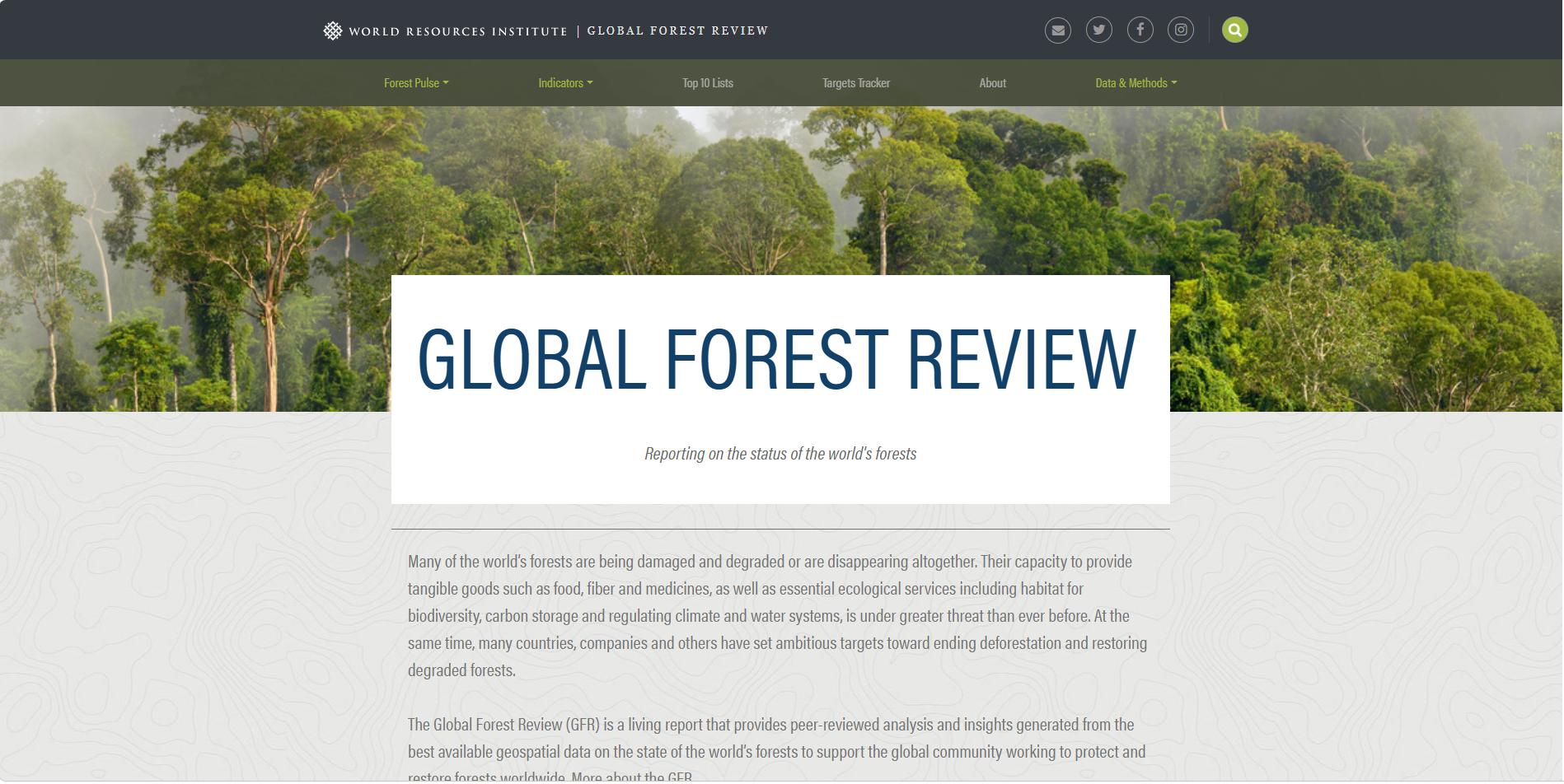
Global Forest Review
The Global Forest Review is an online resource by the World Resources Institute providing annual data on global forest loss, deforestation drivers, and carbon stocks. It helps finance professionals assess environmental risks and track supply chain exposure to deforestation-linked commodities.
Please login or join for free to read more.

OVERVIEW
The Global Forest Review (GFR) is a living online resource developed by the World Resources Institute (WRI) that provides annual data and analysis on the state of global forests. It monitors critical trends in tree cover loss, deforestation, and forest degradation across various biomes, with a primary focus on tropical rainforests. Finance professionals can use this resource to track environmental risks, verify commodity supply chain integrity, and inform ESG-related investment decisions.
Organisation behind the tool
The tool is maintained by the World Resources Institute (WRI), specifically through its Global Forest Watch and Land & Carbon Lab initiatives. The underlying tree cover loss data is produced and updated in collaboration with Svetlana Turubanova and Sasha Tyukavina of the University of Maryland’s Global Land Analysis and Discovery (GLAD) lab.
What the tool does
The Global Forest Review offers several key functions for land and climate analysis:
- Tracks annual tree cover loss data and distinguishes between fire-related and non-fire losses (such as clearing for agriculture or logging).
- Provides indicators on forest extent, condition, biodiversity, and ecological services, including forest carbon stocks and greenhouse gas fluxes.
- Analyses drivers of deforestation, such as commodity production (soy, cattle) and subsistence farming.
- Offers a “Targets Tracker” to monitor global progress against goals to halt and reverse forest loss.
- Integrates with Global Nature Watch, an AI-powered interface for querying complex land data.
Target audience
The primary users include environmental researchers, policymakers, and corporate sustainability officers. It is also designed for NGOs, indigenous communities, and finance professionals monitoring land-use change.
Relevance to finance professionals
Finance professionals can apply GFR data in the following contexts:
- Risk assessment – Identifying physical risks to assets from increasing forest fires and assessing legal/reputational risks associated with illegal land clearing in high-risk jurisdictions.
- ESG analysis – Incorporating specific metrics on carbon storage, biodiversity conservation, and soil stability into sustainability reporting and due diligence.
- Market/commodity insights – Monitoring supply chain exposure to deforestation-linked commodities, particularly in biomes like the Amazon or Pantanal where agriculture drives 73% of primary forest loss.
- Investment context – Evaluating the impact of national environmental policies (e.g., Brazil’s PPCDAm) and voluntary corporate moratoria on long-term project viability.