Overview
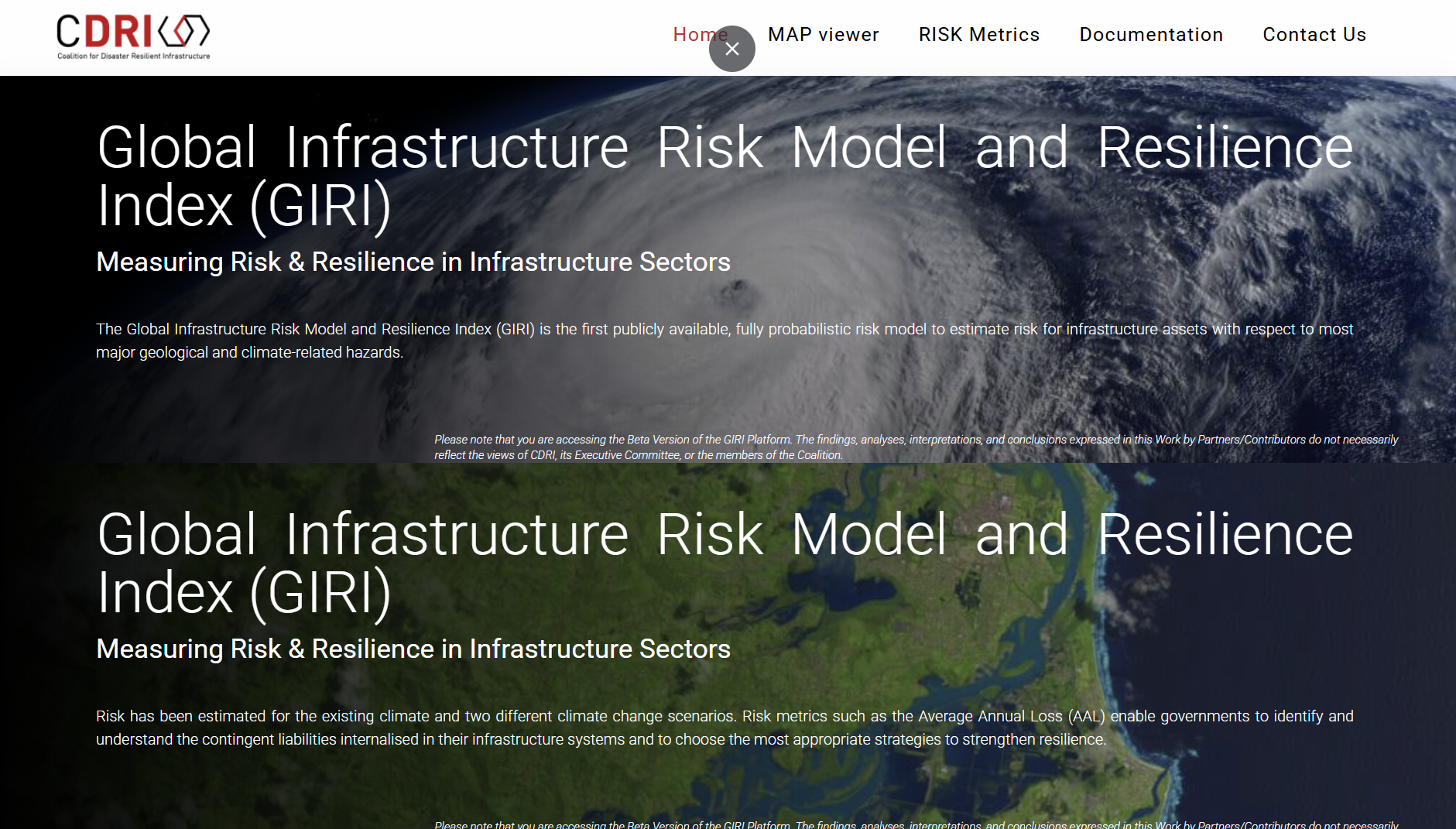
The Global Infrastructure Risk Model and Resilience Index (GIRI) is an open, global risk modelling tool that assesses infrastructure exposure to natural hazards. Its main purpose is to estimate potential physical damage and economic losses across infrastructure sectors. Finance professionals may find it relevant for analysing disaster risk, resilience gaps, and long-term infrastructure vulnerability.
Organisation behind the tool
The tool is developed and maintained by UNEP/GRID-Geneva, a centre of excellence of the United Nations Environment Programme. It supports global environmental data analysis and risk assessment, working with international partners and research institutions.
What the tool does
- Provides a probabilistic global model of infrastructure risk from natural hazards, including earthquakes, floods, tropical cyclones and tsunamis.
- Estimates Average Annual Loss (AAL) and other loss metrics for infrastructure assets.
- Covers multiple infrastructure sectors, such as transport, energy, water and telecommunications.
- Allows users to explore risk and resilience indicators at national and sub-national levels.
- Offers downloadable datasets and visualisations for analysis and comparison.
Target audience
The primary users are policymakers, development institutions and risk analysts. The tool is also relevant to researchers, insurers, infrastructure planners, and finance professionals with an interest in physical climate and disaster risk.
Relevance to finance professionals
Risk assessment
- Supports evaluation of exposure to natural hazards affecting infrastructure assets.
- Provides loss estimates that can inform credit, sovereign and project risk analysis.
ESG analysis
- Contributes data on physical environmental risks relevant to climate and resilience disclosures.
- Useful for assessing alignment with resilience and adaptation considerations.
Market and infrastructure insights
- Highlights countries and sectors with higher infrastructure vulnerability.
- Informs understanding of risk in energy, transport and water-related investments.
Investment context
- Assists long-term analysis of infrastructure resilience and disaster-related economic impacts.
- Can be used alongside climate scenarios and transition analysis to support strategic decision-making.