

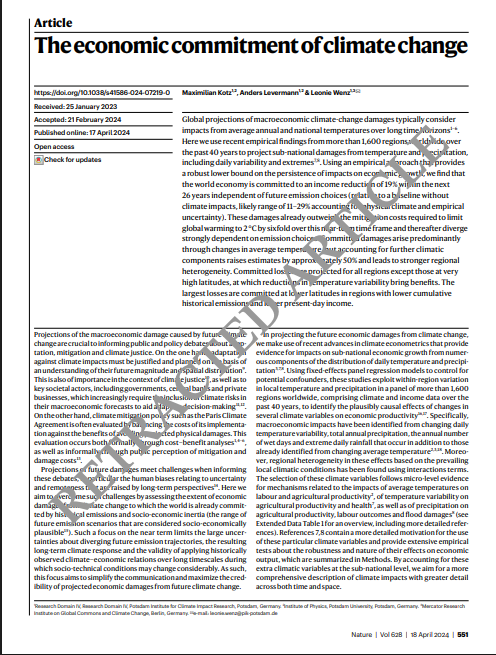
The economic commitment of climate change
This study estimates that climate change has already committed the global economy to around a 19% average income reduction by mid-century, largely independent of future emissions. Near-term damages are projected to substantially exceed mitigation costs, with disproportionate losses in lower-income, low-emitting regions.
Please login or join for free to read more.

OVERVIEW
Introduction
The paper assesses the scale of macroeconomic damages from climate change to which the global economy is already committed because of past emissions and socio-economic inertia. Using sub-national data from over 1,600 regions across 83 countries over four decades, it aims to provide credible near-term damage estimates that are less sensitive to long-run emission uncertainties and more relevant for policy and financial decision-making.
Constraining the persistence of impacts
A central uncertainty in climate–economy modelling is whether climate shocks affect economic growth temporarily (level effects) or persistently (growth effects). The authors adopt a conservative empirical approach using fixed-effects distributed lag models with first-differenced climate variables. This avoids assuming infinite persistence while allowing delayed impacts to be identified empirically. Significant effects are found to persist for up to 8–10 years for temperature variables and around four years for precipitation, providing a robust lower bound on impact persistence.
Committed damages until mid-century
Combining empirically estimated economic responses with projections from 21 CMIP-6 climate models, the study finds that global damages are statistically indistinguishable across high- and low-emission scenarios until around 2049. As a result, the world economy is already committed to a permanent average income reduction of about 19% by mid-century relative to a no-climate-change baseline, with a likely range of 11–29%. While absolute incomes may still grow, most regions experience lower income paths than otherwise expected.
Damages already outweigh mitigation costs
The magnitude of committed damages is compared with estimated mitigation costs consistent with limiting warming to 2 °C. Median global mitigation costs around 2050 are estimated at roughly USD 6 trillion (2005 international dollars), while committed climate damages reach approximately USD 38 trillion annually by 2049. This implies damages outweigh mitigation costs by a factor of about six in the near term. The comparison highlights that the delayed net benefits of mitigation in standard cost–benefit analyses largely reflect the fact that damages across emission pathways diverge only after mid-century.
Damages from variability and extremes
Most committed damages arise from changes in average temperature. However, including additional climate dimensions—daily temperature variability, total precipitation, wet days and extreme rainfall—increases estimated damages by nearly 50% compared with models using average temperature alone. Temperature variability contributes the largest additional losses, equivalent to around USD 10 trillion globally, while precipitation-related effects add smaller but still material damages.
The distribution of committed damages
Damages are unevenly distributed across regions. Losses are largest at lower latitudes, particularly in South Asia and sub-Saharan Africa, where median income reductions approach 22%, compared with around 11% in Europe and North America. High-latitude regions may experience limited benefits from reduced temperature variability. Importantly, regions with lower historical emissions and lower current incomes face disproportionately larger losses, reinforcing concerns around climate injustice and limited adaptive capacity.
Contextualising the magnitude of damages
Estimated damages exceed those in much of the earlier literature due to the use of sub-national data, inclusion of multiple climate variables, and improved treatment of impact persistence. Despite the large projected income losses, the approach remains conservative, capping extrapolations beyond historical climate conditions and excluding several known damage channels, such as sea-level rise, cyclones, tipping points and non-market impacts.
Missing impacts and spatial spillovers
The analysis does not fully capture spatial spillovers through trade and supply chains or several physical impact channels. Evidence from supplementary spatial-lag models suggests that spillovers from neighbouring regions could amplify both the magnitude and heterogeneity of damages, implying current estimates may understate true economic risks.
Policy implications
The findings indicate that substantial economic damages are already locked in and exceed near-term mitigation costs. While mitigation remains essential to prevent sharply diverging losses after mid-century, adaptation measures may reduce some committed damages. The results are relevant for governments, central banks and investors integrating climate risks into macroeconomic forecasts and long-term financial planning.




