
Library | Resource Types
Research
We summarise credible research and reports on sustainable finance and ESG issues. Our summaries, along with our AI ChatBot saves members time reading large reports, to focus on knowledge building and action.
Refine
1385 results
REFINE
SHOW: 16


Accelerating impact-linked finance
The report defines impact-linked finance and proposes a roadmap to accelerate and scale it. It summarises constraints to its implementation and provides examples of solutions.

Child-lens investing framework
This report introduces the Child-Lens Investing Framework, an approach to impact investing designed to guide investors to invest using a child-centric lens. The report provides an overview of the framework's various components and explores its alignment with leading responsible and impact investing standards and frameworks.

Sustainable investing capabilities of private banks
This report presents the findings of research into the sustainable investing capabilities of private banks, including governance, sustainability risk, and client interactions. The report notes progress among leading banks but highlights the need for continuing education for client advisors and improved ESG and impact reporting and monitoring capabilities.

Wealthy private investors and socially responsible investing: The influence of reference groups
The study investigates how wealthy private investors engage with socially responsible investing (SRI) and how reference groups influence their investment behaviour. Qualitative data from 55 interviews with high-net-worth individuals (HNWIs) and industry experts show that while family members emphasize profit, fellow SRI-oriented HNWIs prioritise similarity and reputation.

Who pays for sustainability? An analysis of sustainability-linked bonds
This paper analyses sustainability-linked bonds (SLBs), which tie bond coupons to sustainability performance targets. They find issuing an SLB yields an average premium of -9 basis points on the yield at issue compared to a conventional bond, and the savings for an issuer exceed the maximum penalty for failure to meet the target.

The hidden risk in state pensions: Analysing state pensions’ responses to the climate crisis in proxy voting
This report analyses the proxy voting strategies of 19 state pensions, as well as the five New York City Comptroller systems, managing over US$2 trillion in assets. Results reveal that most pensions failed to address climate-related financial risk, especially in areas such as lobbying, environmental justice, and Indigenous rights.

Natural capital accounting: Design and implementation protocol V1.1
This document provides guidance on natural capital accounting, a means to extend economic information to meaningfully describe the relationship between the economy and the environment. The report outlines a high-level, five-step process for designing and implementing natural capital accounting and compiling coherent environmental-economic data to support policy and decision-making.

Finding affordable home options for invisible women
This report explores ownership models for modest-income earning 'middle-aged' women in Australia. Findings suggest that shared equity, build-to-rent and rent-to-own, and staircasing models provide possible affordable home options to this growing group if financial barriers are eliminated through a subsidy or philanthropic funding.

Exploring philanthropy's role in addressing the affordable housing crisis: A synthesis of the evidence
This report explores how philanthropic funds can be leveraged to tackle financial and non-financial barriers in affordable housing. Desk research, case studies, and financial modelling have been used to highlight the role philanthropy can play in bridging the gap for various affordable housing models.

Child-lens investing framework: Private equity and debt investor toolkit
The toolkit provides guidelines on investing with a child-lens impact strategy, including a child-lens taxonomy, reflection, contribution, and assessment. Six investors tested and refined the framework with case studies.
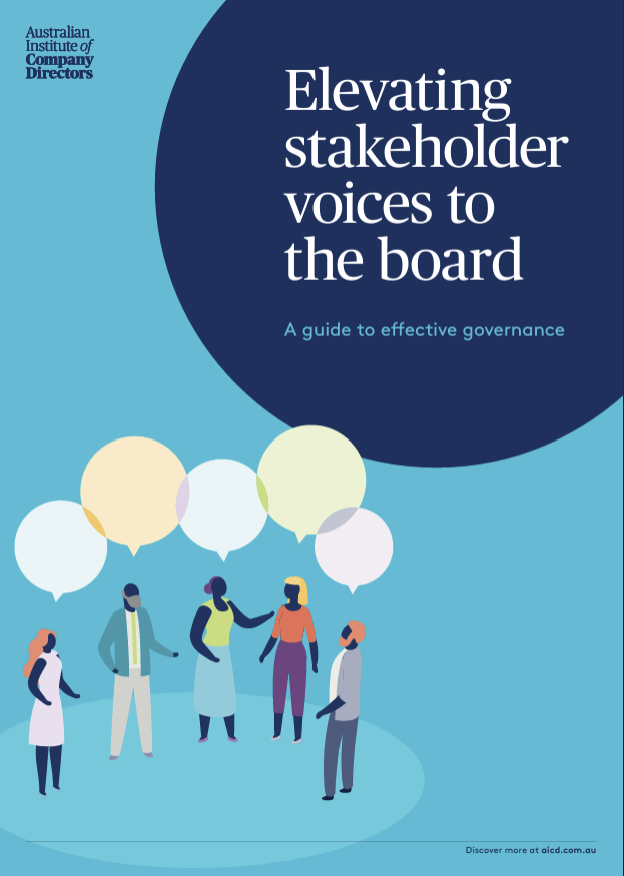
Elevating stakeholder voices to the board: A guide to effective governance
This guide offers Australian directors valuable insights on elevating stakeholder perspectives to the board, emphasising a broader view of corporate interests. It explores stakeholder governance, effective practices, and the advantages of integrating voices from employees, customers, suppliers, and the community into board-level decision-making.

The role of women on boards in corporate environmental strategy and financial performance: A global outlook
This paper examines the relationship between board gender diversity and environmental strategy and financial performance of firms. Empirical findings indicate that women on boards promote proactive environmental strategies leading to a sustained competitive advantage in both short-term and long-term financial performance.

Sustainable corporate governance and non-financial disclosure in Europe: Does the gender diversity matter?
This study explores the link between boardroom gender diversity and Environmental, Social and Governance (ESG) disclosure in European listed firms. The results show that having women directors improves ESG practices, potentially enhancing sustainable value creation for firms. The study recommends policy actions promoting gender equality in decision-making roles to further enhance corporate transparency and accountability.

Increasing female participation on boards: Effects on sustainability reporting
This study explores the relationship between board gender diversity and sustainability reporting using data from 2,116 banks over a ten-year period. Results indicate that having 22–50% female board members positively affects ESG disclosure, but beyond 50%, negative effects appear. It suggests that banks should mandate quotas to promote sustainable disclosure.

Global tipping points
The 2023 report explores ways to prevent potentially irreversible changes to the Earth's natural systems and recommends coordinated global action and governance. It also highlights positive tipping points in technology, economics, and society that can aid a sustainable future.

Adaptation, loss and damage: A global climate impact fund for climate justice
This report delves into climate justice amid anthropogenic climate change, advocating for a pilot Global Climate Impact Fund (GCIF). The fund aims to distribute the financial responsibility for the climate change transition based on attribution and contribution studies, employing standardised criteria. The report emphasises prioritising long-term resilience and sustainable development pathways.


