
Library | ESG issues
Environmental
The environmental pillar in ESG (environmental, social, and governance) assesses an organisation’s impact on the planet. It includes issues such as climate change, biodiversity, waste management and water management. Strong environmental practices help businesses reduce risks, comply with regulations, and drive long-term sustainability.
Refine
1899 results
REFINE
SHOW: 16


Incentivising climate action with executive remuneration in Australia
Provides a framework for linking climate goals to executive remuneration in Australia, emphasising alignment with credible transition strategies, measurable and sector-specific metrics, appropriate weighting, and transparent disclosure. Highlights growing adoption, implementation challenges, and guiding principles to improve investor engagement and incentive effectiveness.
Taking the lead on climate action and sustainable development: Recommendations for strategic national transition planning at the centre of a whole-of-system climate response
The report outlines principles for national transition planning to drive a coordinated, whole-of-economy shift to net zero. It proposes five pillars—strategy, implementation, engagement, metrics and governance—to align policy, mobilise finance, enhance accountability, and support sustainable development and climate resilience.
Sustainable and responsible investment for central banks
NGFS reports outline how central banks can integrate sustainable and responsible investment into corporate, sovereign and broader portfolio management, using climate metrics, risk and impact frameworks, governance arrangements and practical implementation guidance, while recognising data gaps, methodological limits and trade-offs with mandates and core investment objectives.
Regulating finance for biodiversity: An assessment for the global biodiversity framework
This report assesses how financial regulation in Indonesia, Brazil, China, the EU and the US aligns with Global Biodiversity Framework targets, finding biodiversity integration generally weak and recommending stronger disclosure, due diligence, taxonomies, sanctions and sector-specific rules to redirect finance away from forest-risk activities.
The economics of water: Valuing the hydrological cycle as a global common good
The report argues the hydrological cycle should be governed as a global common good, with water valued more accurately and managed for efficiency, equity and environmental sustainability, supported by five missions spanning food systems, ecosystems, circular water use, lower water-intensity industry, and universal safe water access. The report is produced by the Global Commission on the Economics of Water, supported by the OECD.
100 million farmers: Breakthrough models for financing a sustainability transition
Report proposes financing and collaboration models to accelerate adoption of regenerative agriculture. It identifies economic, technical and social barriers farmers face and outlines coordinated mechanisms—combining ecosystem-service monetisation, blended capital and multi-actor partnerships—to scale sustainable food production and support farmers’ transition.
Breaking down silos: Navigating the intersection of environmental and social risks for investors
Examines how environmental and social risks interact to create compounding financial impacts for investors. Presents a systems-based framework and agrifood case study illustrating portfolio volatility, credit risk and supply disruptions. Recommends integrated risk assessment, value-chain finance, stewardship and blended finance to strengthen portfolio resilience.
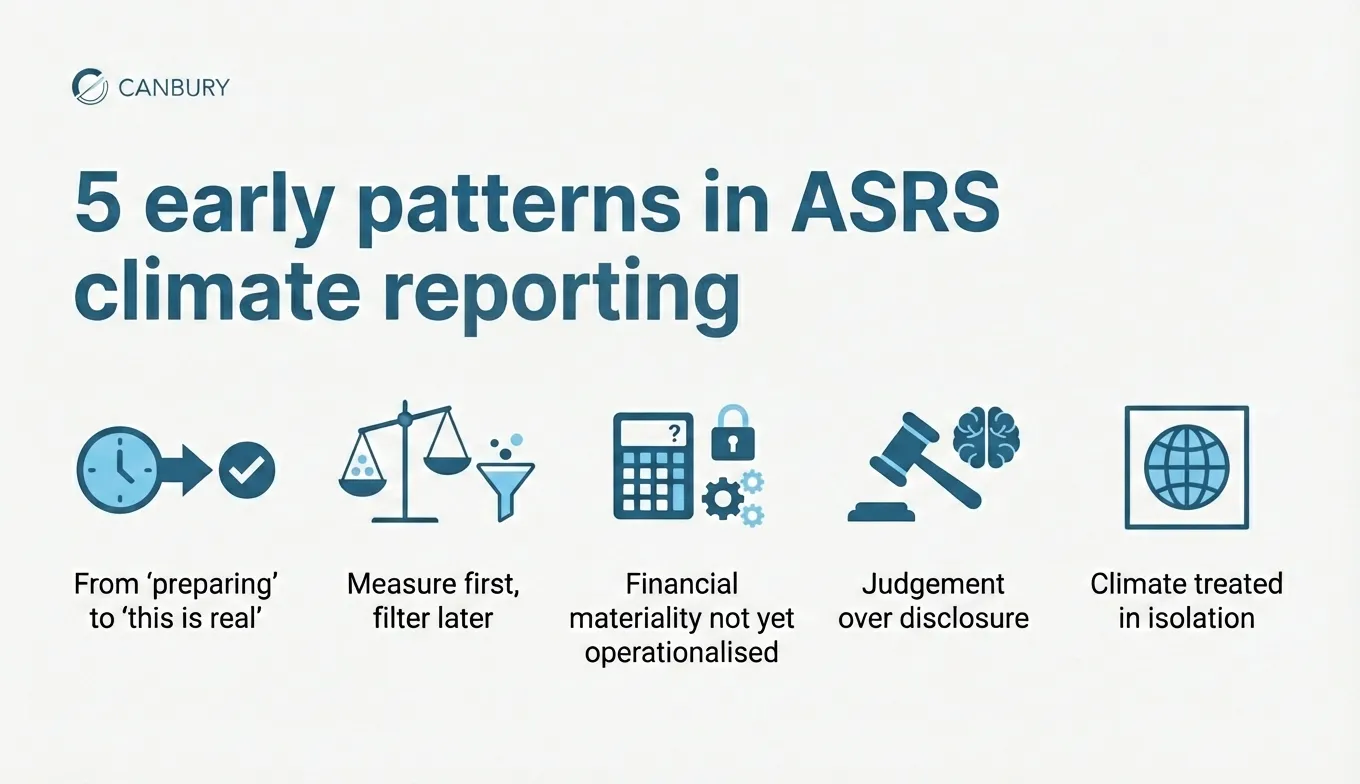
ASRS first year has landed: Here's what we’re seeing in the market
This article examines how Australian organisations are approaching the first year of mandatory ASRS climate disclosures. It highlights common implementation patterns, areas of misallocated effort, and emerging practices that prioritise financially material, decision-useful climate reporting.
The EAT-Lancet Commission on healthy, sustainable, and just food systems
This report assesses how transforming global food systems can improve health, sustainability, and equity. It updates evidence on the planetary health diet, quantifies food systems’ pressures on planetary boundaries, and analyses justice in food access and production, recommending coordinated policy, dietary shifts, and sustainable agricultural practices to support healthy diets within environmental limits.
A method to identify positive tipping points to accelerate low-carbon transitions and actions to trigger them
The report proposes a methodology to identify “positive tipping points” that can accelerate low-carbon transitions. It outlines a framework to assess their likelihood, drivers and proximity, and identifies actions that could trigger self-reinforcing decarbonisation processes to help achieve Paris Agreement climate goals.
Science in the courtroom: Evidentiary needs in climate litigation
This guide outlines how climate science evidence is used in climate litigation. It explains evidentiary standards, types of scientific evidence and litigation strategies, and provides guidance for courts and litigants on presenting and assessing climate science to support legal claims related to climate change impacts and responsibility.
Emissions gap report series
UNEP's annual assessment of the gap between countries' climate pledges and emission reductions needed to meet the Paris Agreement's temperature goals, with 2025 focus on new NDCs and 2035 targets.
Climate-related risks and opportunities and the disclosure of material information
This educational material explains how entities apply AASB S2 to identify and disclose material information on climate-related risks and opportunities affecting cash flows, access to finance and cost of capital. It outlines concepts such as value chains, dependencies and impacts, and provides a four-step process for assessing and reporting material climate-related information.

The slow forces behind this year’s fast crises
The article argues that today’s rapid global crises (political, ecological, and social) are the visible outcomes of long-building systemic pressures. Using complexity science and systemic risk analysis, it highlights how understanding these deep drivers can help societies both anticipate crises and accelerate positive, transformative change.
Mandatory climate reporting in Australia: A practical guide for 2026
Australia’s mandatory climate reporting regime began implementation from 2025, aligned with ISSB IFRS S2 standards. This guide explains regulatory expectations, governance responsibilities, emissions data requirements and practical steps organisations should take in 2026 to establish compliant climate disclosures, integrate climate risks into financial reporting, and prepare for assurance and regulatory scrutiny.
Investing in nature: Navigating the landscape with Handprint’s nature tech ecosystem map V.4
The report maps the emerging nature-tech ecosystem, grouping participants into frontliners, builders and enablers, and highlights version 4 updates: 62 new organisations and three new categories—paradigm shifters, regulatory and compliance, and payment for ecosystem services.


