
Library | ESG issues
Governance
The governance pillar in ESG (environmental, social, and governance) refers to the systems, policies, and practices that ensure an organisation is managed responsibly and ethically. It includes issues such as board structure, reporting & disclosures, shareholders & voting, and risk management. Strong governance reduces risks, enhances trust, and supports long-term business sustainability.
Refine
2256 results
REFINE
SHOW: 16


Government of Singapore Investment Corporation (GIC)
GIC (Government of Singapore Investment Corporation) is a global long-term sovereign investor managing Singapore’s foreign reserves. Established in 1981, it delivers disciplined, diversified portfolio management across equities, fixed income, real estate and infrastructure. Committed to preserving and enhancing long-term purchasing power, GIC emphasises risk management and sustainable investing.

Greenhouse Gas Protocol
GHG Protocol (Greenhouse Gas Protocol) sets globally recognised greenhouse-gas accounting standards and guidance. Developed by World Resources Institute and World Business Council for Sustainable Development, it enables businesses, governments and cities to measure, report and manage emissions—covering operations, value chains and mitigation actions across Scopes 1, 2 and 3.

Guidance for leveraging the Singapore-Asia taxonomy in green and transition financing
This report provides practical guidance for applying the Singapore-Asia Taxonomy (SAT) in green and transition financing. It addresses data gaps, evolving criteria, transition plans, and scenarios where full alignment with SAT is not possible, promoting credible financing practices across Southeast Asia’s key sectors.

Singapore Sustainable Finance Association (SSFA)
Singapore Sustainable Finance Association (SSFA) supports Singapore’s emergence as a trusted, vibrant and inclusive sustainable‑finance centre. Established in January 2024 by Monetary Authority of Singapore (MAS) and financial industry stakeholders, SSFA drives collaboration across financial, corporate and academic sectors via workstreams on taxonomy, carbon markets, transition finance, blended finance and natural capital.

Unlocking the sustainable transition for agribusiness
This report examines how entrenched political and market structures hinder agribusinesses from transitioning to sustainable models. It identifies three systemic “lock-ins” and outlines how policy reforms, financial incentives, and political commitment can unlock agribusiness potential to drive food system transformation at scale and pace.

Mobilising institutional capital towards the SDGs and a just transition
This report outlines pathways for mobilising institutional capital towards the Sustainable Development Goals and a Just Transition. It focuses on investment vehicles, emerging markets, and private asset classes, providing practical recommendations, case studies, and frameworks to integrate environmental, social, and community considerations into scalable, impactful financial strategies.

GHG protocol calculation tools and guidance
The GHG Protocol’s calculation tools and guidance details Excel‑based, cross‑sector, sector‑specific, and country‑specific tools, including those for cities and countries. Each tool includes step‑by‑step guidance and emission factors to support accurate GHG inventory development in line with the Protocol’s standards

Interpreting the corporate standard for U.S. public sector organizations
This guide interprets the Greenhouse Gas Protocol Corporate Standard for U.S. public sector organisations. It provides standardised methods for accounting and reporting greenhouse gas emissions, supports inventory quality, and addresses public sector-specific scenarios such as leased assets, joint operations, and regulatory compliance.

LMI Solutions
LMI provides advanced logistics, supply chain resilience and analytics solutions for U.S. federal agencies. With more than 60 years of public‑sector expertise, LMI delivers applied artificial intelligence, machine learning, modelling and simulation to enable risk‑informed decisions, optimisation of inventory and fleet sustainment, and rapid technology deployment.

ICLEI - Local Governments for Sustainability
ICLEI – Local Governments for Sustainability (ICLEI) is a global network of 2,500+ cities, towns and regions across 125+ countries. It supports local governments with technical assistance, peer exchange and tools to accelerate climate action, sustainable urban development, biodiversity protection and resilient, equitable and circular outcomes.

Global protocol for community-scale greenhouse gas inventories: Supplemental guidance for forests and trees
This supplemental report provides standardised methods for communities to estimate greenhouse gas emissions and carbon removals from forests and trees. It expands the global protocol for community-scale greenhouse gas inventories by offering detailed guidance for accounting Scope 1 emissions and removals, supporting local climate action planning and integration with national inventories.

Guidelines for quantifying GHG reductions from grid-connected electricity projects
These guidelines provide a standardised, policy-neutral framework for quantifying greenhouse gas (GHG) reductions from grid-connected electricity projects. They cover both generation and electricity reduction activities, using simplified methods to estimate baseline emissions and avoided emissions. Intended for project developers and programme designers, the guidelines emphasise accuracy, transparency, and conservativeness.

Estimating and reporting the comparative emissions impacts of products
This report outlines a neutral framework for estimating and reporting the greenhouse gas impacts of products, both positive and negative. It advocates the use of consequential methods for decision-making, highlights methodological challenges in attributional approaches, and recommends transparency and completeness in emissions assessments and corporate reporting.

Greenhouse gas protocol land sector and removals initiative: Project overview
The greenhouse gas protocol’s land sector and removals initiative aims to develop internationally accepted corporate guidance for accounting and reporting emissions and removals from land use, bioenergy, and carbon removal. It seeks to improve transparency, support target-setting, and align with climate goals through a multi-stakeholder, science-based process.

The GHG protocol for project accounting
This report outlines standards and procedures for quantifying and reporting greenhouse gas (GHG) reductions from mitigation projects. It provides a framework to estimate baseline emissions, assess additionality, and apply consistent accounting principles. The guide supports transparency, credibility, and harmonisation across project-based GHG initiatives.
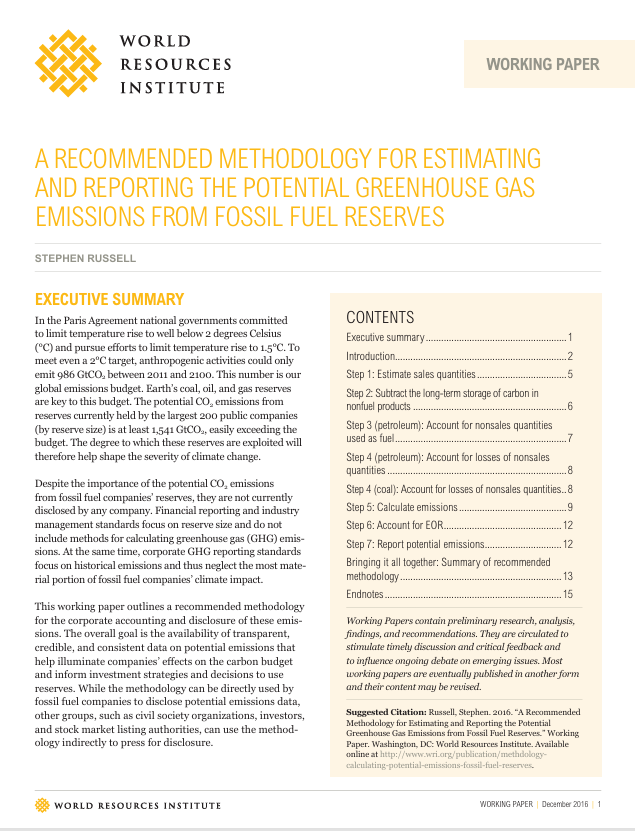
A recommended methodology for estimating and reporting the potential greenhouse gas emissions from fossil fuel reserves
This working paper presents a methodology for fossil fuel companies to estimate and disclose potential greenhouse gas emissions from their reserves. It outlines seven steps for calculating emissions, addressing combustion, leakage, and storage factors, with the aim of improving transparency and enabling comparison across companies and alignment with climate targets.


