
Library | SDGs
GOAL 12: Responsible Consumption and Production
Refine
471 results
REFINE
SHOW: 16



Federal Institute for Geosciences and Natural Resources (BGR)
Federal Institute for Geosciences and Natural Resources (BGR) is Germany’s national geological survey, advising the federal government on geoscience and raw materials. It undertakes research in earth sciences, resource management, geodata systems and sustainability. Located in Hannover, BGR coordinates national geoscientific data infrastructure and policy.
Target-setting protocol fourth edition
The report outlines the fourth edition of the Science Based Targets initiative’s target-setting protocol. It provides updated guidance, criteria, and methodology for companies to set near-term science-based greenhouse gas emission reduction targets, aligning with 1.5°C pathways and incorporating broader coverage across sectors, geographies, and organisational boundaries.
Global pricing of carbon-transition risk
This report examines the global pricing of carbon-transition risk by assessing equity markets’ responses to climate policy and transition exposure. It analyses regional variations, sectoral impacts, and the role of carbon pricing in financial markets, highlighting implications for asset valuation and investment strategies.
Survey of CFA institute members on latest ESG matters
The CFA Institute survey (Nov 2021) captures member views on ESG integration and sustainability reporting. Respondents support flexibility in ESG integration, oppose government mandates, and favour global product disclosure standards. They also prefer mandatory, globally consistent sustainability reporting with regulatory frameworks in place before adoption.
City development limited: Industry case studies: Real estate
City Developments Limited outlines its sustainability strategy, focusing on climate resilience, stakeholder engagement, and SDG-aligned investments. The report details historical drivers, innovation in green building, ESG integration, and financial performance, highlighting case studies on technology adoption and partnerships to advance low-carbon operations and responsible real estate growth.
Externalities and the common owner
This article analyses institutional investors’ incentives to internalise negative externalities across their portfolios. It focuses on climate change, showing how large asset managers influence fossil fuel companies to reduce emissions, disclose risks, and limit lobbying, reframing shareholder primacy by prioritising portfolio-wide welfare over firm-level profit maximisation.
Chemsec's Sin Producers
The SIN Producers tool identifies companies producing hazardous chemicals, helping finance professionals assess risks in their portfolios. The tool provides concise, structured information for making informed investment decisions, focusing on sustainability and regulatory compliance.
Just transition, environment and social considerations for the aviation fuel transition: An investor guide
This guide outlines environmental, social, and just transition considerations for investors in aviation’s fuel shift. It compares biofuels and e-fuels, highlights regulatory and biodiversity risks, and provides engagement questions to assess companies’ transition strategies, ensuring alignment with climate goals while safeguarding communities and long-term financial stability.

Chatham House
Chatham House, known formally as Royal Institute of International Affairs, is an independent policy institute in London. It delivers rigorous research, analysis and dialogue on global issues—such as international relations, climate change, security and economics. Its mission: help governments and societies build a sustainably secure, prosperous and just world.

Copernicus interactive climate atlas (C3S atlas)
The Copernicus Interactive Climate Atlas (C3S Atlas) is a web‑based tool from the Copernicus Climate Change Service offering flexible exploration of past, present and future climate data. It integrates observational, reanalysis and projection datasets, and allows users to customise regional analyses and visualise key climate variables via maps, charts and time series.

Unlocking the sustainable transition for agribusiness
This report examines how entrenched political and market structures hinder agribusinesses from transitioning to sustainable models. It identifies three systemic “lock-ins” and outlines how policy reforms, financial incentives, and political commitment can unlock agribusiness potential to drive food system transformation at scale and pace.

GHG protocol calculation tools and guidance
The GHG Protocol’s calculation tools and guidance details Excel‑based, cross‑sector, sector‑specific, and country‑specific tools, including those for cities and countries. Each tool includes step‑by‑step guidance and emission factors to support accurate GHG inventory development in line with the Protocol’s standards

Interpreting the corporate standard for U.S. public sector organizations
This guide interprets the Greenhouse Gas Protocol Corporate Standard for U.S. public sector organisations. It provides standardised methods for accounting and reporting greenhouse gas emissions, supports inventory quality, and addresses public sector-specific scenarios such as leased assets, joint operations, and regulatory compliance.

Estimating and reporting the comparative emissions impacts of products
This report outlines a neutral framework for estimating and reporting the greenhouse gas impacts of products, both positive and negative. It advocates the use of consequential methods for decision-making, highlights methodological challenges in attributional approaches, and recommends transparency and completeness in emissions assessments and corporate reporting.

The GHG protocol for project accounting
This report outlines standards and procedures for quantifying and reporting greenhouse gas (GHG) reductions from mitigation projects. It provides a framework to estimate baseline emissions, assess additionality, and apply consistent accounting principles. The guide supports transparency, credibility, and harmonisation across project-based GHG initiatives.
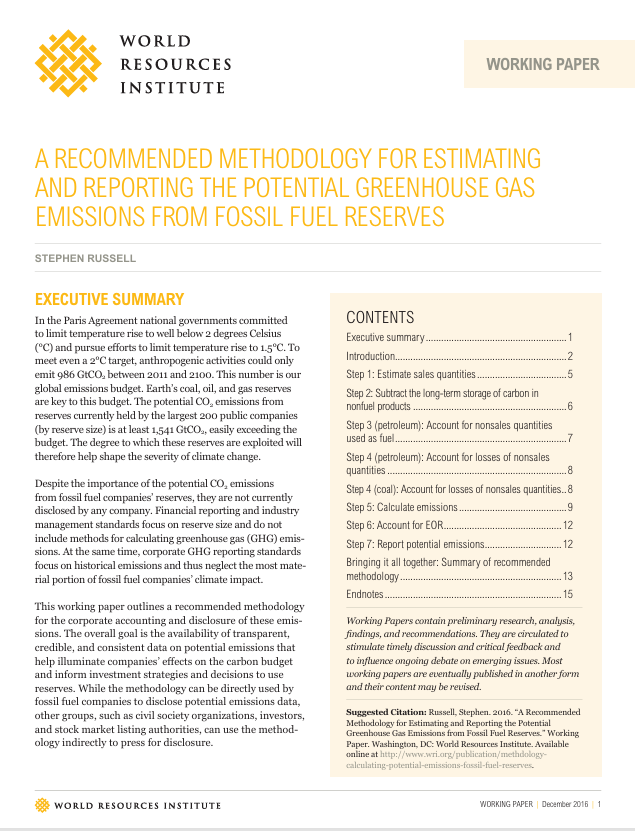
A recommended methodology for estimating and reporting the potential greenhouse gas emissions from fossil fuel reserves
This working paper presents a methodology for fossil fuel companies to estimate and disclose potential greenhouse gas emissions from their reserves. It outlines seven steps for calculating emissions, addressing combustion, leakage, and storage factors, with the aim of improving transparency and enabling comparison across companies and alignment with climate targets.


