
Library | Asset Class
Other Real Assets
Tangible assets with intrinsic value beyond financial instruments, e.g., timberland, farmland, or natural resources.
Refine
120 results
REFINE
SHOW: 16


Investing in nature: Opportunities for institutional investors
This guide aims to assist institutional investors in navigating the evolving landscape of nature-based finance. It offers practical insights into various investment opportunities, showcasing case studies that exemplify best practices and innovative approaches in nature investments.

Catalytic capital: A key to aligning infrastructure investments with climate mitigation in emerging markets
This report provides a roadmap for directing more institutional capital toward climate infrastructure financing in emerging markets. It identifies the importance of using catalytic capital and outlines four themes crucial to its effective use: targeting, speed, support, and analysis. The report offers recommendations for how to address climate challenges through targeted catalytic interventions.

Experimental evidence for tipping points in social convention
This study shows the theoretical and empirical existence of a tipping point for changing social conventions. Minority groups can overturn established behaviour by reaching a critical mass, expected to vary depending on social setting. The findings offer insight for organizations with potential shifts in conventional behaviour.

Mobilizing money and movements: Creative finance for food systems transformations
This report explores creative financing strategies for transforming food systems. Through six case studies, it showcases levers of change for transformational investing, including blended finance, shared ownership, and diverse investment types. The report emphasizes community engagement and local food production to build sustainable and resilient food systems.

Navigating the reporting landscape
This guide provides an introduction to sustainability-related reporting for finance professionals. It covers mandatory reporting requirements and reporting frameworks, as well as key reporting components for sustainability. The guide also explores recent developments in reporting standards and the accounting profession, highlighting the future of corporate reporting.

Social tipping dynamics for stabilizing Earth’s climate by 2050
This report identifies the key actors capable of rapidly decarbonising industry, society, and economy, suggesting six social tipping elements to stabilise Earth's climate by 2050. The research provides social tipping elements candidates with their associated social tipping interventions and estimated time for triggering tipping.

Impact investing decision-making: Insights on financial performance
This report explores the financial performance of impact investments in private debt, private equity, and real assets, based on a scoping exercise of the industry's published research. Nearly nine in ten impact investors find that their portfolios are either meeting or exceeding their financial performance expectations.

Asset-level data and the energy transition: Findings from ET risk work package 2
This report demonstrates the potential of asset-level data to manage risks and opportunities arising from the transition to a net-zero emissions economy. The authors develop a demonstrator database of assets across six carbon-intensive industries, calculating cumulative committed carbon emissions (CCCE) and potential reductions (RCCCE) through retrofits.

Future of sustainability in investment management: From ideas to reality
This report examines sustainable investing, considering the increasing investor demand for ESG factors and how to adapt to the sustainability paradigm. It identifies business model and investment model drivers, as well as operating and people model enablers and the challenges and skills required for integrating ESG.

Enabling FPIC through voluntary standards: An ISEAL innovations fund project
This report explores ways to enable Free, Prior, and Informed Consent through voluntary standards. It reviews existing literature and provides a framework for companies and assurance providers to verify and monitor successful implementation of Free, Prior, and Informed Consent from the perspective of affected communities.

Dhawura Ngilan: A vision for Aboriginal and Torres Strait Islander heritage in Australia
Dhawura Ngilan (Remembering Country) is a vision statement outlining aspirations for the protection, preservation, and celebration of Aboriginal and Torres Strait Islander heritage in Australia. The report emphasises the importance of Indigenous communities' involvement in heritage management and calls for consistent policies and legislation across jurisdictions.
Renewable energy and human rights benchmark report series
The Renewable Energy and Human Rights Benchmark series assesses how leading renewable energy companies manage and respect human rights across their operations and value chains. The series provides a consistent, comparative framework to track corporate practices and accountability in the global energy transition.
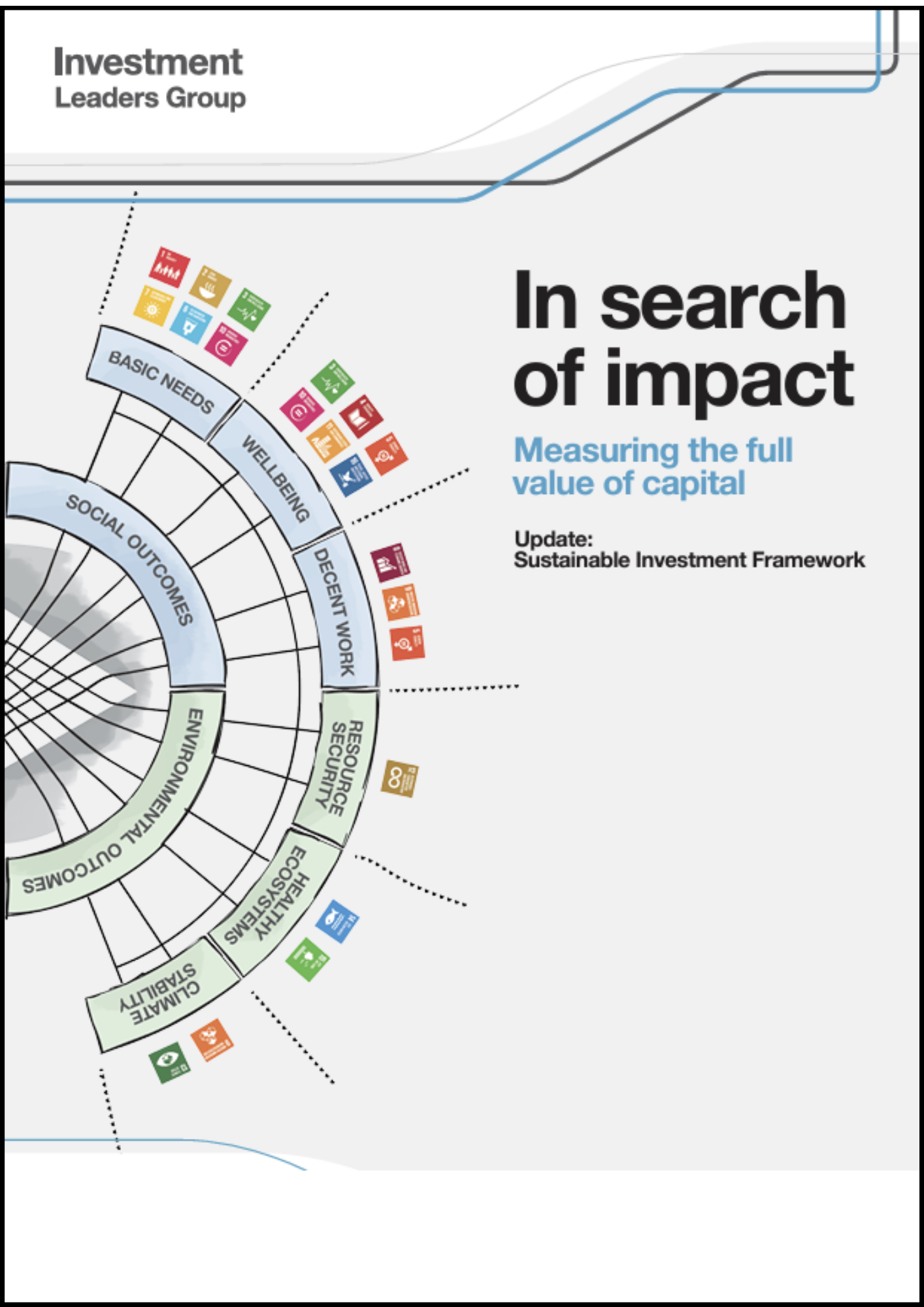
In search of impact: Measuring the full value of capital
This report outlines a sustainable investment framework, designed to empower individuals and organisations to better understand and make informed investment choices. The framework utilises six themes to communicate the impact of financial flows into the economy and contains theoretically grounded metrics that can be practically applied.

Impact investing for pensions
This report analyses the growth of impact investing strategies among European pension funds. The report examines challenges and opportunities, regulatory restrictions, impact measurement and management, private equity case studies, and emerging investments in affordable and social housing.

Towards financing large-scale holistic landscape restoration in Europe: Recommendations for EU policy actors to attain inspirational, social, natural and financial returns
The report provides financing recommendations for large-scale holistic landscape restoration in Europe, addressing climate change, biodiversity loss, and food and water insecurity. It emphasises the effectiveness of landscape finance in promoting healthy ecosystems, offering practical frameworks for policymakers to accelerate impactful activities and align natural and community needs for comprehensive restoration.
Earth system justice needed to identify and live within Earth system boundaries
This article considers how to integrate principles of justice within Earth’s system boundaries, specifically for climate, the biosphere, water and nutrient cycles, and aerosols. Using the Earth system justice approach, it discusses living within planetary limits whilst minimising significant harm to all people and ensuring equitable access to resources.


