
Library | Sustainable Finance Practices
Active ownership
Active ownership is a component of effective stewardship. It refers to how investors influence the behaviour and practices of investee companies (and, where relevant, borrowers or policyholders) through engagement, proxy voting, and, where necessary, escalation. The aim is to improve ESG performance, foster long-term value creation, and ensure responsible business conduct at the company level.


Refine
142 results
REFINE
SHOW: 16


The big three and board gender diversity: The effectiveness of shareholder voice
The report analyses how campaigns by major institutional investors significantly boosted gender diversity on corporate boards. From 2017 to 2019, these initiatives increased female directorships by encouraging firms to broaden candidate searches and reduce the focus on executive experience, indicating impactful, non-tokenistic change.

Community forest governance and synergies among carbon, biodiversity and livelihoods
The report examines the relationships between carbon sequestration, biodiversity, and livelihoods in tropical forest commons. It highlights the importance of local governance, particularly community management and rule-making, in achieving synergies among these benefits. The study identifies trade-offs and co-benefits across five distinct forest clusters, emphasising that effective governance plays a key role in fostering multifunctional forest landscapes.

Divestment and engagement: The effect of green investors on corporate carbon emissions
This report investigates whether green investors influence corporate carbon emissions by either divesting from polluters or engaging with management through stock ownership. The findings suggest green investors significantly reduce emissions through active engagement, whereas divestment strategies may counterproductively increase emissions. The report highlights private markets’ potential to address environmental issues independently of government regulation.


Modern slavery UK benchmark report series
The CCLA Modern Slavery UK Benchmark is an annual benchmark series assessing how major UK-listed companies disclose and act on modern slavery risks in their operations and supply chains, supporting investor engagement and improved corporate practice on human rights due diligence.

The unseen 'others': A framework for investor stewardship
The report introduces an analytical model that expands traditional investment management by recognising multiple stewardship relationships beyond immediate clients and beneficiaries. It advocates for enlightened stewardship that considers the broader impacts on society, the environment, and the economy, urging the integration of such perspectives into stewardship codes.

An introduction to responsible investment: Human rights for asset owners
This guide by PRI summarises human rights relevance for asset owners, offering strategies for policy, governance, stewardship, and disclosure. It includes case studies, international standards, and practical resources to promote human rights in the financial system.

Big oil reality check: Aligned in failure
Big oil and gas companies’ climate pledges lack ambition and integrity, resulting in continued exploration and extraction. They fail to align with the Paris Agreement, relying on misleading accounting and greenwashing. Immediate action from governments and investors is essential to catalyse a socially just and equitable phase-out of fossil fuels.
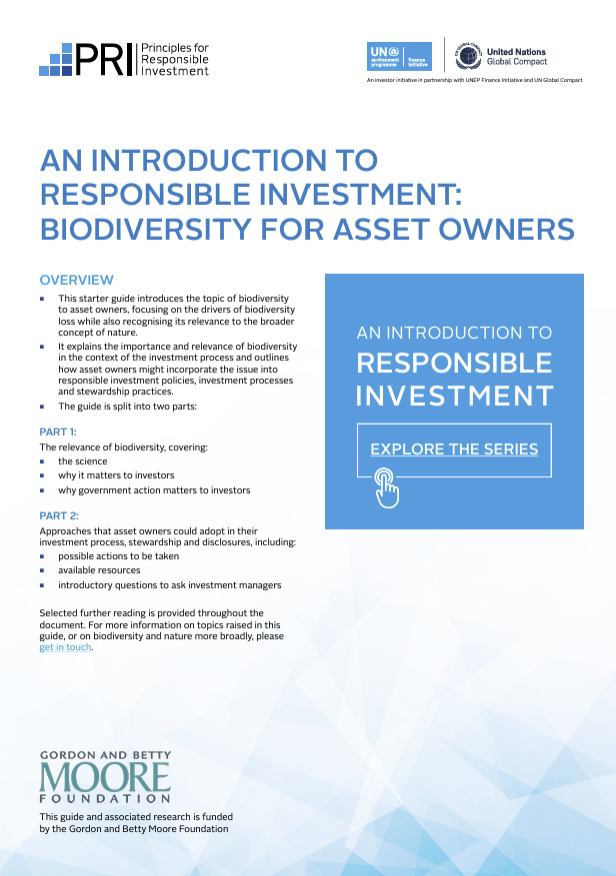
An introduction to responsible investment: Biodiversity for asset owners
This introductory guide for asset owners explores the financial risks and opportunities associated with biodiversity loss. It explains the relevance of biodiversity to investment processes and outlines how asset owners can incorporate biodiversity considerations into their responsible investment policies, stewardship practices, and disclosures.
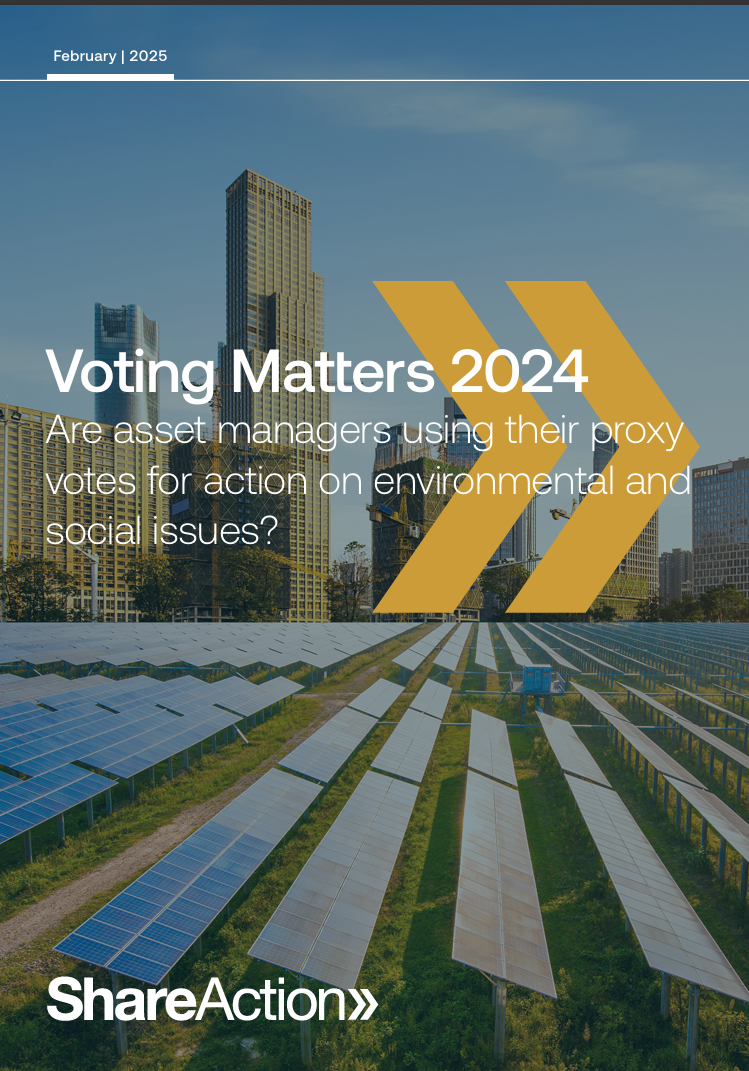
ShareAction's voting matters series
Voting Matters are benchmark-series reports by ShareAction evaluating the proxy voting behaviour of asset managers on environmental and social issues. This report analyses the voting patterns of major asset managers to determine their commitment to responsible investment practices.

Constructive corporate engagements: From a corporate perspective
This research focuses on constructive corporate engagement. This report analyses survey results from 100 senior company directors and interviews with ten executives to examine the drivers of successful engagements. Insights include the importance of collaborating with companies, focusing on material issues, and using standard metrics for success.

Making global goals local business: A new era for responsible business
This report highlights the need for private sector involvement in achieving the Sustainable Development Goals (SDGs) of the 2030 Agenda. It showcases the progress made so far by various companies and organisations and the role they play in building a better world through responsible business practices.

Who owns a company?
This speech examines the evolution of corporate governance, focusing on the shift towards shareholder primacy. It discusses the incentive problems this model creates, such as short-termism and excessive risk-taking, and their economic consequences. The speech concludes by exploring potential policy responses to mitigate these issues.

Women decision makers: How can more capital reach women decision makers in emerging markets?
This report explores the barriers preventing women fund managers from receiving capital, particularly local, diverse women. The report outlines recommendations and tools for investors to better support women decision makers.

Industry influence on biodiversity policy: A pilot study demonstrating industry associations’ engagement on biodiversity-related policy and regulations
This report reveals that industry associations representing key sectors and some of the largest companies in the world are lobbying to delay, dilute, and block critically needed biodiversity policy in both the EU and US. The vast majority of engagement on specific policies and regulations is oppositional, seeking to roll back, weaken, or block policy.

The future of investor engagement: A call for systematic stewardship to address systemic climate risk
This report provides a call to action for investors to engage in systematic stewardship to address systemic climate risk. It explores limitations of corporate engagement and presents alternative opportunities for engagement such as sector and value chain engagement, policy engagement, and asset manager engagement.


