
Library | Sustainable Finance Practices
Issue/sector focused research
General research and analysis that provides deep dives and insights into specific sustainability issues or industry sectors, addressing the current status, trends, risks, and opportunities for the issue but not specifically addressing a finance or business audience.
Refine
761 results
REFINE
SHOW: 16


The path to a new era for nuclear energy
Nuclear energy is gaining momentum as a reliable, low-emissions electricity source. The report outlines growth drivers, investment needs, emerging technologies such as small modular reactors, and policy frameworks required for scale-up. Financing challenges, supply chain risks, and workforce planning are key to realising nuclear’s role in future energy systems.

Nature positive: Leaders’ insights for the transition in cities
The report outlines strategies and case studies from global cities integrating nature into urban development to address climate and biodiversity challenges. It highlights the importance of public-private collaboration, compact planning, and nature-based infrastructure in fostering resilient, sustainable, and equitable cities. Solutions are scalable and grounded in real-world examples.

Reducing animal testing in the health sector through strategic investment: Guide for investors
The report outlines how strategic investment can reduce animal testing in the health sector. It provides investors with guidance on promoting transparency, encouraging non-animal methods, and influencing regulation, while highlighting the risks of limited disclosure and misalignment with consumer concerns.
Exploring pathways for world development within planetary boundaries
The report assesses global development scenarios to 2050 using planetary boundaries. Current trends worsen conditions across key Earth system indicators, except ozone depletion. Implementing strong sustainability measures, including climate agreements, diet shifts, and resource efficiency, significantly reduces boundary breaches but still leaves climate, biodiversity, and nutrient flows at risk.

Find it, fix it, prevent it: Modern slavery report 2024
CCLA’s 2024 report outlines investor-led efforts to address modern slavery through corporate engagement, policy advocacy, and improved data. Key sectors include construction and agriculture. Progress was made via benchmarking and collaborative initiatives, though disclosure and remedy remain limited. EU legislation and stakeholder coordination are driving further momentum.
The disability inclusion imperative
Companies excelling in disability inclusion earn higher revenue, profit, and productivity. Despite rising interest, action lags. Barriers include disclosure fears and cost assumptions. The report introduces a five-part “A List” framework—Access, Awareness, Advocacy, Action, Accountability—to guide inclusive practices and improve organisational and financial outcomes.
Watermark Search International's board diversity index series
This benchmark series provides an annual analysis of board diversity across ASX300 companies. It tracks representation beyond gender, covering areas such as cultural background, skills, age, tenure, and independence. The series offers longitudinal insights to assess diversity trends and board composition in the Australian corporate sector.
CEW's senior executive census series
This benchmark series tracks annual progress in women's representation in executive leadership roles across the ASX300. It provides a consistent and comparative overview of gender diversity trends, highlights structural barriers, and evaluates corporate efforts towards achieving gender balance in leadership.
Disability: IN's disability equality index series
The Disability Equality Index is a benchmark series assessing corporate performance in disability inclusion across multiple markets. It provides organisations with a structured tool to evaluate, compare, and enhance their inclusive practices aligned with sustainability and governance expectations.
AI, data governance and privacy: Synergies and areas of international co-operation
This report examines the synergies between artificial intelligence, data governance, and privacy, highlighting international collaboration opportunities. It identifies key regulatory frameworks, interoperability standards, and policy recommendations to address shared global challenges and promote responsible AI deployment while safeguarding data privacy across jurisdictions.

Back to Blue
Back to Blue Initiative is a joint project by Economist Impact and the Nippon Foundation addressing ocean pollution. It focuses on data-driven solutions for plastic and chemical pollution in marine environments. The initiative offers research, policy insights and advocacy to support sustainable ocean health and inform global environmental decision-making.

International Council on Mining and Metals
The International Council on Mining and Metals (ICMM) is a global leadership organisation dedicated to enhancing the mining and metals industry's contribution to sustainable development. ICMM brings together a third of the global industry, promoting ethical business practices, environmental stewardship, and social responsibility. Members commit to stringent Mining Principles, aiming for a safe, just, and sustainable world enabled by responsibly produced minerals and metals.
First Nations investment screening approach
This document provides a clear and concise example of how to screen investments for potential financed impacts to Indigenous Peoples, including both positive and negative impacts. The screening approach described was developed in consultation with First Nations representatives.
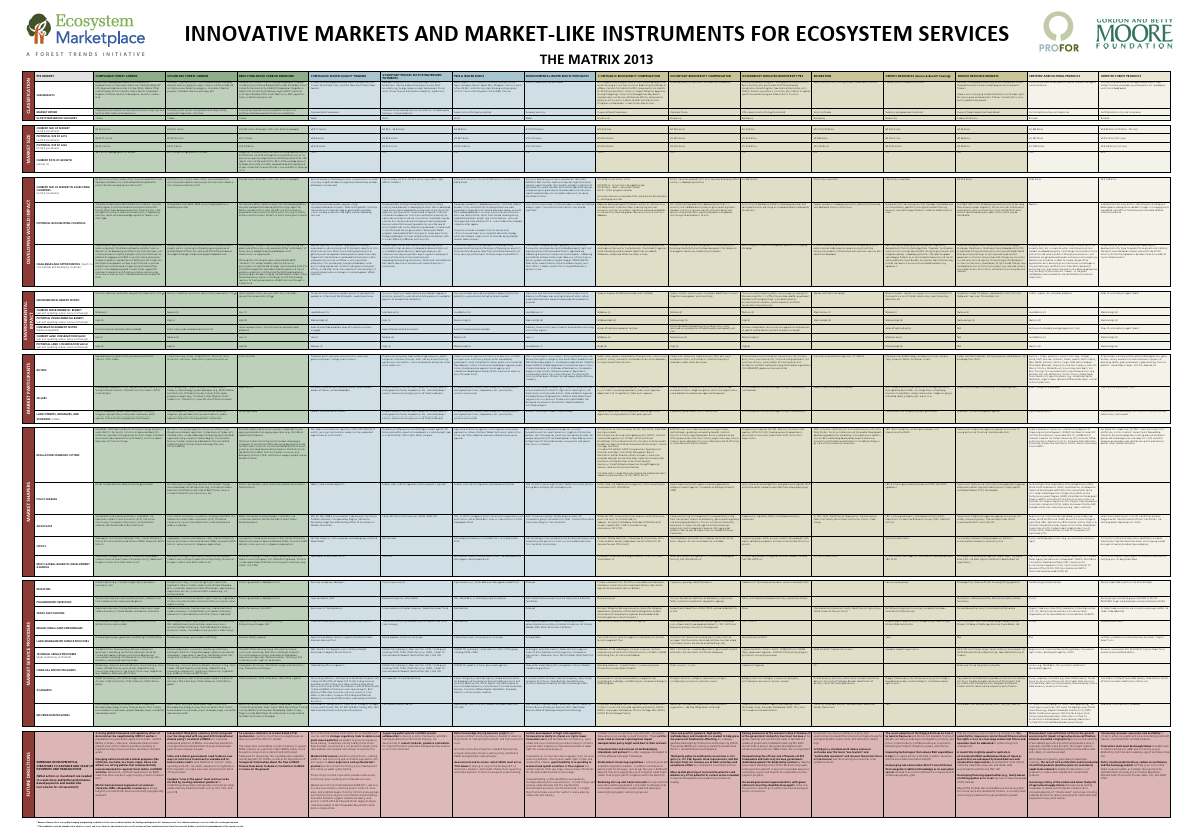
Innovative markets and market-like instruments for ecosystem services
This tool provides investors with a framework for evaluating and comparing different nature-based investment opportunities. It helps identify projects that offer the best combination of financial returns and environmental impact, supporting informed investment decisions.
Conservation investment blueprint: Cocoa smallholder renovation and rehabilitation (R&R)
This blueprint provides a model for investing in the renovation and rehabilitation of smallholder cocoa farms. It highlights strategies for improving productivity and sustainability in cocoa farming, offering investors opportunities for impact investment with financial returns.
Conservation investment blueprint: Forest landscape conservation, restoration, and sustainable timber production
This blueprint contributes to the conservation and restoration of forest ecosystems – achieved by investors purchasing forests, or purchasing land and reforesting; with the express goal of sustainably managing those forests in adherence to relevant sustainability or management certifications.


