

Altiorem Weekly - 8 November 2026
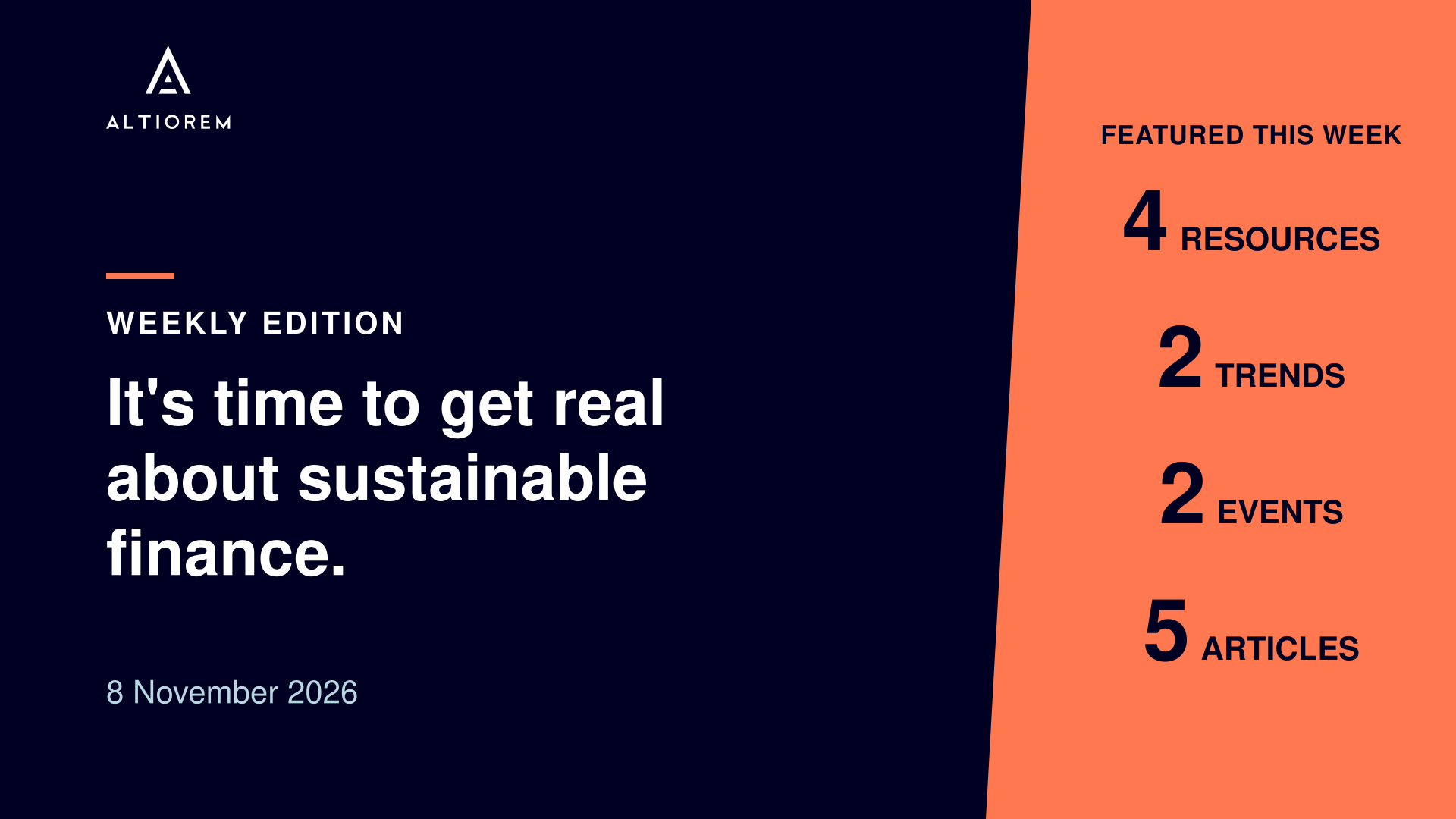
Research explores the transition from climate adaptation classification to active capital allocation and the financial exposure of bond issuers to the 2026 Indonesian forest fires. It analyses the UK Financial Conduct Authority’s new regulatory framework for ESG rating providers and systemic failures in corporate efforts to eradicate modern slavery. Further reports investigate the impact of Spanish wildfires on securitisation and the financial materiality of social risks for technology hyperscalers.

Dear friends and supporters of Altiorem,
It's time to get real about sustainable finance – A new five-part series from Altiorem.
Something has been troubling me for a long time. In 2007, when I completed my first Carbon Disclosure Project response for my employer, I had managed to merge my concern for the environment and our collective future with my job as a risk manager. I was excited and determined not to waste the opportunity to make a difference.
However, when this eventually turned into my first dedicated responsible investment role in 2009, it didn’t take long for me to be convinced that rather than concern for our collective future, the only way to get the investment professionals around me to pay attention was to make the case for sustainability through the prism of risk and return. We were doing it for the money, with win-win a nice to have.
I felt uncomfortable with this but time and again the paradigm of institutional investment where fiduciary duty was reduced to the narrowest possible financial interest of beneficiaries, performance (and pay!) was assessed against benchmarks that treated company size as a substitute for quality, and time horizons that seemed to get shorter by the month, demanded that any other reason for caring be put aside. That they were not just irrelevant, but contrary to our solemn duty.
| Add your voice Take OUR two-minute poll |
When the SDGs were agreed in 2015 and a few months later the Paris Agreement was also, there seemed an inevitability that the interests of people and planet could be made to align with the financial interests of beneficiaries. That governments would enact laws and regulations that would introduce costs that made destructive and extractive practices unprofitable and incentives that would supercharge a green and just transition. The endless studies and debates on the financial materiality of ESG issues and the positive performance of more sustainable companies could end, as the weight of the challenges and growing societal response made it so.
Ten years on, it is easy to see how naïve this was. After all the Global Financial Crisis, which started the year after the Principles for Responsible Investment were founded, took the economic system to the precipice and yet governments responded with more debt, money printing and bailing out the organisations which caused the crisis in the first place!
Our unsustainable economic and financial system has proved resilient (with massive government support) through repeated crises, growing climate and environmental disasters, wars and even a global pandemic. The wheels spin faster and the signs of strain continue to grow but on and on it goes with AI its latest manifestation. Nothing must stop the runaway train that we are all on, institutional investors and their beneficiaries included.
But even runaway trains run out of track. In her book Hospicing Modernity, Vanessa Machado de Oliveira reflects on a Brazilian saying that you can’t learn to swim until the water is up to your hips. Maybe that has been the issue with the last 20 years of sustainable finance, and now with the confirmation that the 1.5°C goal will be breached and that we have exceeded seven of nine planetary boundaries, we will finally learn to swim.

The pushback/rollback/backlash on ESG issues and sustainability over the last few years is an opportunity to reckon with these questions and be deliberate about what we fight to protect, what we reform, what we discard, and the new things we need to build in their place. Over the next five weeks, we will be exploring these issues in more depth and we need your help. To start, I would be very grateful if you would complete this survey, which will take only two minutes and forms an important plank of the series. Secondly, if you would like to write (300-500 words) or contribute case studies we would love to incorporate them. Please get in touch.
Until next week,
Pablo
| Add your voice Take OUR two-minute poll |
New in the library
Pablo’s handpicked highlights from Altiorem last week:
|
★ Featured
The adaptation and resilience imperative: From classification to capital allocation Schroders
Schroders explores the transition from simply classifying adaptation activities to actively allocating capital. The report provides a framework for investors to identify opportunities that enhance climate resilience while delivering sustainable long-term financial returns. ESG Integration and analysisIssue/sector focused researchProduct development and trends
|
| Mobilising private finance for nature: Learning from large-scale nature investment vehicles
Grantham Research Institute on Climate Change and the Environment
This report examines large-scale nature investment vehicles to identify lessons for mobilising private finance. It analyses the structures required to scale investment in natural capital and the role of institutional investors in protecting biodiversity. Fixing financial and economic systemsIssue/sector focused researchProduct development and trends
|
| Scaling tropical forest finance: Perspectives from the Amazon Basin, the Congo Basin, and Borneo
Sustainable Development Solutions Network (SDSN)
Experts from across the globe provide perspectives on scaling finance for tropical forest conservation in the Amazon, Congo, and Borneo. The research highlights the financial mechanisms and policy frameworks needed to protect these critical ecosystems. Fixing financial and economic systemsIssue/sector focused researchProduct development and trends
|
| Indonesia’s 2026 fires: mapping exposure to bond issuers
Anthropocene Fixed Income Institute
This analysis maps the exposure of bond issuers to the 2026 Indonesian forest fires. It provides a critical look at how physical climate risks and environmental degradation impact fixed income portfolios and the creditworthiness of regional issuers. Issue/sector focused researchLaws and regulations
|
| India insights: Sustainable debt investor survey 2026
Climate Bonds Initiative
The Climate Bonds Initiative presents findings from its 2026 survey of sustainable debt investors in India. The report identifies key trends, investor expectations, and the regulatory developments necessary to further grow India’s sustainable finance market. Issue/sector focused researchLaws and regulationsProduct development and trends
|
To see all of the resources added this week visit Altiorem’s website: Altiorem Articles: Insightful Reads & Expert Knowledge
This week in ESG trends
|
★ Featured
Human Rights Court Environmental Testimony 5 November 2026
Environmental defenders from several Latin American nations testified before human rights panels on November 3, 2026, alleging that Canadian mining companies are causing widespread water pollution. The testimony details how extractive projects have contaminated local water sources with heavy metals and toxic chemicals, leading to health crises and the displacement of Indigenous communities. Advocates are seeking international intervention and stricter accountability for the environmental and social impacts of mining operations conducted by foreign entities in South and Central America. [Published: 03 Nov 2026] |
UK/Europe
| UK ESG Ratings Regulation
4 November 2026
The Financial Conduct Authority (FCA) published its final rules (PS26/22) on November 3, 2026, to bring environmental, social, and governance (ESG) rating providers under its regulatory remit for the first time. The new framework introduces requirements for transparency, governance, and the management of conflicts of interest for firms providing ESG ratings in the UK. Providers currently operating in the market must apply for FCA authorisation by June 24, 2027, with the full regulatory regime scheduled to take effect on June 29, 2028. [Published: 03 Nov 2026] |
| Modern Slavery Corporate Accountability Report
4 November 2026
On November 3, 2026, Hult International Business School released the report "Corporate Leadership on Modern Slavery: Ten Years On," which revealed systemic failures in corporate efforts to eradicate forced labor. The study found that 55% of surveyed professionals at large listed companies identified actual or suspected cases of modern slavery in their value chains over the past three years. The report criticised the UK’s Modern Slavery Act 2015 for encouraging performative reporting and noted that 92% of businesses now support tougher mandatory human rights due diligence requirements. [Published: 03 Nov 2026] 📖 The state of domestic work in 2025: 15 years after Convention No. 189 |
To see all of the daily trends follow us on LinkedIn: Altiorem on LinkedIn
Webinars and events
|
★ Featured
United Nations Framework Convention on Climate Change · 9 November 2026 · Antalya, Türkiye · in_person
The 31st Conference of the Parties to the UN Framework Convention on Climate Change, bringing together governments, businesses, and civil society to advance global climate commitments. Fixing financial and economic systems
|
| How can we tell whether an investor is serious and strategic about climate policy?
Volans · 10 November 2026 · Online · webinar
A session focused on evaluating the authenticity and effectiveness of investor engagement with climate policy. Stakeholder engagement and advocacy
|
| Science-Based Targets for Nature 2.0
Science Based Targets Network · 10 November 2026 · Online · webinar
SBTN technical experts provide a walkthrough of the 2.0 framework changes and how organisations can get started with scaling corporate nature action. Industry standards and guidance
|
For the full list of sustainable finance events visit our events page
From the community
|
★ Featured
How social risk is financially-material for hyperscalers AFII
An analysis of the financial materiality of social risks within the context of large-scale technology and data infrastructure providers. ESG Integration and analysis
|
| The Impact of Spanish Wildfires on Securitisation
PGIM
A commentary on how physical climate risks, specifically wildfires, impact the valuation and risk profile of securitised assets in Spain. Issue/sector focused research
|
| BHP Chair rejects shareholder request for 2040 operational emissions target
ACCR
ACCR reports on BHP's rejection of a request for an interim 2040 emissions target and highlights concerns regarding the company's long-term decarbonisation pathway. Active ownership
|
| Environmental compliance risks in Brazil’s soy and beef supply chains
Trase
Analysis of new research regarding environmental compliance risks in Brazil’s beef and soy sectors and their implications for international markets. Issue/sector focused research
|
| BP’s response leaves shareholders waiting for evidence on upstream returns
ACCR
An update on BP's response to a shareholder resolution regarding capital allocation and the value of new upstream oil and gas spending. Active ownership
|
| AI and the price of an easy answer
MSCI Inc
An examination of how AI impacts investment data, benchmarks, and portfolio design, highlighting the risks of trusting automated answers. Industry standards and guidance
|
|
Support Altiorem If this newsletter is useful to you, please consider becoming a paying subscriber. Your support keeps the library growing.
|


