

The state of domestic work in 2025: 15 years after Convention No. 189
This International Labour Organization report examines global domestic work trends for 2025. With 80 million workers, the sector remains 83.1 per cent informal. Key findings highlight significant wage gaps, gender disparities, and extreme working hours, underscoring the need for formalisation and improved labour protections to achieve decent work.
Please login or join for free to read more.

OVERVIEW
Key points
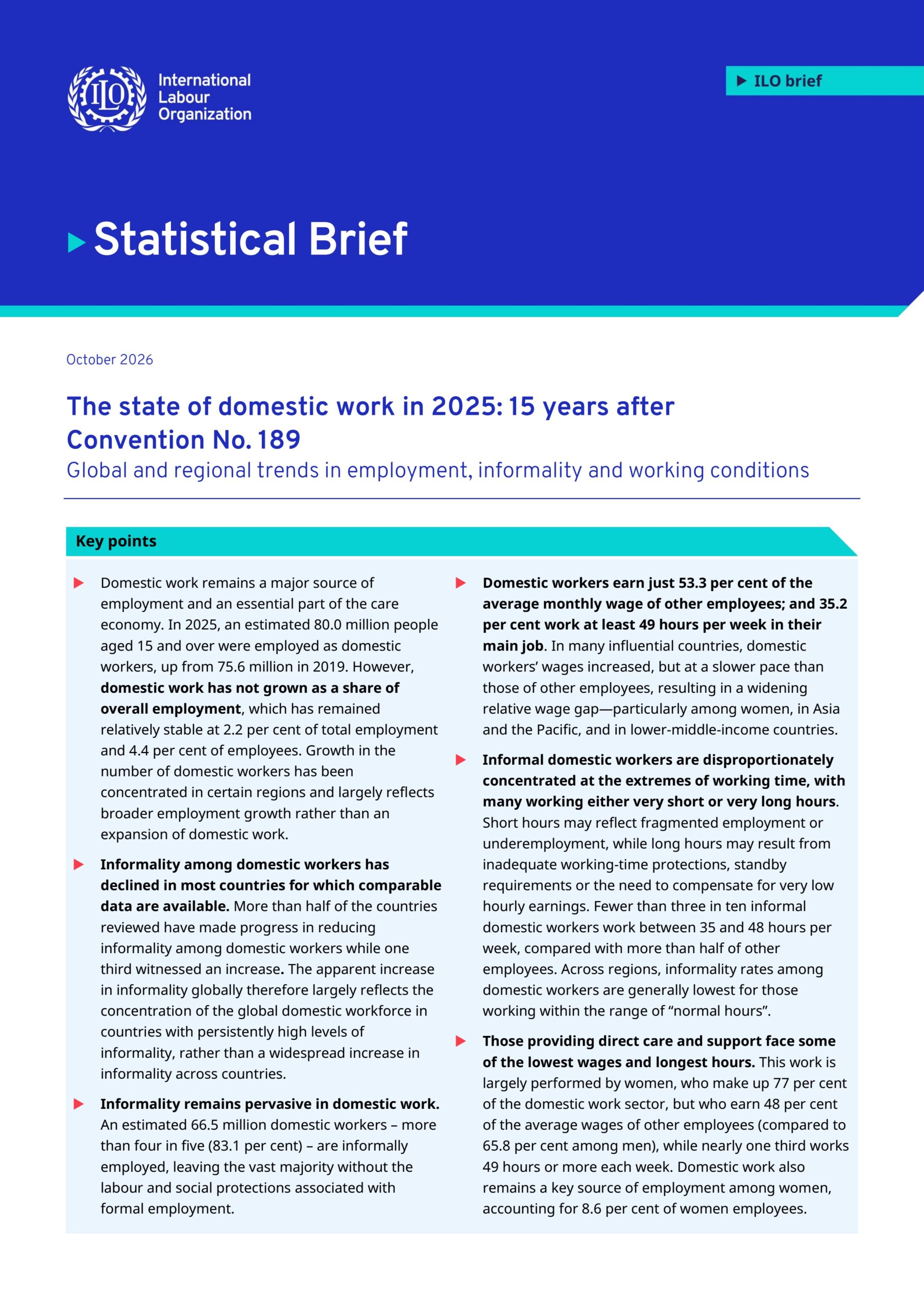
Domestic work remains a major source of employment and an essential part of the care economy. In 2025, an estimated 80.0 million people aged 15 and over were employed as domestic workers, up from 75.6 million in 2019. However, domestic work has not grown as a share of overall employment, remaining relatively stable at 2.2 per cent of total employment. Informality remains pervasive, with 83.1 per cent (66.5 million workers) informally employed. Domestic workers earn just 53.3 per cent of the average monthly wage of other employees, and 35.2 per cent work at least 49 hours per week in their main job.
Global overview
The global domestic workforce grew by 4.4 million between 2019 and 2025, an increase of 5.8 per cent. This growth was geographically concentrated; Africa recorded the largest increase, adding around 4.2 million domestic workers, followed by Asia and the Pacific with 1.9 million. Conversely, the number of domestic workers fell by 1.6 million in the Americas and by half a million in Europe and Central Asia. Asia and the Pacific continues to host the largest share of domestic work, with 40.2 million workers representing 50.2 per cent of the global total.
Size of the sector
The incidence of domestic work varies significantly by region. The Arab States record the highest incidence, where domestic workers represent 14.1 per cent of total employees. This compares with 7.7 per cent in Africa, 4.7 per cent in the Americas, 4.6 per cent in Asia and the Pacific, and 0.8 per cent in Europe and Central Asia. This growth largely reflects broader employment trends rather than a specific expansion of domestic work relative to other forms of employment.
A sector structured by gender
Domestic work continues to be strongly feminised, with women accounting for 61.8 million domestic workers and 77.2 per cent of the global total. In Latin America and the Caribbean, women represent 88.6 per cent of the workforce. The Arab States provide a notable exception, where men account for 60.6 per cent of the sector, reflecting the inclusion of roles such as drivers and gardeners. Globally, domestic work is a critical source of employment for women, accounting for 8.6 per cent of all female employees.
Informality has reduced in most countries, but remains pervasive
While informality has declined in more than half of the countries reviewed, the global rate rose to 83.1 per cent in 2025. This apparent increase reflects compositional effects, as the global workforce shifted toward countries where informality remains high. Informality is nearly universal in the Arab States and reaches 93.3 per cent in Africa. Europe and Central Asia has the lowest regional rate, yet more than one in three domestic workers there are still informally employed.
Wages and working time
Domestic workers earn just over half the average monthly wage of other employees. The global wage ratio fell from 56.4 in 2019 to 53.3 in 2025, indicating a widening relative wage gap. The gap is strongly gendered; women domestic workers earn 48.0 per cent of the average monthly wage of other employees, compared with 65.8 per cent among men. Informal domestic workers fare worst, with a global average wage standing at 48.7 per cent of other employees’ earnings.
A widening relative wage gap between 2019 and 2025 does not necessarily mean falling wages
In many countries, domestic workers’ nominal wages increased, but at a slower pace than those of other employees, causing them to fall further behind in relative terms. This was visible in several influential countries including India, the United States, and Mexico. Conversely, relative gains were recorded in parts of Africa and Europe where domestic worker wages grew faster than those of other employees.
Working time
Domestic workers are over-represented at the extremes of working time. Globally, 35.2 per cent work at least 49 hours per week, with the Arab States standing out at 72.1 per cent. Long hours often result from inadequate protections or the need to compensate for very low hourly earnings. Meanwhile, 30.9 per cent work fewer than 35 hours per week, which may reflect fragmented employment across multiple households or involuntary part-time work.
Age and education profiles
The workforce spans different stages of life, with 12.4 per cent aged 15–24 and 18.2 per cent aged 55 or over. Africa has the youngest profile, where nearly one third of domestic workers are aged 15–24. Regarding education, secondary education is the largest attainment category globally at 41.5 per cent. However, more than half have either no schooling (19.4 per cent) or only primary education (33.3 per cent). Lower educational attainment can constrain access to information and weaken bargaining power.
Domestic work in regions in 2025
Africa: In 2025, there are an estimated 13.8 million domestic workers. Informality is the region’s key challenge, affecting 93.3 per cent of workers. Approximately 31.9 per cent work at least 49 hours per week, while nearly half work fewer than 35 hours. Domestic workers receive just 37.3 per cent of the average monthly wage of other employees.
Americas: The region hosts 16.1 million domestic workers and is the most feminised (86.7 per cent women). In Latin America and the Caribbean, more than three out of four domestic workers are informally employed. Average monthly wages equal 45.8 per cent of those of other employees.
Arab States: This region has the world’s highest incidence of domestic work at 14.1 per cent of employees. It is the only region where men form the majority (60.6 per cent). Near-universal informality and exceptionally long hours are dominant features, with more than half working at least 60 hours per week.
Asia and the Pacific: Hosting 40.2 million domestic workers (half the global total), the region sees 85.4 per cent informality. Wages average 61.2 per cent of other employees’ earnings, and working time is heavily skewed towards long hours.
Europe and Central Asia: This is the smallest regional workforce (3.0 million). It has the lowest informality rate globally, though it still affects over one in three workers. It has the oldest profile, with 26.9 per cent aged 55 or over.
Turning recognition into decent work
The report underscores the need to extend effective labour and social protection, promote formalisation, and strengthen compliance with wage and working-time provisions. Recommendations include simplified registration procedures, written contracts in understandable languages, and labour inspections adapted to private households. Essential rights should not be made conditional on formal status. Recognising and developing skills in the sector can further support occupational mobility and fairer remuneration.




