

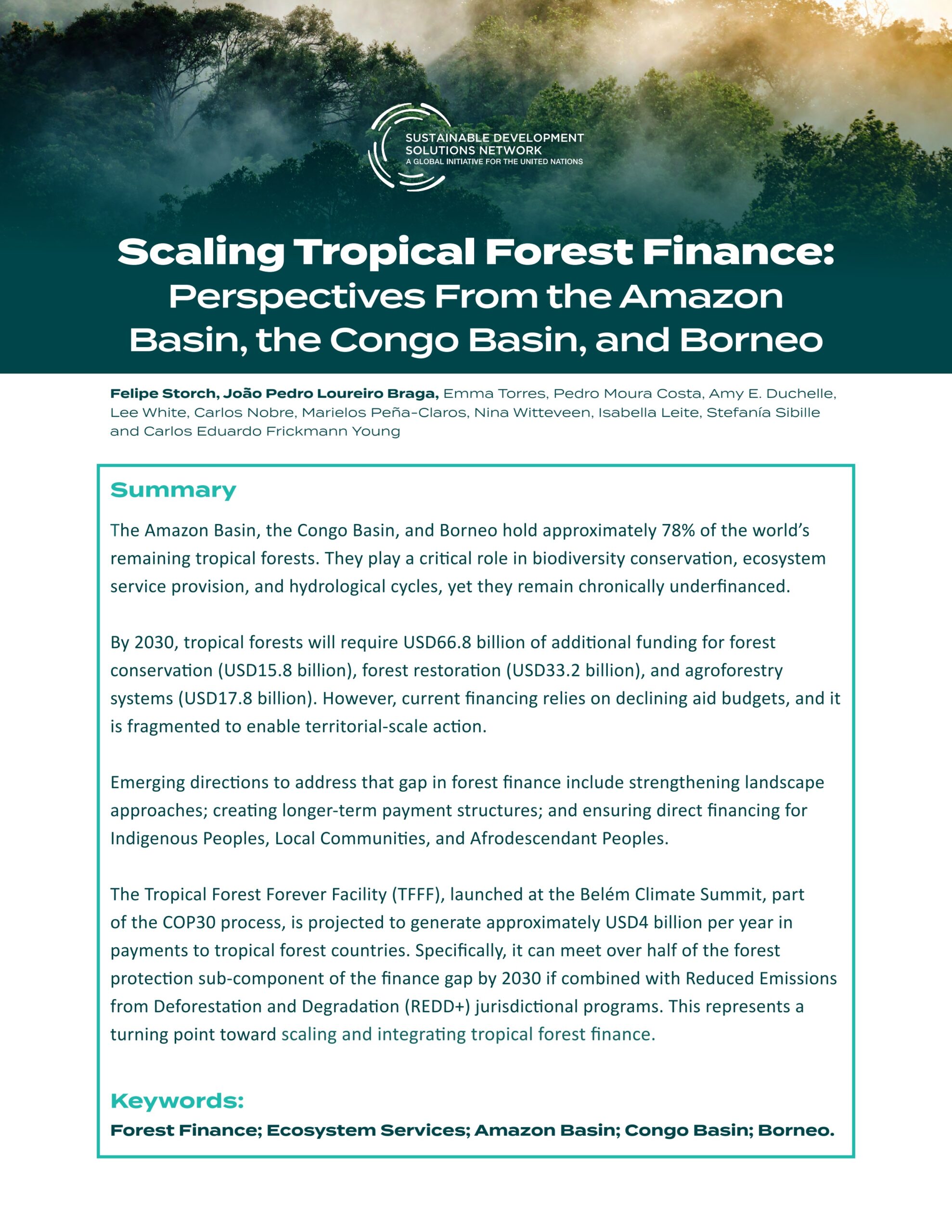
Scaling tropical forest finance: Perspectives from the Amazon Basin, the Congo Basin, and Borneo
This research identifies a USD66.8 billion annual gap in tropical forest finance by 2030. It evaluates the Tropical Forest Forever Facility as an innovative model for predictable payments for standing forests and recommends landscape-scale approaches and direct funding for Indigenous Peoples to secure biodiversity and climate stability.
Please login or join for free to read more.

OVERVIEW
Summary
The Amazon Basin, the Congo Basin, and Borneo together contain approximately 78% of the world’s remaining undisturbed tropical forests. These regions provide essential ecosystem services, including biodiversity conservation and hydrological regulation, yet they remain chronically underfinanced. By 2030, tropical forest regions will require an additional USD66.8 billion in annual funding, specifically USD15.8 billion for forest protection, USD33.2 billion for forest restoration, and USD17.8 billion for agroforestry systems. Current financing models, which rely on fragmented and declining aid budgets, are ill-equipped to address this gap.
Key messages
Tropical forests are vital biodiversity hotspots, containing over half of the world’s known species, including 62% of terrestrial vertebrate species and 72% of bird species. They sustain over 1 billion rural people living within 5 km of forest boundaries. The IPCC identifies Agriculture, Forestry, and Other Land Use (AFOLU) mitigation as a cost-effective solution, with potential net emission reductions of 3.5–3.6 GtCO2-eq per year achievable at costs below USD20 per tCO2-eq. Despite this, primary tropical forest loss reached a record 6.7 million hectares in 2024. Although ecosystem services are valued at USD1,837 to USD2,355 per hectare annually, current financial architecture fails to capture this value.
Recommendations for policymakers and the finance sector
The report outlines ten critical recommendations:
1. Prioritise funding for tropical regions as essential global infrastructure.
2. Support the Tropical Forest Forever Facility (TFFF) to unlock annual revenue.
3. Integrate ecosystem services valuation into institutional frameworks.
4. Prioritise direct and dedicated finance for Indigenous Peoples, Local Communities, and Afrodescendant Peoples.
5. Adopt replicable and scalable forest metrics.
6. Increase international climate finance specifically for tropical countries.
7. Redirect public subsidies, such as agricultural credit programmes, towards forest-positive activities.
8. Expand national public funding for biodiversity-based economic activities.
9. Prioritise blended finance frameworks to close the USD66.8 billion annual gap.
10. Explore variations of the TFFF model for other forest finance modalities.
Socioeconomic and ecological importance of tropical forests
Tropical forests regulate the global climate through carbon sequestration and moisture recycling. In the Amazon, evapotranspiration contributes up to 40% of monthly rainfall in some regions. The Congo Basin sequesters carbon at roughly six times the rate of the Amazon, while Borneo’s peat forests store carbon equivalent to decades of regional emissions. However, degraded areas may now function as net carbon sources, necessitating urgent intervention. Community forest governance is noted as a consistently positive factor for carbon and biodiversity outcomes.
Limits to traditional forest finance
Traditional forest finance is misaligned with actual needs. In 2023, global forest finance reached USD84 billion, but only 17% of public domestic spending (USD12.9 billion) was invested by tropical forest countries. Official development assistance (ODA) is projected to decline by 9% in 2025 and 15% in 2026. Furthermore, carbon markets have faced challenges regarding additionality, leakage, and permanence, leading to inconsistent demand and disappointing results.
Emerging directions in forest finance
New models are shifting from project-based interventions to territorial and landscape-scale approaches. There is a growing emphasis on direct financing for forest-reliant communities, who manage approximately 37% of the world’s remaining natural lands. The Shandia Principles for Direct Financing advocate for Indigenous-led decision-making and long-term stability. Currently, direct funding for tenure rights and guardianship stands at only USD270 million per year, which is far below identified requirements.
The case of the Tropical Forest Forever Facility (TFFF)
The TFFF is an innovative blended finance structure designed to mobilise USD125 billion. It uses USD25 billion in ‘sponsor capital’ from sovereign wealth funds to leverage USD100 billion in senior debt from capital markets. Eligible countries would receive approximately USD4 per hectare per year for maintained forest cover, while deforestation is penalised at 100 times that value (USD400/ha). At full capitalisation, the facility is projected to generate USD4 billion annually. The TFFF requires a 20% dedicated allocation of funds directly to Indigenous Peoples and Local Communities.
Conclusions: financial redirection strategies
The cost of climate inaction far exceeds the cost of integrated forest finance. Bridging the gap requires building on the momentum of Brazil’s COP30 presidency to unlock the potential of the TFFF. Success depends on reinforcing environmental enforcement, improving land-tenure security, and designing resilient financial mechanisms that can withstand political and market cycles to ensure the long-term preservation of tropical forests as critical global infrastructure.




