

IGF country profiles collection
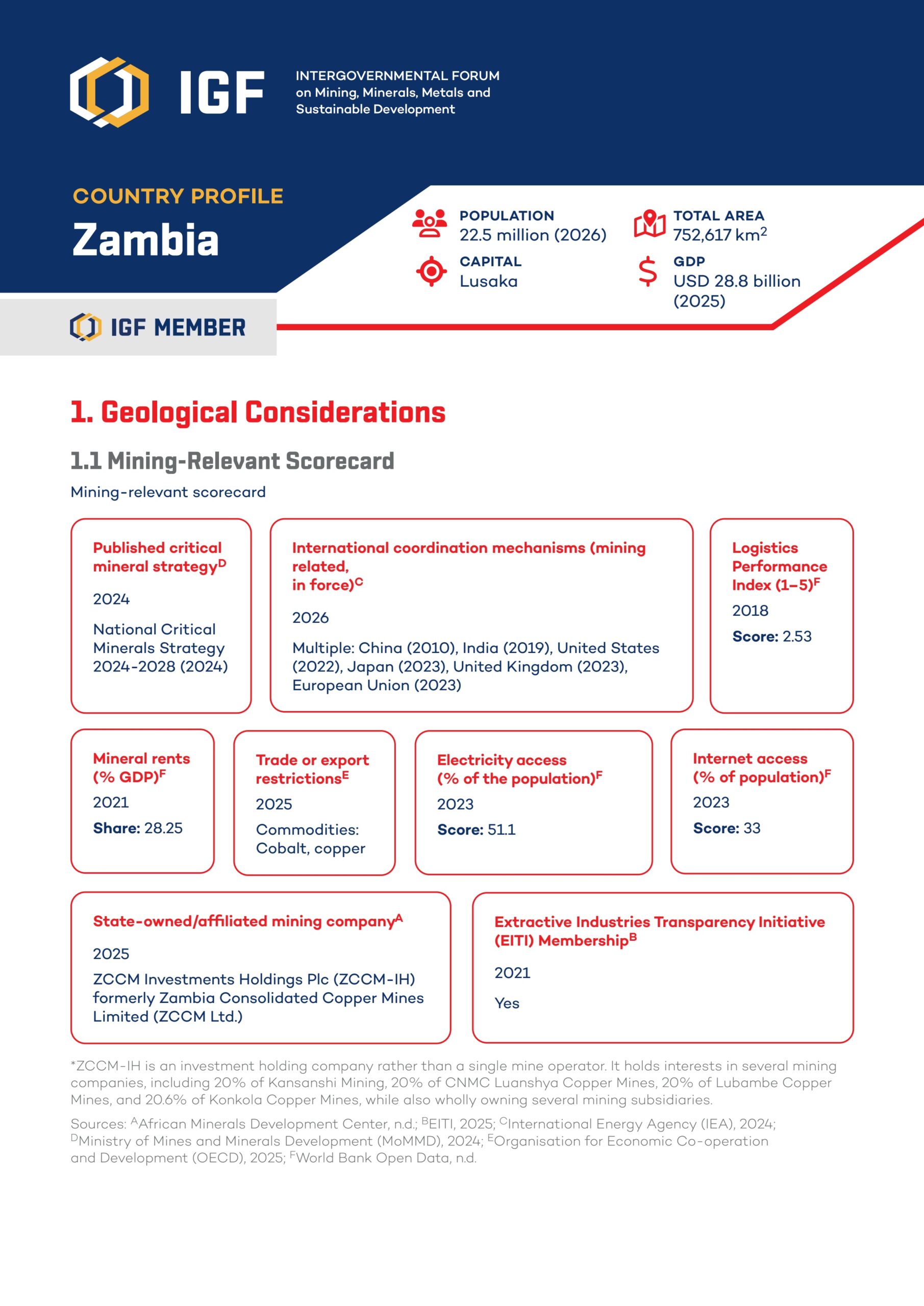
This country profile is part of a benchmark series providing a comprehensive overview of Zambia’s mining sector. It examines geological, industrial, economic, and environmental factors to evaluate the mining landscape. The report offers structured data on mineral reserves, infrastructure, and regulatory frameworks for the extractive industries.
Please login or join for free to read more.

OVERVIEW
Overview
Produced by the Intergovernmental Forum on Mining, Minerals, Metals and Sustainable Development (IGF), this report is a comprehensive country profile of Zambia’s mining sector. It provides a detailed snapshot of the nation’s extractive landscape, focusing on key commodities such as copper, cobalt, manganese, and gold. The report is structured into four primary sections: geological considerations, industrial infrastructure, economic contributions, and environmental, social, and governance (ESG) factors. It covers essential datasets including mineral reserves, operational mining projects, and the regulatory environment, alongside infrastructure maps that detail transmission lines, railroads, and roads.
Purpose
The profile exists to provide a centralised and structured repository of data regarding Zambia’s extractive industry to inform strategic decision-making. It is designed to assist stakeholders in assessing Zambia’s role in global critical mineral supply chains, particularly the Zambia–DRC Battery Value Chain Initiative. The report aims to highlight investment opportunities in mining and related infrastructure, such as the rehabilitation of the Tanzania–Zambia Railway Authority and the development of the Lobito Corridor. By providing transparent data on mineral royalties, trade restrictions, and exploration budgets, it seeks to facilitate informed policy development and private sector investment.
Methodology
The analysis is conducted using a multi-pillar assessment framework that incorporates a wide variety of data sources and indicators. Geological assessments are based on data from the Ministry of Mines and Minerals Development (MoMMD) and the U.S. Geological Survey. The report utilises a Mining-Relevant Scorecard and an Environmental Scorecard to track progress across several years. Industrial and economic analysis draws from the World Bank’s Logistics Performance Index, the International Energy Agency’s energy mix data, and the Extractive Industries Transparency Initiative (EITI) membership status. Financial projections and project-specific data, such as net present value (NPV) and production forecasts for 2025 and 2026, are sourced from S&P Global Market Intelligence and BloombergNEF.
Use for finance professionals
Finance professionals can use this profile to conduct comprehensive due diligence and risk assessments for mining and infrastructure investments in Zambia. The report provides specific NPV figures for major development projects, such as the Kansanshi and Konkola mines, which are crucial for project valuation and financial modelling. Analysts can evaluate the impact of trade policies, such as the 5% import duty on concentrates and the varying mineral royalty rates, on operational profitability. Furthermore, the ESG scorecard and social data, including workforce diversity and Gini coefficient rankings, allow investors to assess reputational risks and align their strategies with international sustainability standards. The detailed energy mix data also enables an assessment of transition risks related to the sector’s reliance on hydropower versus coal-generated power.




