Overview
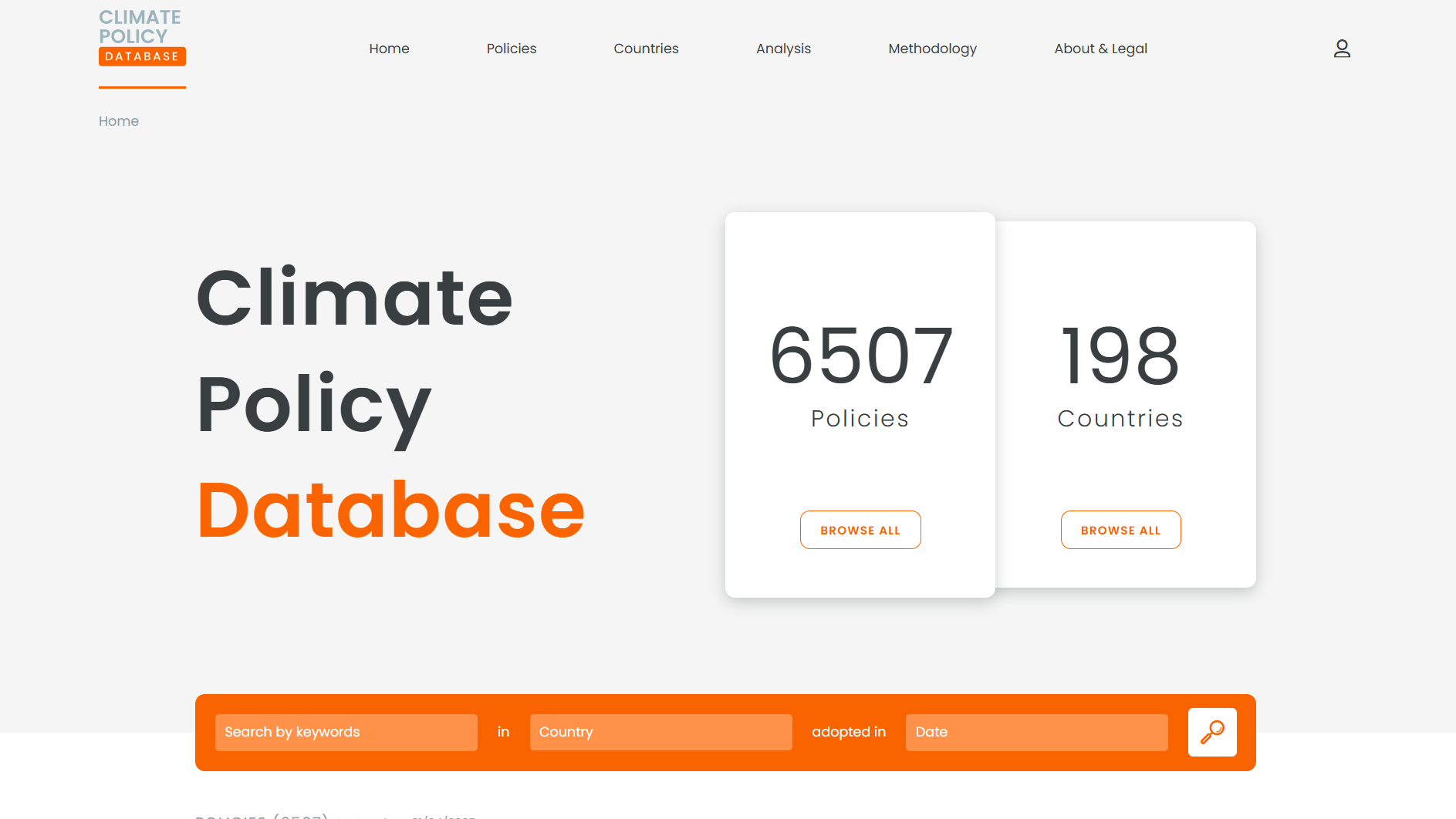
The Climate Policy Database (CPDB) is an open, collaborative database cataloguing national climate-change mitigation policies globally. It aims to compile and maintain up-to-date records of laws, strategies, targets and other policy instruments that reduce greenhouse-gas emissions. Finance professionals may find it useful for assessing regulatory and transition risks, tracking policy landscapes across jurisdictions and informing ESG or climate-risk analysis.
Organisation behind the tool
The CPDB is developed and maintained by the NewClimate Institute, with support from Wageningen University & Research (WUR) and PBL Netherlands Environmental Assessment Agency. The project is funded by European Commission programmes (e.g. H2020 ELEVATE, ENGAGE, CD-Links).
What the tool does
Provides a comprehensive catalogue of climate-mitigation policies worldwide. Policies include laws, strategic documents, targets or other instruments that influence emissions intensity. Classifies policies by sector (e.g. energy supply, transport, industry, buildings, agriculture & forestry), policy instrument type (e.g. economic instruments, regulatory instruments, standards, voluntary measures) and mitigation area (e.g. energy efficiency, renewables, low-carbon technology deployment, non-energy emissions). Tracks the implementation status of policies (planned, in force, amended, terminated). Enables users to browse, filter and download policy data. Data is available via the website or API. Offers analytical tools to assess policy-coverage gaps, compare adoption across countries (e.g. G20), and evaluate the evolution of policy adoption over time.
Target audience
Primary: policy analysts, researchers, economists working on climate and environmental policy, mitigation strategies and comparative policy analysis. Secondary: academics, sustainability professionals, investors and other stakeholders requiring insight into national climate policy frameworks or evaluating regulatory risk exposure across jurisdictions.
Relevance to finance professionals
- Regulatory & transition-risk assessment — Helps identify where countries have adopted (or lacked) mitigation policies, aiding assessment of future regulatory risks for sectors such as energy, utilities, transport, industry or agriculture.
- ESG analysis & reporting — Policy data can feed into environmental metrics for corporate portfolios, helping to benchmark climate-policy alignment across regions.
- Market and commodity insight — Offers insight on national shifts in energy, infrastructure, agriculture and land-use policies that could affect commodity markets, energy demand, renewables investment or resource-intensive industries.
- Investment context & scenario analysis — Long-term policy trends and coverage gaps may inform investment decisions, especially for assets exposed to decarbonisation, carbon pricing, or regulatory transition.