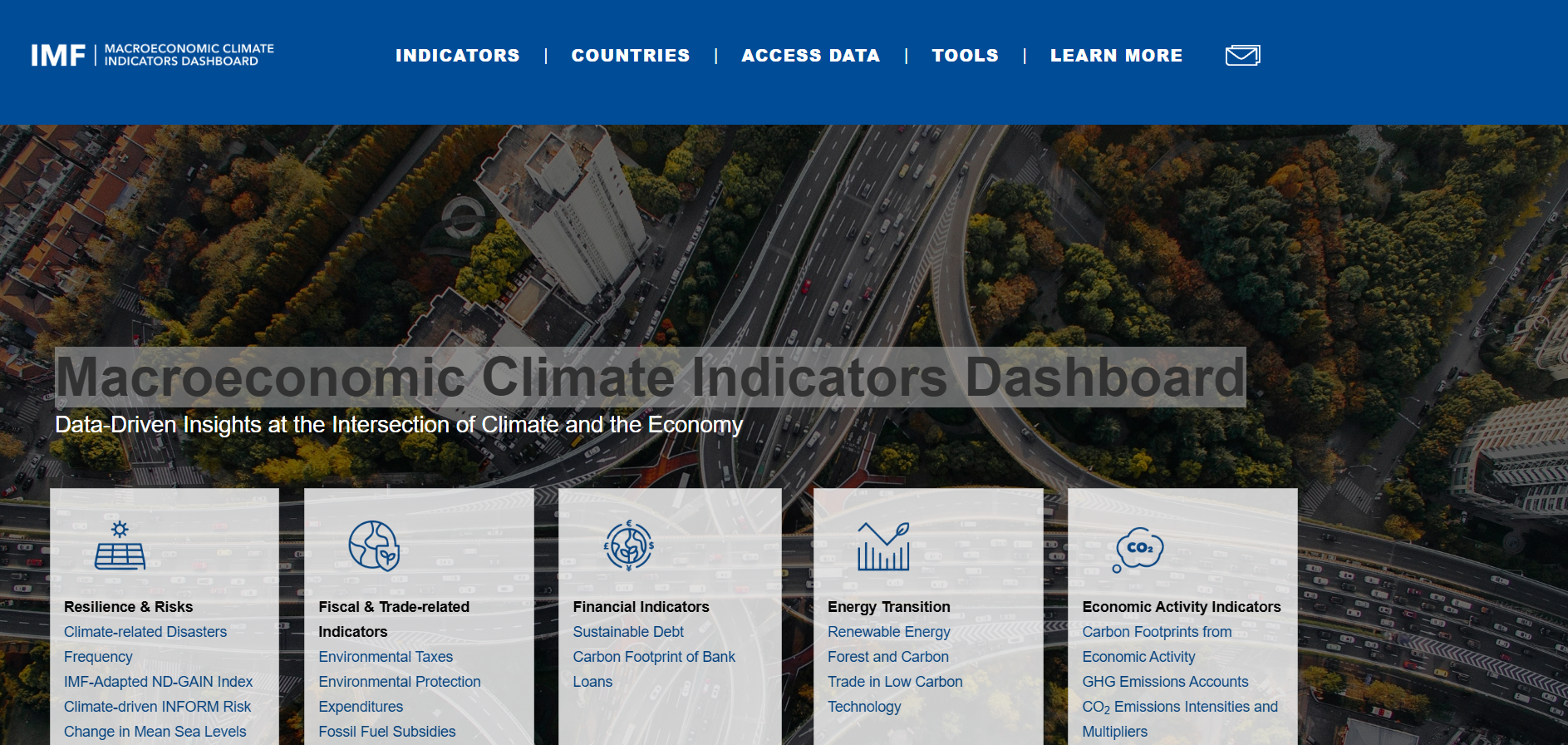
Overview
The IMF Climate Data Portal and the World Bank–IMF Climate Economics and Finance Data Guide are complementary online tools supporting analysis at the intersection of climate change and economics. Together, they provide access to climate-relevant macroeconomic indicators and guidance on authoritative datasets. Finance professionals may use them to inform risk analysis, policy assessment, and long-term investment context.
Organisation behind the tool
The IMF Climate Data Portal is developed and maintained by the International Monetary Fund as part of its work on climate-related macro-financial surveillance and policy analysis.
What the tool does
IMF Climate Data Portal
- Provides country-level climate and macro-financial indicators.
- Covers emissions, climate risks, mitigation, adaptation, and climate finance.
- Enables comparison across countries and time.
- Allows users to view dashboards and download standardised datasets.
Target audience
- Economists and finance professionals.
- Policymakers and public sector analysts.
- Researchers and academics working on climate and development.
- Analysts seeking authoritative climate-economics data sources.
Relevance to finance professionals
Risk assessment
- Country exposure to climate hazards and macroeconomic vulnerabilities.
- Context for sovereign and systemic risk analysis.
ESG analysis
- Environmental indicators relevant to climate-related disclosures.
- Inputs for climate-focused ESG and sustainability assessments.
Market and sector context
- Data relevant to energy transition, emissions trends, and climate finance.
- Supporting analysis of sectors sensitive to climate policy or physical risk.
Investment context
- Long-term climate and economic trends at national and global levels.
- Background data for strategic allocation, scenario analysis, and policy-driven investment decisions.