Overview
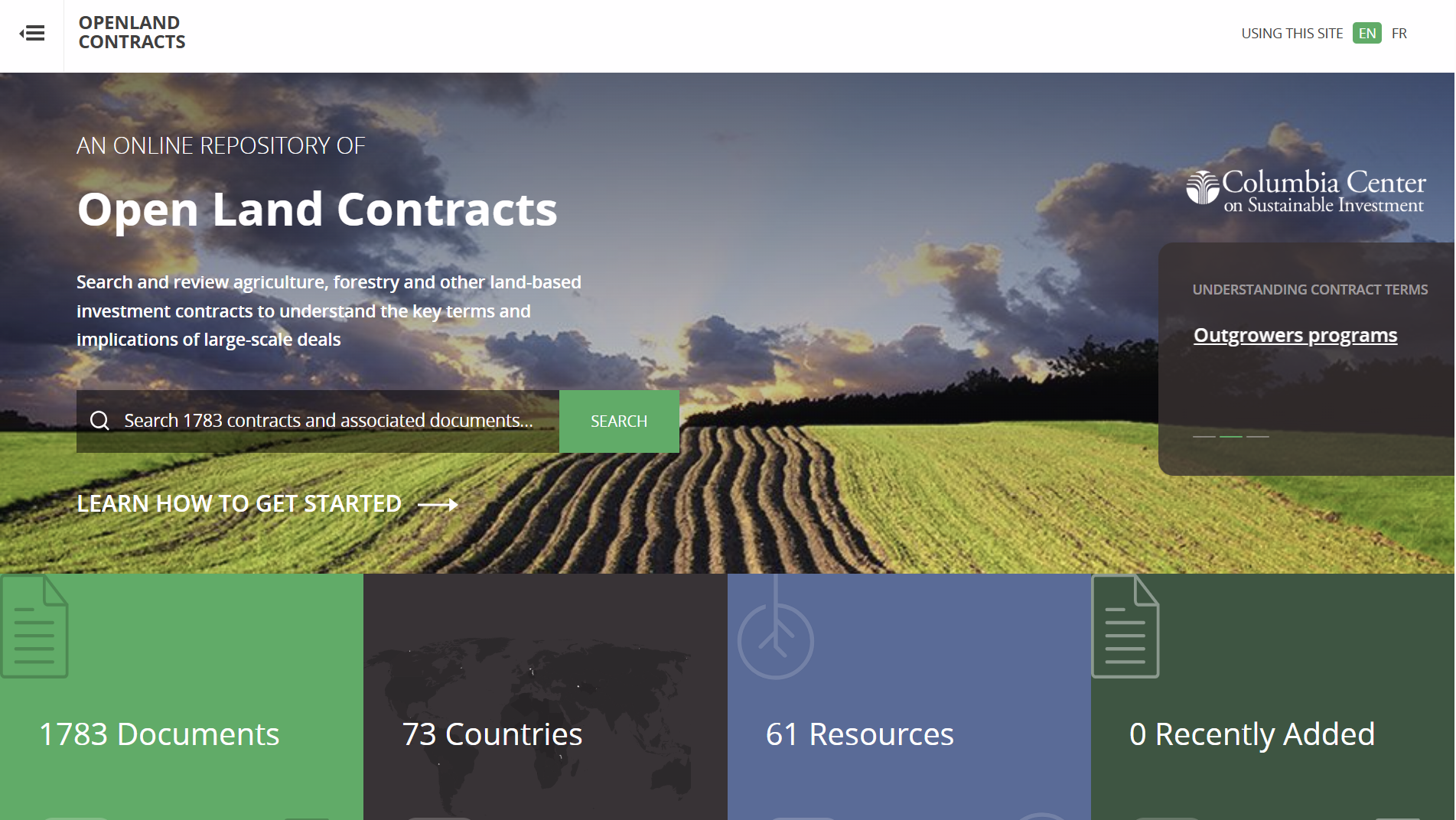
OpenLandContracts is an online database that provides public access to contracts governing large-scale land-based investments. Its main purpose is to improve transparency around land, agriculture, forestry, and renewable energy deals by publishing contract texts and structured summaries. Finance professionals may find it relevant for assessing legal, social, and environmental risks linked to land-intensive investments.
Organisation behind the tool
The tool is developed and maintained by the Columbia Center on Sustainable Investment (CCSI), a joint centre of Columbia Law School and Columbia Climate School. It forms part of CCSI’s broader work on investment governance, contract transparency, and sustainable development, with contributions from legal and policy experts.
What the tool does
OpenLandContracts provides access to publicly disclosed contracts and related documents for land-based investments. Key functions include:
- A searchable database of contracts covering agriculture, forestry, mining, and renewable energy projects
- Full contract texts alongside structured summaries highlighting key clauses
- Thematic tagging of provisions, including land rights, environmental protection, fiscal terms, labour, and community obligations
- Downloadable documents for independent review and analysis
- Comparative views that allow users to examine how similar issues are addressed across contracts and countries
Target audience
The primary audience includes researchers, civil society organisations, and policymakers working on land governance and investment transparency. It is also relevant to finance professionals, legal practitioners, development institutions, and academics. The platform is publicly accessible and can be used by the general public.
Relevance to finance professionals
For finance professionals, the tool can support due diligence and contextual analysis in land-intensive sectors, including:
- Risk assessment – identification of legal, social, and environmental obligations that may affect project viability, community relations, or long-term returns
- ESG analysis – insight into how environmental safeguards, labour standards, and community rights are contractually addressed
- Market and asset context – understanding governance practices in agriculture, forestry, and renewable energy investments across jurisdictions
- Investment decision-making – evaluation of contractual frameworks that influence stability, compliance costs, and reputational exposure over the life of an investment
The database is most relevant as a qualitative reference tool rather than a source of quantitative financial data.