
Library | Location
Global
Refine
1146 results
REFINE
SHOW: 16


Rethinking food and agriculture 2020-2030: The second domestication of plants and animals, the disruption of the cow, and the collapse of industrial livestock farming
Rethinking food and agriculture focuses on new technologies driving the transformation of the food and agriculture sectors and the implications for the cattle industry in the United States. It argues that 2020-2030 will see the current industrialised, animal-agriculture system be replaced with a Food-as-Software model.

Internal Displacement Monitoring Centre
The Internal Displacement Monitoring Centre provides high-quality data, analysis and expertise on internal displacement. Their objective is to advise on policy and operational decisions that can improve the quality of life for internally displaced people and reduce the risk of future displacement worldwide.

Pensions in a changing climate
A critical review and gap analysis of the pension industry’s positioning in regard to the recommendations from the Task Force on Climate-related Disclosures. The review includes a rating index of the world’s 100 largest public pension funds with rankings linked to both their approach and engagement.
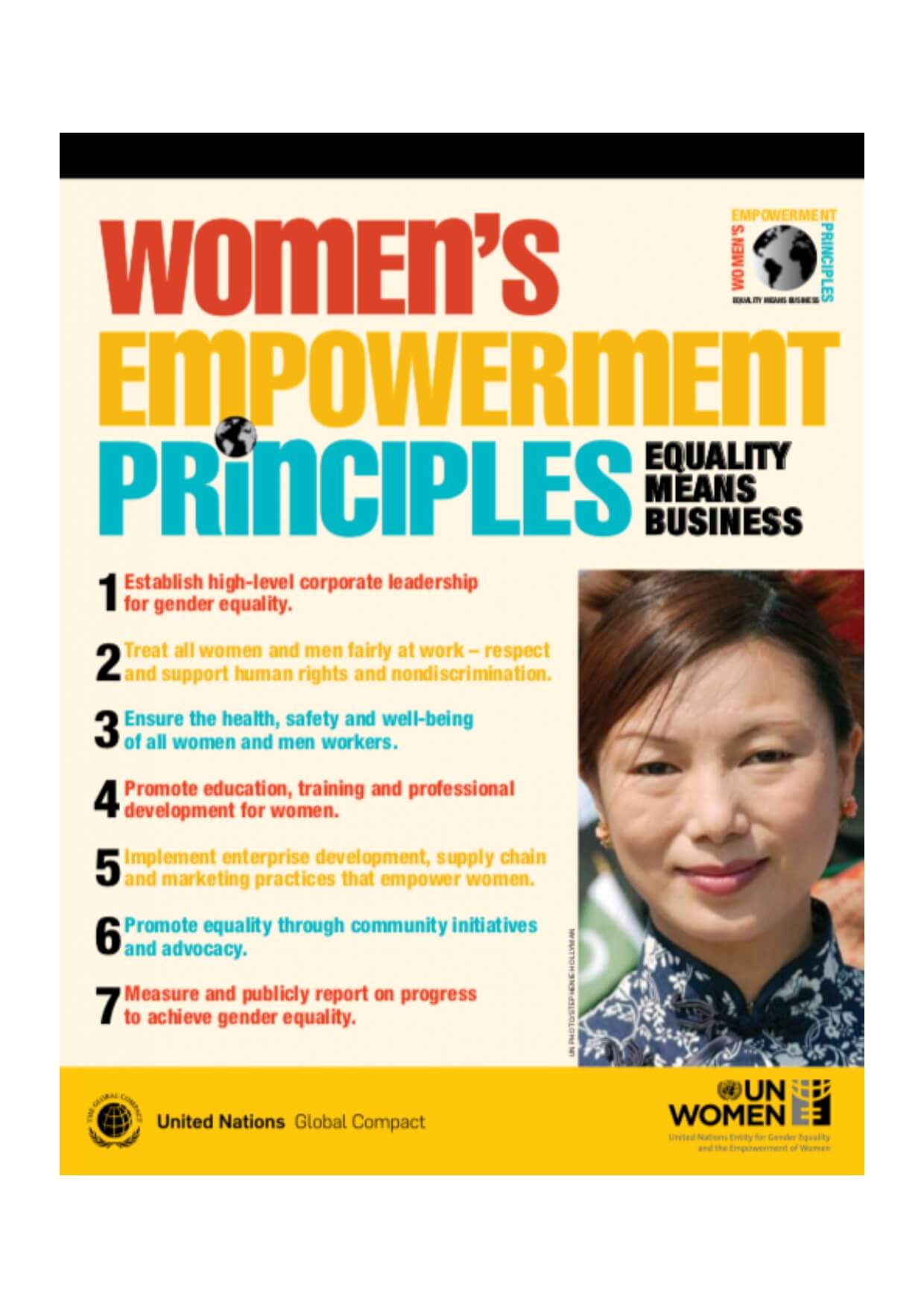
Women's empowerment principles: Equality means business
The UN Women and United Nations Global Compact's collaboration provides a framework of principles for businesses to integrate gender equality in the workplace, marketplace and community. The report highlights that women's empowerment will have a positive effect on business success and society.

UN Women: United Nations Entity for Gender Equality and the Empowerment of Women
UN Women are an entity established by the United Nations to address issues pertaining to female gender inequalities. The entity is responsible for promoting women's empowerment and gender equality and was founded to accelerate progress to meet the needs of women and girls worldwide.

Final report: Recommendations of the Task Force on Climate-related Financial Disclosures
This report contains the final recommendations of the Task Force on Climate-related Financial Disclosures. It includes information on climate-related risks and opportunities, scenario analysis, and guidance to support organisations from all sectors to make climate-related financial disclosures consistent with these recommendations.
TCFD good practice handbook
This Task Force on Climate-related Financial Disclosures (TCFD) handbook provides examples of good practice climate-related financial disclosures across the four core TCFD elements of governance, strategy, risk management, metrics and targets from corporates across the G20.

Sustainability Accounting Standards Board (SASB)
SASB is now part of IFRS. This profile and the respective publications are maintained for historical purposes. Updated resources are collected under IFRS.
The Sustainability Accounting Standards Board (SASB) connects businesses and investors on the financial impacts of sustainability. An independent non-profit, SASB develops reporting standards that enable businesses around the world to identify, manage and communicate financially-material, sustainability information to investors.
The Sustainability Accounting Standards Board (SASB) connects businesses and investors on the financial impacts of sustainability. An independent non-profit, SASB develops reporting standards that enable businesses around the world to identify, manage and communicate financially-material, sustainability information to investors.

States of the apes: The impact of infrastructure development on biodiversity
The impact of infrastructure projects on biodiversity are examined, using apes to illustrate how investors can contribute to biodiversity protection. A sustainable approach to infrastructure development, which mitigates environmental, financial and reputational risks of investment, is presented.

Arcus Foundation
Arcus Foundation is a charitable foundation for causes related to great ape conservation and LGBTQ rights and social justice. They partner with experts and advocates for change to ensure that LGBTQ people and apes thrive in a world where social and environmental justice are a reality.

Task Force on Climate-related Financial Disclosures (TCFD)
TCFD is now part of IFRS. This profile and the respective publications are maintained for historical purposes. Updated resources are collected under IFRS.
The Financial Stability Board (FSB) established the Task Force on Climate-related Financial Disclosures to develop recommendations for more effective disclosures. The recommendations aim to promote more informed investment, credit and insurance underwriting decisions to enable stakeholders to better understand carbon-related assets and the financial system’s exposures to climate-related risks.
The Financial Stability Board (FSB) established the Task Force on Climate-related Financial Disclosures to develop recommendations for more effective disclosures. The recommendations aim to promote more informed investment, credit and insurance underwriting decisions to enable stakeholders to better understand carbon-related assets and the financial system’s exposures to climate-related risks.
Sustainability, well-being, and economic growth
Substantial reductions in economic growth for environmental and social sustainability may be unnecessary. Policies and market signals are required to conserve natural resources, equally distribute wealth and mitigate the impacts of climate change. It is argued that environmental and social goals are of greater importance in meeting the needs of society than economic development.
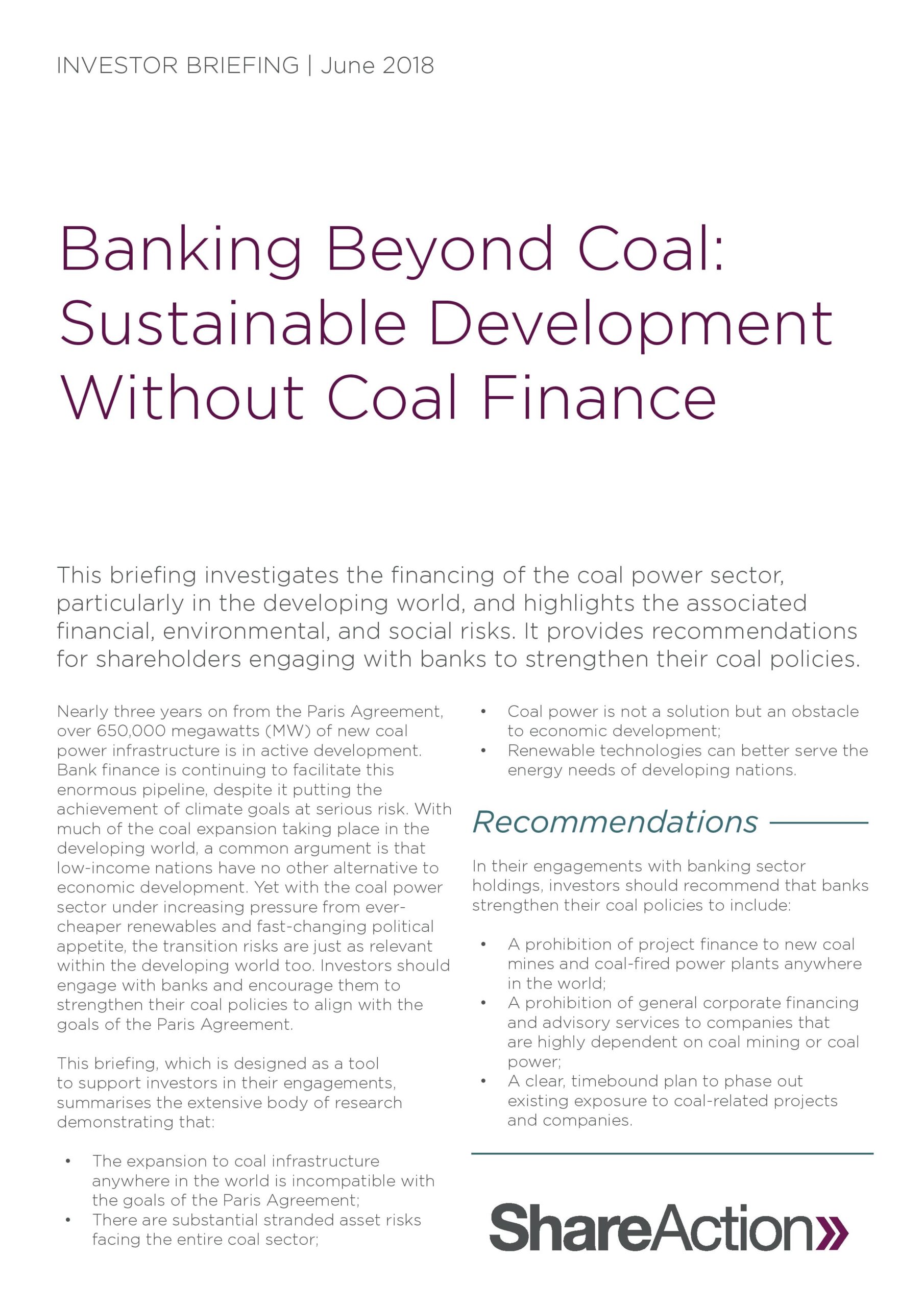
Banking beyond coal: Sustainable development without coal finance
This investor briefing investigates the financing of the coal power industry. Highlighting that bank financing continues to facilitate active development of coal power infrastructure, particularly in developing nations, which is incompatible with the Paris Agreement. Additionally, it provides a call to action for investors to engage with their banks to strengthen coal divestment policies.
Guiding principles on business and human rights: Implementing the United Nations protect, respect and remedy framework
The United Nations Guiding Principles on Business and Human Rights is a report that implements the United Nations ‘Protect, Respect and Remedy’ framework, regarding the obligations of states and responsibilities of business to ensure that human rights are protected and respected throughout all business operations and ultimately remedied when breached.
The ambition loop: How business and government can advance policies that fast track zero-carbon economic growth
This report highlights how building on business leadership and strong national policy measures spur additional investment and action on businesses, accelerating the transition to a prosperous zero carbon economy. This requires an "ambition loop" - a positive feedback loop between business leadership and government policies.
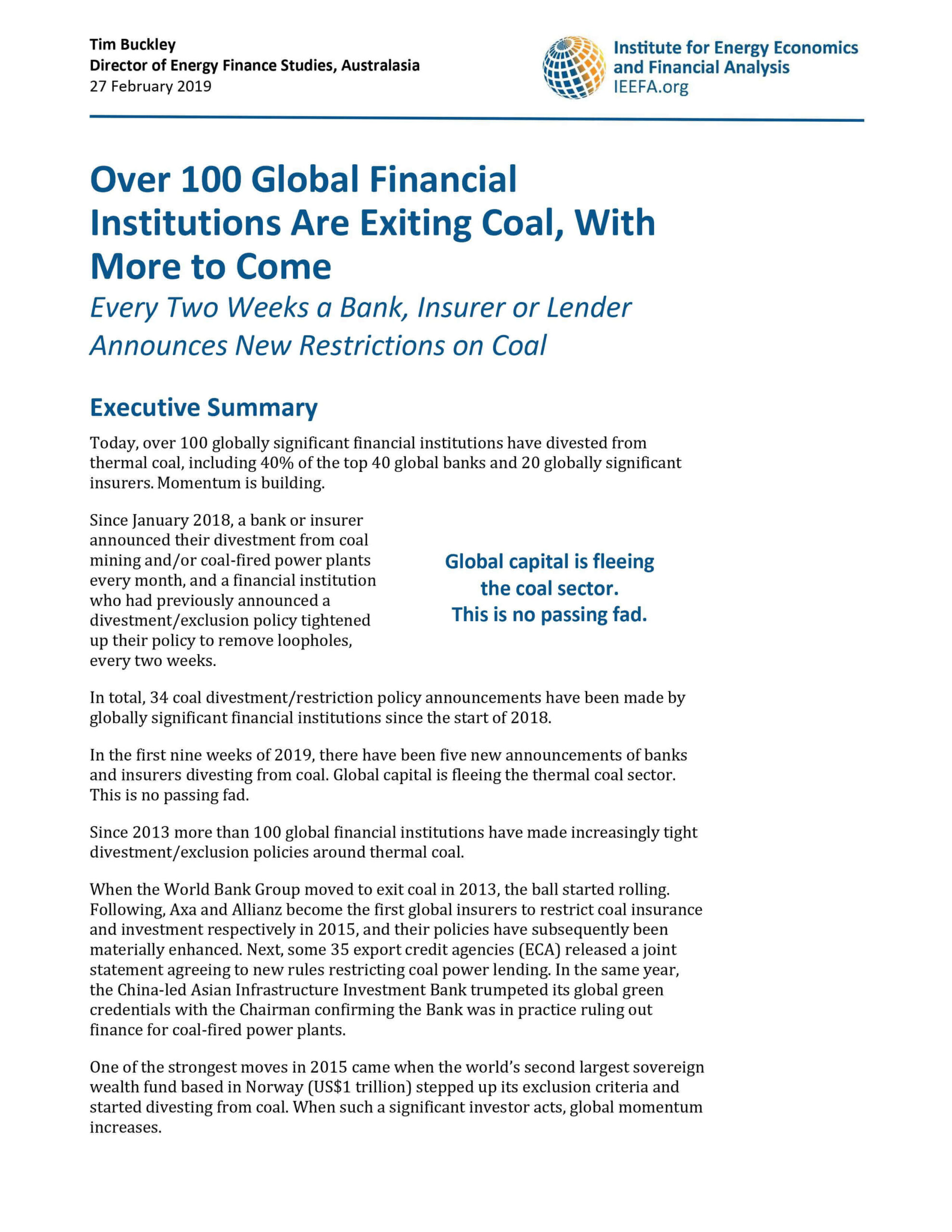
Over 100 global financial institutions are exiting coal, with more to come
This report published by IEEFA highlights the fact that over a hundred globally significant financial institutions are divesting from coal projects. It mentions that these major financial institutions, including commercial banks, insurance companies, pension funds, asset management companies, and development finance institutions, are building up the momentum against coal projects.


