
Library | Location
United States
Refine
611 results
REFINE
SHOW: 16


Environmental risk analysis by financial institutions: A review of global practice
This report examines how financial institutions tackle environmental risk, with an emphasis on credit and market risks. The study highlights examples of successful risk mitigation and draws attention to gaps in practice, particularly around modelling approaches and short-term decision-making.

Delivering through diversity
This report shows that strong financial performance correlates with greater representation of women and ethnically/culturally diverse individuals in the leadership of large companies. Companies that invest in inclusion and diversity not only align with social justice but may also achieve competitive advantage and growth.

FERC's failure to analyze energy market forces: Risks to ratepayers, landowners and the overall economy
This report shows the Federal Energy Regulatory Commission (FERC) is failing to analyse vital energy market forces that should underpin assessment of new interstate gas pipelines. The research shows FERC’s decisions regarding these pipelines can impose unjustified costs on captive customers in the form of expensive and long-term contracts, and harm landowners and the wider economy.
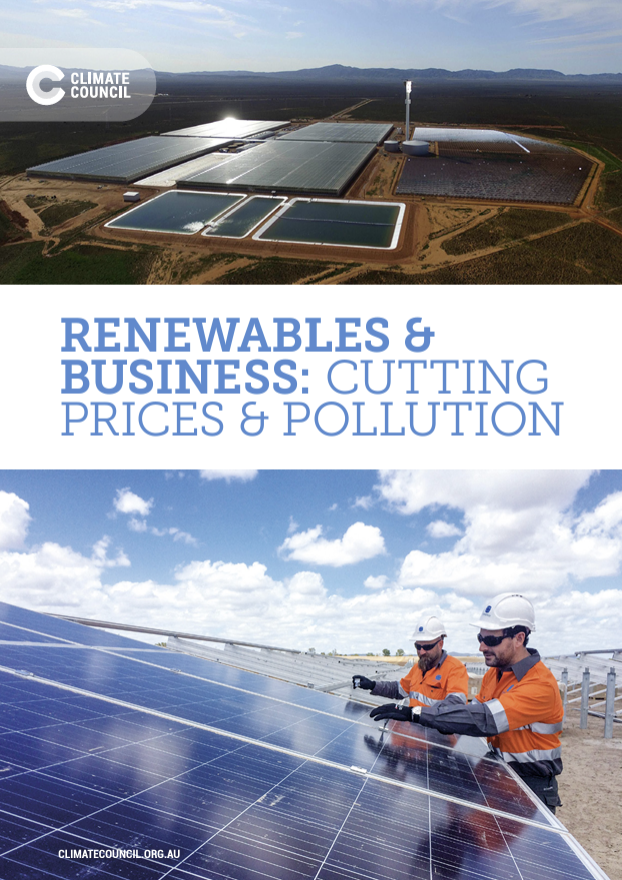
Renewables and business: Cutting prices and pollution
This report shows how investment in renewable energy can reduce exposure to volatile electricity prices and future price hikes. Over 46,000 businesses have already invested in large solar installations, and 40% of businesses are considering similar initiatives. Local and State Governments are also supporting business investment in clean, affordable and reliable renewable energy.

Growth-positive zero-emission pathways to 2050
This paper presents pathways to achieving growth positive zero-emission targets by 2050. The report concludes that significant action is required globally to achieve the low-carbon transition required to limit temperature increases to 1.5 °C, including the refashioning of multiple fundamental socio-economic systems and the international co-operation of decision-makers.

Making global goals local business: A new era for responsible business
This report highlights the need for private sector involvement in achieving the Sustainable Development Goals (SDGs) of the 2030 Agenda. It showcases the progress made so far by various companies and organisations and the role they play in building a better world through responsible business practices.

Acute climate risks in the financial system: Examining the utility of climate model projections
This research examines the effectiveness of global mean temperature projections as a tool for identifying acute climate risks to the financial sector. The study highlights the limitations of current 'top-down' approaches and recommends the use of more granular 'bottom-up' methods to more accurately estimate regional-level financial risks.

Guidance and case studies for ESG integration: Equities and fixed income
The CFA Institute and Principles for Responsible Investment commissioned a survey on ESG integration, revealing that 56% of investors integrate governance into their equity analysis. Analysts may engage in ESG in fixed-income analysis to evaluate the risks and value of assets. ESG issues help investors arrive at estimates of fair stock value.

Climate scenario analysis: Cement's financial performance under 2°c and 2.7°c
The report examines the financial implications of climate transition scenarios on the cement sector's future. It provides useful insights to company analysis and financial risk analysis for the cement sector, providing readers with a comprehensive understanding of the impact of climate transition scenarios.

Leaders or laggards? Tax and revenue transparency of ASX listed mining, gas and oil companies
This report investigates the tax and revenue transparency disclosure policies of 20 ASX listed mining, gas and oil companies. It examines indicators deemed as "best practices" for conformity to standards, such as country-by-country reporting, mandatory disclosure legislation and The Extractive Industries Transparency Initiative. Recommendations are to move towards mandatory regulation and better disclosure.

The role of local narratives in emerging climate governance
This report examines how local climate narratives are shaped by the history, power dynamics, needs, and priorities of a region. The report analyses the case of Miami-Dade County, Florida, an early adopter of climate policies that faces inequity and worsening climate impacts, to understand how local narratives influence climate governance.

Retiring oil and gas assets will have long-term financial and environmental impacts
Ageing oil and gas assets will have significant long-term financial and environmental impacts, with decommissioning costs rising steadily in coming decades. Asset retirement obligations could reach US$42 billion by 2024, posing considerable financial, logistical, and environmental challenges given limited financial assurance requirements, regulatory loopholes, and the complexity of decommissioning.

The implications of behavioural science for effective climate policy
This report explores the implications of behavioural science for effective climate policy and focuses on eight main sectors, such as diet change, adaptation and aviation, with recommendations for further empirical research. The report underscores the importance of understanding human behaviour and how insights can be used in climate policy development for effective implementation.

Education - learning for Life: Why enterprise L&D is the next frontier In global education
This report examines the growing importance of Learning & Development (L&D) programmes for businesses. It highlights the increasing recognition of L&D as a strategic investment, particularly for upskilling and reskilling employees to address the skills gap. The report also explores the challenges in L&D implementation, such as low employee engagement and vendor satisfaction, and offers insights into the future of corporate L&D, including trends in digitalisation and budget growth.

Toward ESG alpha: Analyzing ESG exposures through a factor lens
This paper investigates the relationship between environmental, social and governance (ESG) exposures and factor returns for 1,312 US equity mutual funds. The study suggests that factor tilts, rather than pure ESG considerations, drive factor returns. ESG components unrelated to factors carry insignificant excess return premiums that are economically small.

A toolbox of sustainable crisis response measures for central banks and supervisors – second edition: Lessons from practice
This report is a toolbox of options for central banks and supervisors to align crisis response measures with climate and sustainability objectives. The second edition includes an extended analysis of sustainability-linked measures. It also highlights the importance of moving from voluntary to mandatory environmental reporting and recommends efficient disclosure to regulated financial institutions.


