
Library | Location
United States
Refine
680 results
REFINE
SHOW: 16


Unused tools: How central banks are fueling the climate crisis
This report dissects the role of central banks in fossil fuel finance and climate change, presenting 10 criteria for assessment and analysing 12 central banks worldwide. While there is increased recognition among global central banks of the severity of climate change, they continue to prop up fossil fuels and largely maintain an industrial structure that uncritically exacerbates the climate crisis.

Do socially responsible firms walk the talk?
This study evaluates U.S. firms that signed the Business Roundtable's stakeholder capitalism pledge. Despite claims of social responsibility, signatories performed worse on environmental, labor, and governance metrics than peers, both before and after signing. The results suggest these public commitments lacked substance and may have been strategic signaling.

Transition risk framework: Managing the impacts of the low carbon transition on infrastructure investments
This report introduces a transition risk framework aiding investors and regulators in navigating risks and seizing opportunities in the low-carbon transition. It enhances comprehension of how transition risks impact financial performance in infrastructure investments, offering a transparent, adaptable, and robust methodology for assessing the financial implications of a shift towards a low-carbon economy.
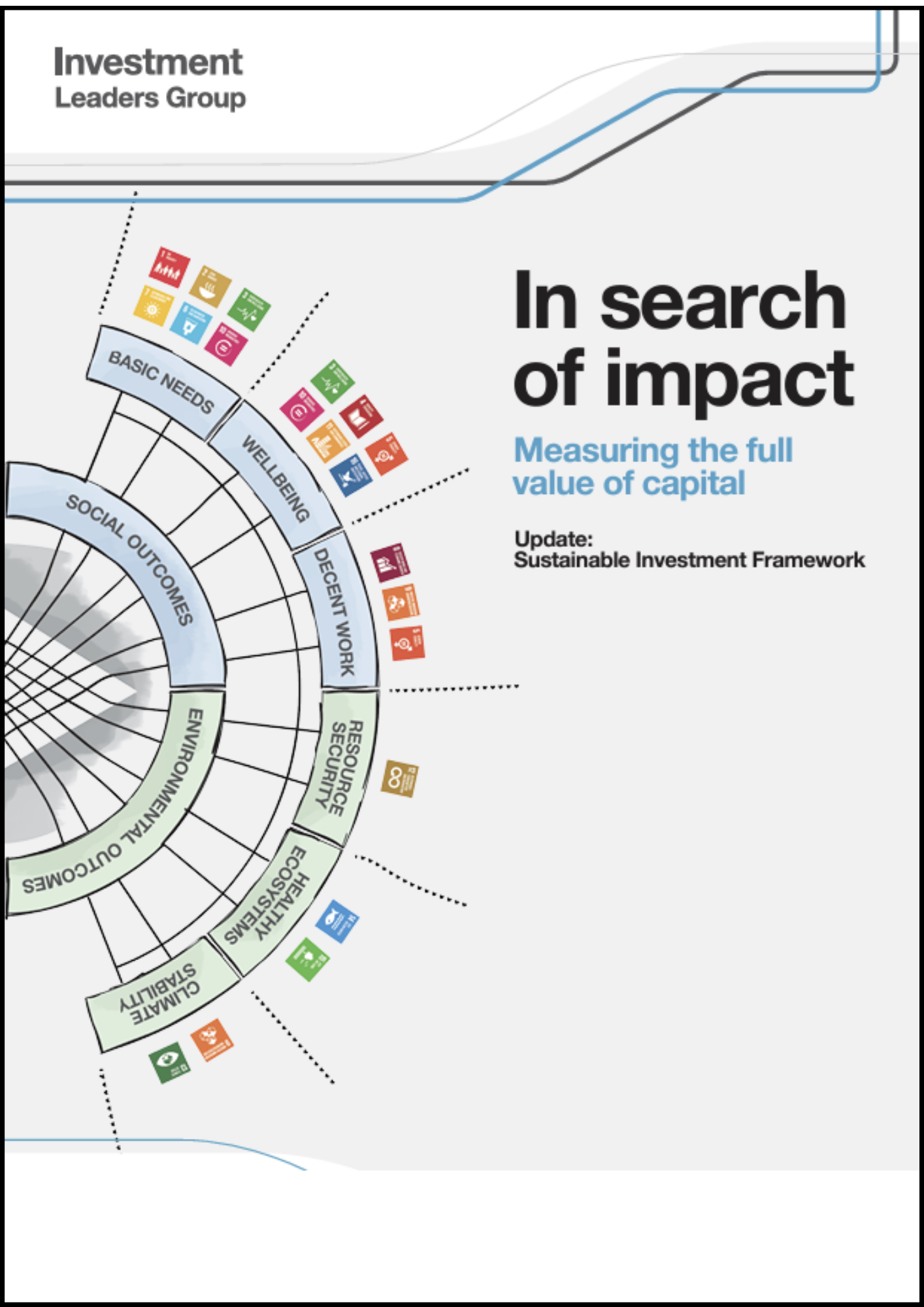
In search of impact: Measuring the full value of capital
This report outlines a sustainable investment framework, designed to empower individuals and organisations to better understand and make informed investment choices. The framework utilises six themes to communicate the impact of financial flows into the economy and contains theoretically grounded metrics that can be practically applied.

The economic impact of ESG ratings
This report examines the impact of ESG ratings on fund holdings, stock returns, and firm behaviour. The study finds that only MSCI ESG ratings can explain the holdings of US ESG funds, and slow, gradual responses in ownership suggest that fund managers mainly use ESG ratings to comply with ESG mandates.

At the crossroads: 10 years of implementing the UN Guiding Principles on Business and Human Rights in Australia
The report examines the implementation and impact of the UN Guiding Principles on Business and Human Rights in Australia over the past decade.

A sustainable finance policy engagement handbook
This handbook introduces six principles outlining institutional investors' commitment to incorporate ESG issues in investment analysis, ownership policies and practices, and promotion of acceptance and implementation of the Principles. The report explains how responsible investors can engage with policymakers to promote a sustainable financial system.

Industry influence on biodiversity policy: A pilot study demonstrating industry associations’ engagement on biodiversity-related policy and regulations
This report reveals that industry associations representing key sectors and some of the largest companies in the world are lobbying to delay, dilute, and block critically needed biodiversity policy in both the EU and US. The vast majority of engagement on specific policies and regulations is oppositional, seeking to roll back, weaken, or block policy.

Intangible cultural heritage, diverse knowledge systems, and climate change
This paper explores the relationship between climate change, different knowledge systems, culture, and heritage. It discusses the importance of a historical perspective, defines and describes different knowledge systems, and addresses the limitations of the predominant scientific approach. It also presents a framework for collaboration among plural knowledge systems.

Materiality: The word that launched a thousand debates
This report explores the concept of materiality in the context of corporate sustainability disclosure. It discusses evolving definitions of materiality in the US and abroad, the need for a common language and structure for disclosure frameworks, and SASB's role in providing decision-useful and financially material information to investors and financial capital providers.

Super-powering the energy transition in Australia: A policy blueprint to facilitate superannuation investment
This policy blueprint advocates for a shift to renewable energy, proposing over A$40 billion annual investment. It highlights superannuation funds as potential long-term capital sources for the transition, addressing barriers and recommending clear policies to achieve ambitious sustainability goals across critical sectors for a more sustainable future.

Seeing through the green: A guide to greenwashing risks for asset managers
This report is an in-depth analysis of the risks and pitfalls of greenwashing in sustainable investments. It provides an overview of the current regulatory landscape, common greenwashing practices, and best practices for addressing them.

Finance and climate change: A comprehensive climate assessment of the world’s largest financial institutions
An analysis of the top 30 global financial institutions exposes a notable absence of immediate action on climate change. While pledging net-zero targets by 2050, their plans lack focus and lack measurable short-term actions. Urgent reshaping of activities is imperative for these institutions to effectively transition to a net-zero future.

Angel networks in emerging markets: A guide for development institutions
This is a comprehensive and insightful guide for organisations seeking to engage with angel investors and support the development of entrepreneurship ecosystems in emerging markets. The report covers key topics such as the nature of angel investing, challenges facing angel networks, best practices and strategies, and practical tools for development institutions.

Credit repair for survivors of modern slavery and human trafficking
Finance Against Slavery and Trafficking (FAST) conducted a roundtable discussion with survivors, survivor support organizations, and financial institutions to address credit repair. Survivors' recommendations include implementing a manual review of onboarding processes, dismissing survivors' adverse credit, and developing a survivor-led approach to manage finances.

Business banking and start-up support for survivors of modern slavery and human trafficking
The report highlights the Survivor Inclusion Initiative (SII), addressing the business banking and startup needs of survivors of modern slavery and human trafficking. It outlines efforts such as training, support, expert review, and the global Survivor Business Roundtable to enhance survivors' access to financial services.


