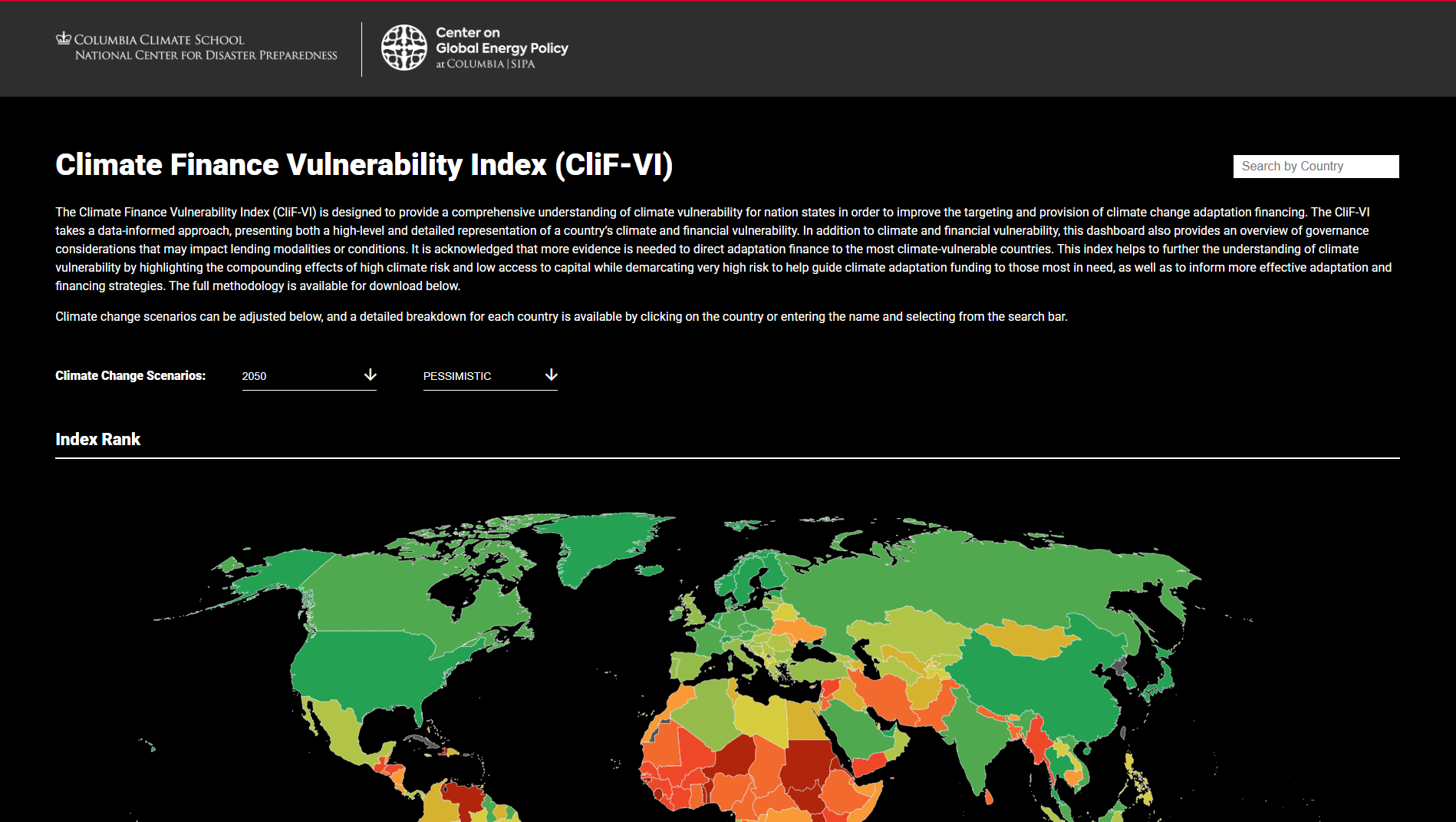
The Climate Finance (CliF) Vulnerability Index (CliF-VI) is an interactive data tool that assesses nations’ exposure to climate hazards along with their financial capacity to respond, aiming to improve the targeting and provision of climate adaptation finance. It presents current and future scenarios and highlights where climate risk and limited access to capital coincide, supporting evidence-based resource allocation and planning for adaptation finance.
Organisation behind the tool
The CliF-VI is developed by the National Center for Disaster Preparedness (NCDP) at the Columbia Climate School, in collaboration with the Center on Global Energy Policy at Columbia University. The project is supported by The Rockefeller Foundation and informed by consultation with institutions such as the European Commission’s Joint Research Centre.
What the tool does
• Provides an interactive dashboard of country climate and financial vulnerability results.
• Ranks countries on combined climate risk and financial vulnerability scores.
• Offers adjustable future climate scenarios (e.g. 2050 and 2080, optimistic and pessimistic).
• Displays climate risk exposure including hazards like floods and droughts.
• Includes financial vulnerability metrics such as debt sustainability, access to capital, financial integration and sophistication.
• Shows governance indicators that may influence lending and finance conditions.
• Allows download of methodology and data for further analysis.
Target audience
Primary users include:
• Global and regional financial institutions allocating climate adaptation finance.
• Donor agencies and development banks prioritising concessional funds.
• Policymakers and government agencies planning resilience strategies.
Other relevant audiences:
• Researchers analysing climate risk and finance linkages.
• Non-governmental organisations (NGOs) advocating for equitable funding.
Relevance to finance professionals
- Risk assessment – Helps identify countries with high climate hazard exposure combined with weak financial resilience, assisting in risk profiling for portfolios and sovereign risk analysis.
- ESG analysis – Provides climate and governance indicators relevant for environmental and social dimensions in reporting frameworks.
- Investment context – Informs long-term adaptation investment decisions by showing where climate risks and financing gaps intersect, aiding strategy for concessional finance, blended instruments, or resilience bonds.
- Allocation and prioritisation – Supports evidence-based allocation of limited adaptation funds by highlighting where finance is most needed and potentially most impactful.