Overview
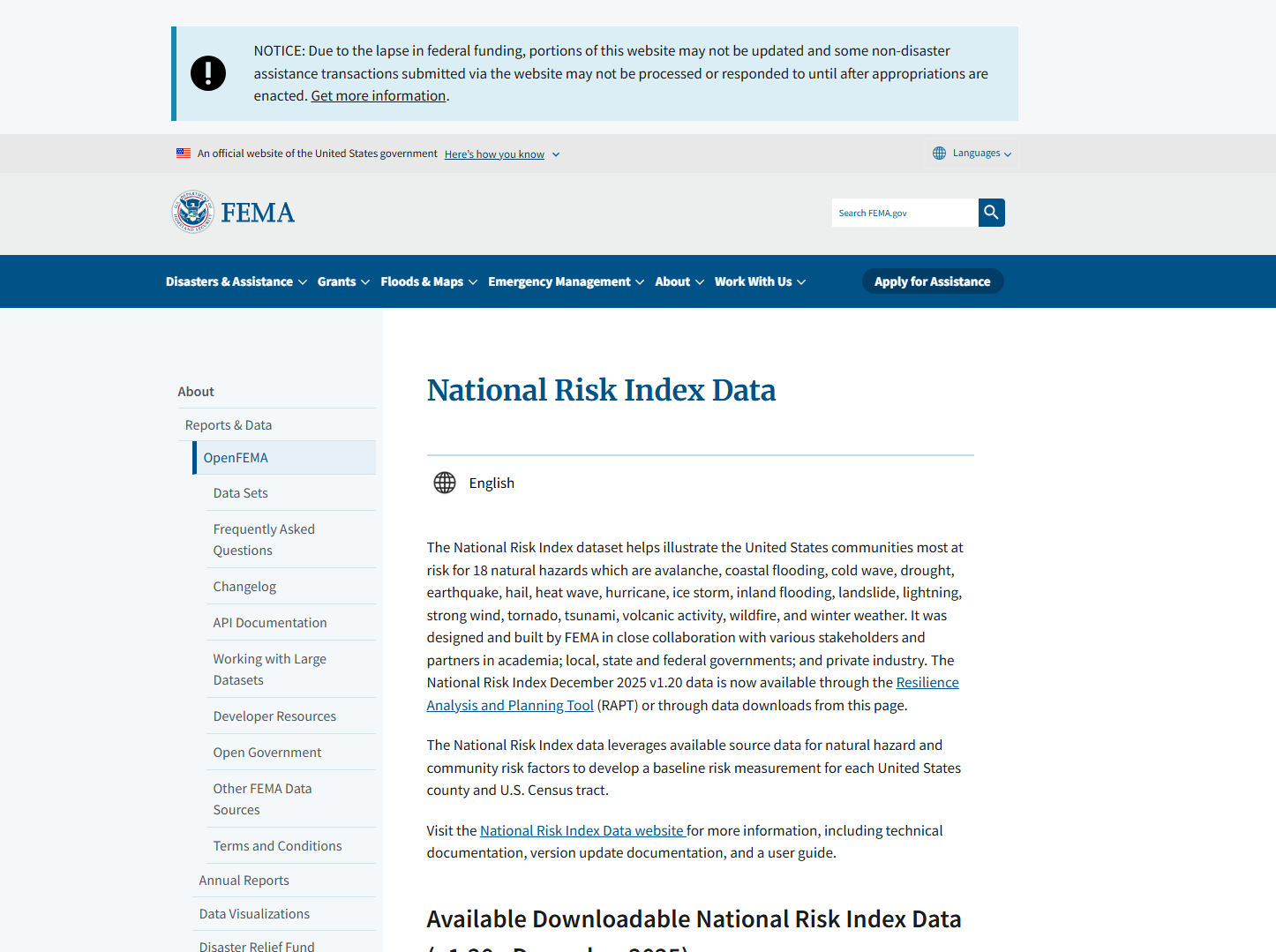
The National Risk Index Data is a dataset from the Federal Emergency Management Agency (FEMA) that quantifies natural hazard risks for U.S. counties and Census tracts. It integrates expected annual economic losses, social vulnerability, and community resilience into baseline risk measurements. Finance professionals may find it useful for quantifying hazard exposure and resilience metrics across regions.
Organisation behind the tool
The dataset is developed and maintained by the Federal Emergency Management Agency (FEMA), a U.S. government agency responsible for disaster response and mitigation, in collaboration with academic, state, local and private sector partners.
What the tool does
• Provides risk index values for 18 natural hazards (e.g. drought, earthquake, wildfire) across U.S. counties and Census tracts.
• Measures Expected Annual Loss representing average annual economic loss due to hazards.
• Includes Social Vulnerability metrics indicating susceptibility of populations to harm.
• Includes Community Resilience measures reflecting capacity to prepare for, respond to and recover from hazards.
• Offers downloadable datasets in multiple formats (table, shapefile, geodatabase).
Target audience
Primary users include emergency planners, risk analysts, public agencies and researchers. The dataset is also relevant to insurers, urban planners, community developers and other interested stakeholders requiring geographic risk information.
Relevance to finance professionals
• Risk assessment – Quantifies regional exposure to hazard-related losses and vulnerability.
• ESG analysis – Provides environmental and social metrics useful for sustainability reporting and risk disclosure.
• Market/commodity insights – Insight into hazard exposure for agriculture, infrastructure and real estate markets.
• Investment context – Long-term risk trends that may inform capital allocation, insurance and resilience investment decisions.