Overview
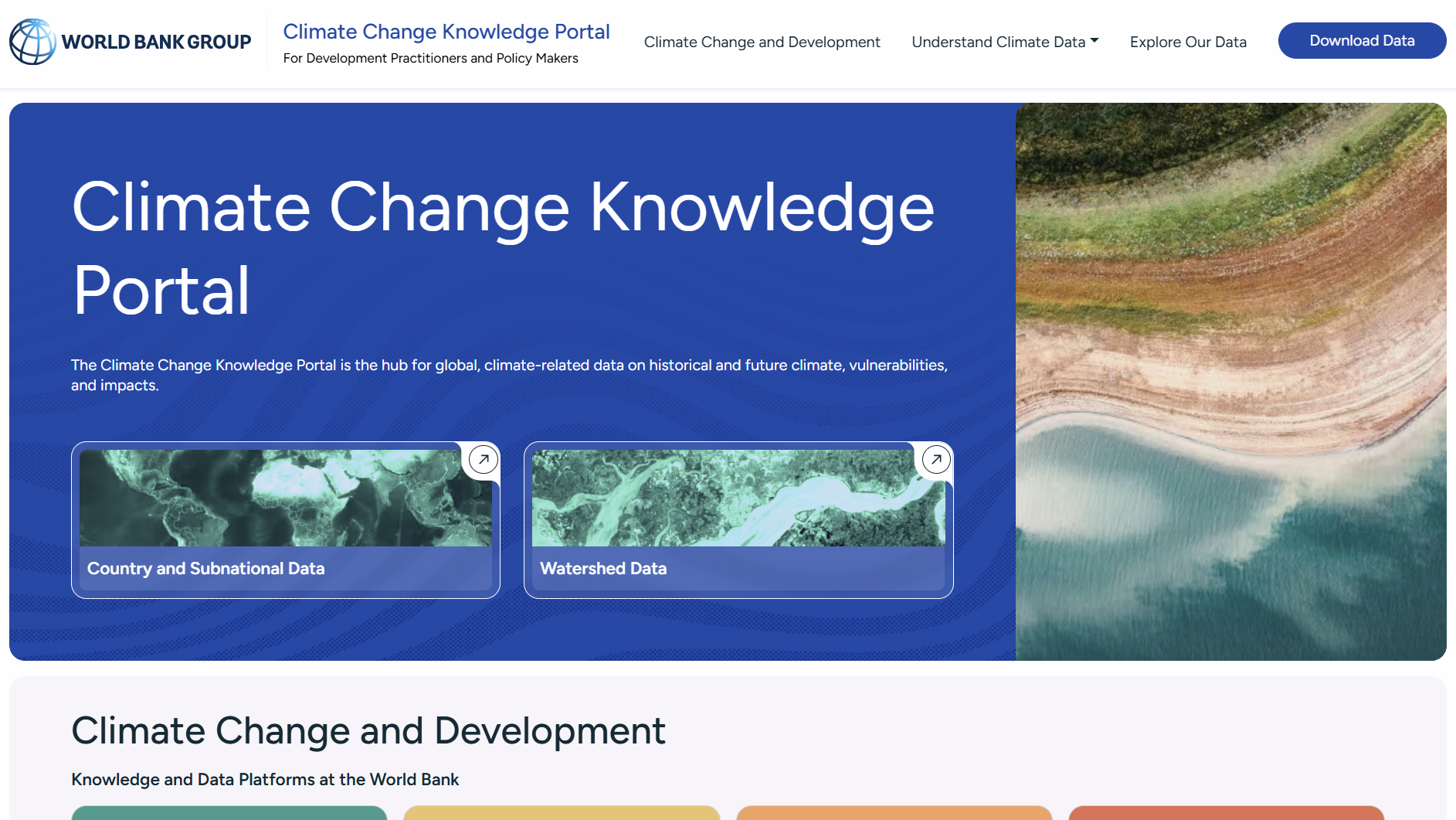
The CMIP5 section of the Climate Knowledge Portal provides access to historical and projected climate data derived from the Coupled Model Intercomparison Project Phase 5. It enables users to explore long-term climate trends and scenarios at global, regional, and country levels. The tool supports evidence-based assessment of climate risks relevant to economic and financial decision-making.
Organisation behind the tool
The tool is developed and maintained by the World Bank through its Climate Change Group. It forms part of the World Bank’s Climate Knowledge Portal, which consolidates climate data and analytics to support development, policy, and risk analysis.
What the tool does
The CMIP5 tool provides structured access to climate model outputs, including:
- Historical climate baselines and future projections
- Temperature and precipitation indicators
- Multiple emissions scenarios (Representative Concentration Pathways)
- Multi-model ensemble averages to support uncertainty analysis
- Country-level and regional climate profiles
- Users can visualise trends, compare scenarios, and download data for further analysis.
Target audience
The primary users are policymakers, researchers, and development practitioners. Secondary audiences include finance professionals, climate risk analysts, consultants, and institutions assessing long-term climate exposure.
Relevance to finance professionals
The tool is relevant to finance professionals in several contexts:
- Risk assessment – supports evaluation of physical climate risks such as heat stress, drought, and rainfall variability across geographies.
- ESG analysis – provides environmental data that can inform climate-related disclosures and scenario analysis.
- Market and sector insights – offers climate inputs relevant to agriculture, water resources, infrastructure, and energy systems.
- Investment context – enables assessment of long-term climate trends that may affect asset values, supply chains, and regional economic resilience.
The CMIP5 tool is most suitable for strategic, long-horizon analysis rather than short-term forecasting, and is commonly used as an input to broader climate and economic assessments.