
Library | Resource Types
Research
We summarise credible research and reports on sustainable finance and ESG issues. Our summaries, along with our AI ChatBot saves members time reading large reports, to focus on knowledge building and action.
Refine
1385 results
REFINE
SHOW: 16


Investors' expectations on responsible artificial intelligence and data governance
This report outlines responsible AI and data governance principles and engagement framework for investors across multiple sectors. The six core principles aim to enhance machine learning, auditability, explainability, and transparency, while taking into account legal, regulatory, ethical, and reputational risks.

Human rights risks in tech: Engaging and assessing human rights risks arising from technology company business models
This tool outlines strategies for investors to assess technology companies’ responsibility to respect human rights. It includes questions addressing engagement on specific business model features that may create human rights risks and an evaluation framework to assess company responses.

Generative artificial intelligence in finance: Risk considerations
Generative AI is a subset of AI/ML that creates new content. It offers enhancements to efficiency and customer experience, as well as advantages to risk management and compliance reporting. However, the deployment of GenAI in the financial sector requires the industry to recognise and mitigate the technology's risks comprehensively; financial institutions must strengthen their cybersecurity and regulatory oversight capacities.

Ethics guidelines for trustworthy AI
The European Commission's AI High-Level Expert Group has released their Ethics Guidelines for Trustworthy AI. The report provides a framework for creating lawful, ethical, and robust AI systems throughout the system's life cycle. The guidelines focus on respect for human autonomy, prevention of harm, fairness, and explicability.

Ethically aligned design: A vision for prioritising human well-being with autonomous and intelligent systems
This report is a call-to-action for technologists to align creation of autonomous and intelligent systems to defined values and ethical principles prioritising human well-being. Emphasising the importance of embedding values and morals into these systems, it discusses a range of topics, including job automation, personal data protection, A/IS education, law, and more.

Engaging the ICT sector on human rights: Privacy and data protection
This report provides sector-wide risk assessment on privacy and data protection in the Information and Communications Technology (ICT) industry. It includes international standards and salient issues to consider when engaging with ICT companies, the "business case" for privacy and data protection, and investor guidance for engaging ICT companies.

Engaging the ICT sector on human rights: Political participation
This ICT sector-wide risk assessment examines potential impacts on the salient human rights issue of political participation. It presents international standards, discusses the use of ICT in politics, and offers human rights guidance for businesses to follow. Additionally, the report highlights risks and offers stakeholder-engagement suggestions and investor efforts to mitigate negative impacts.

Engaging the ICT sector on human rights: Freedom of opinion and expression
This report assesses freedom of opinion (FOE) and expression risks in the ICT sector. It identifies negative impacts and provides guidance for companies and investors on how to respect and promote FOE.

Engaging the ICT sector on human rights: Discrimination
This report examines the risks of discrimination in the Information and Communication Technologies sector and its impact on human rights. It provides company guidance on eliminating discrimination and promoting inclusion, as well as investor guidelines for holding companies accountable.

Engaging the ICT sector on human rights: Conflict and security
This report provides an overview of the main human rights instruments and adverse impacts of the ICT sector in conflict-affected areas, emphasising its role in promoting security and other human rights while highlighting the potential risks of new technologies in this context. It also includes investor guidance to help evaluate if companies are meeting their human rights responsibilities.

Engaging the ICT sector on human rights: Child rights
This briefing explores the risks and opportunities Information and Communication Technologies (ICT) companies face in relation to children's rights. It highlights the importance of adhering to international standards and implementing internal policies and practices that prioritise the most severe impacts on children. Investors are encouraged to hold companies accountable.

Dutch pension funds agreement on responsible investment
The Dutch Pension Funds Agreement on Responsible Investment outlines the policies and procedures needed for pension funds to prevent, mitigate, and remediate against negative social and environmental consequences of investments. The agreement promotes long-term shareholder engagement and encourages due diligence in outsourcing, reporting, and transparency.

Digital safety risk assessment in action: A framework and bank of case studies
This report contains a framework and case studies for digital safety risk assessment. The case studies cover topics such as trust and safety best practices, human rights due diligence, and child safety in gaming and immersive worlds.

Beyond explainability: A practical guide to managing risk in machine learning models
This report offers a comprehensive guide for effectively managing risk in machine learning models. It presents a framework that enables data science and compliance teams to create better, more accurate, and more compliant models. The report stresses the importance of understanding the data used by models and implementing three lines of defence to assess and ensure their safety.
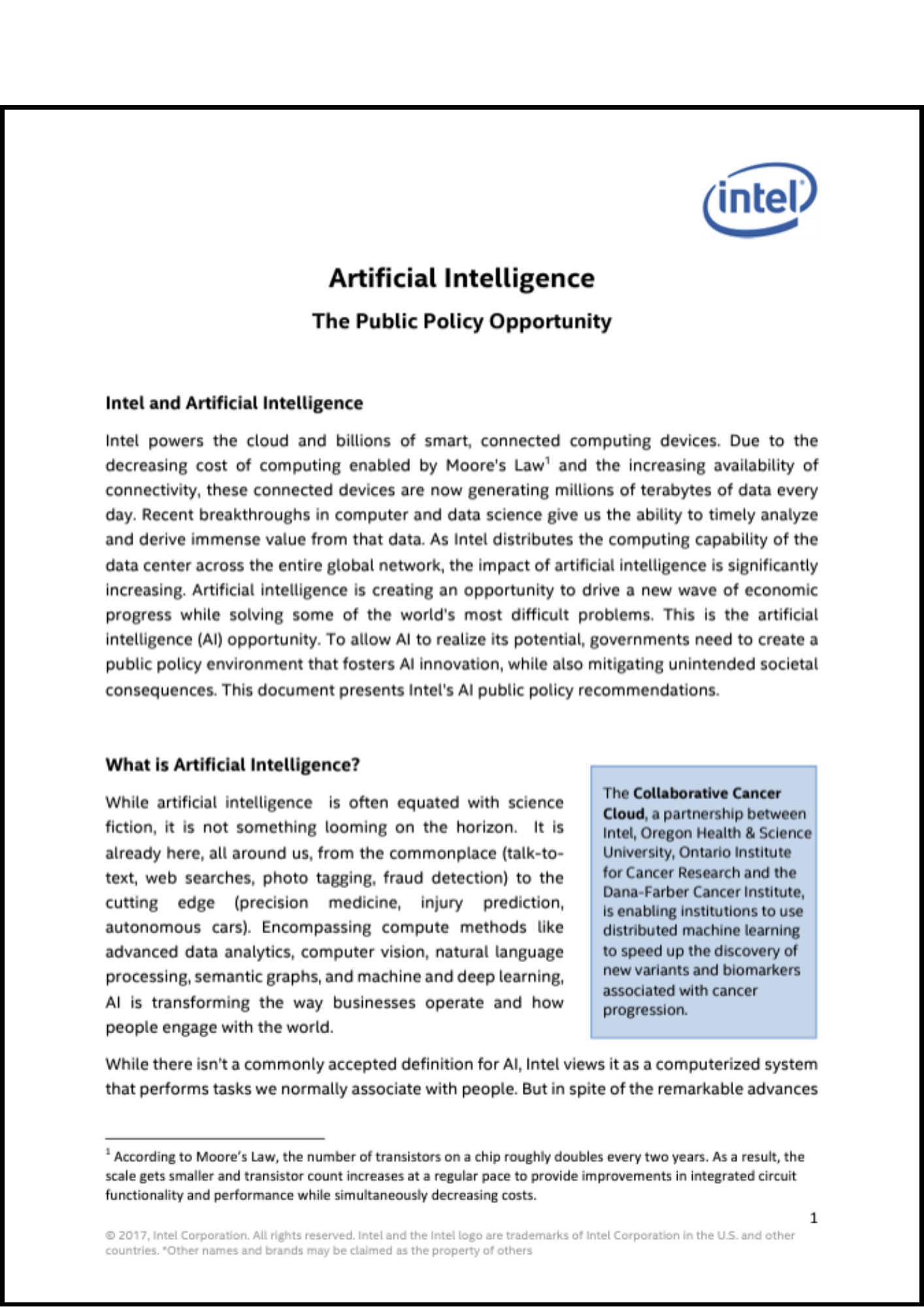
Artificial intelligence: The public policy opportunity
The artificial intelligence (AI) opportunity is here, and it's transforming industry and society. Governments must create public policy environments that encourage AI innovation, while mitigating negative consequences. This report by Intel outlines several key recommendations necessary to realise the potential of AI and to prepare for this transformative technology.

AI policy principles
This report outlines the responsibility of industry and governments in promoting responsible development and use of artificial intelligence. The policy principles focus on the integration of principles into the design of AI technologies, investment in AI research and development, and collaboration through public-private partnerships.


