
Library | Resource Types
Research
We summarise credible research and reports on sustainable finance and ESG issues. Our summaries, along with our AI ChatBot saves members time reading large reports, to focus on knowledge building and action.
Refine
1838 results
REFINE
SHOW: 16


The rising tide of greenwashing: Navigating ‘greenwashing’ risks in climate change targets and sustainability credentials
The report highlights the risks and challenges associated with businesses misrepresenting their sustainability credentials or strategies. The document elaborates on the subject with the help of multiple examples and practical guidelines to reduce legal and reputational exposure to businesses and corporations.
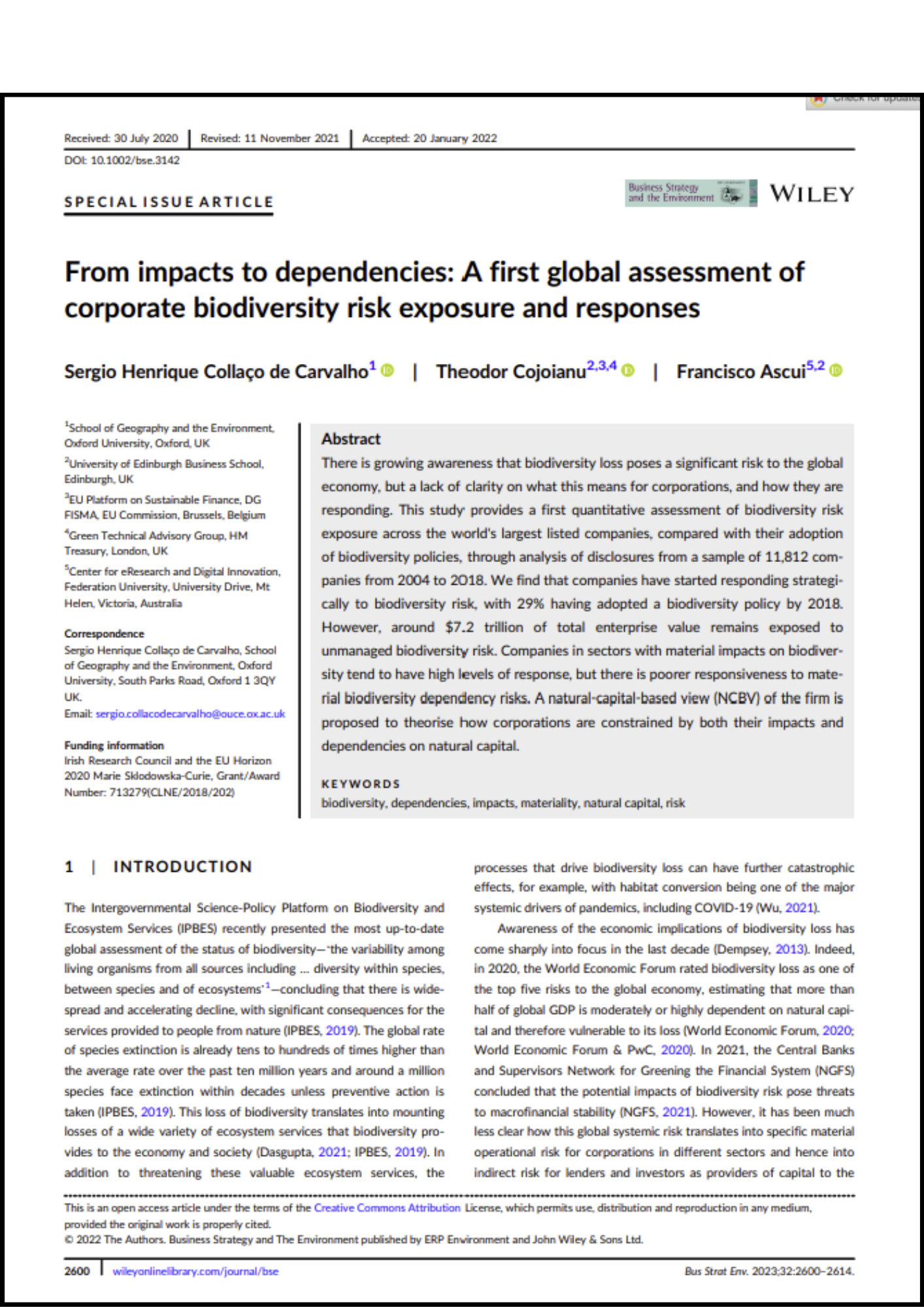
From impacts to dependencies: A first global assessment of corporate biodiversity risk exposure and responses
The report unveils a significant gap in corporate biodiversity risk management, with $7.2tn exposed despite a 29% adoption rate of biodiversity policies among 11,812 sampled companies. It emphasises the inadequate response to biodiversity risks, especially in sectors highly reliant on biodiversity.

In search of the true greenium
The expected return of green securities relative to brown is a crucial impact measure for ESG investors, and the greenium is more negative in greener countries and over time. The equity greenium has become more negative over time. The proposed robust green score combined with forward-looking expected returns yields a more precisely estimated annual equity greenium.

Measuring what matters: Australia's first well-being framework
Measuring What Matters is Australia's first wellbeing framework, published in July 2023 by the Commonwealth of Australia. It seeks to deepen our understanding of how Australians are faring beyond traditional economic indicators. The framework includes 50 wellbeing indicators under the themes of healthy, secure, sustainable, cohesive, and prosperous societies.

ESG investing in emerging markets – a roadmap towards net-zero
This report discusses the challenges in ESG investing for emerging markets due to varying standards in regulations and reporting. It also covers the importance of sovereign engagement and incorporating biodiversity in investment decisions. The lack of standardisation in data and regulation presents difficulties in generating sustainable investments.

Biodiversity in the balance: Hedging portfolio risks
The report illustrates increased NGO reporting, land use, and biodiversity incidents linked to industrial firms. With 31% of companies having no official management initiatives, investors are eager to address portfolio risks from biodiversity loss and deforestation. The report connects land use and biodiversity controversies with various risks, including operational, credit, market, physical, and systemic.

Oxford principles for net zero aligned carbon offsetting
This 2024 framework of four principles and guidance for organisations and standard bodies involved in offsetting practices. The revised principles emphasise the need for urgency in the reduction of emissions and the closing of the carbon removal gap, while maintaining transparency and integrity in all projects.

Climate scorpion – the sting is in the tail: Introducing planetary solvency
The report explores the risks and impact of climate change on a global scale. The report emphasises the need for a realistic risk assessment urgently and laying out a blueprint on developing a Planetary Solvency framework.

Australian material flow analysis to progress to a circular economy
This report provides a comprehensive material flow account for Australia in 2019 to support the assessment of its circular economy progress. The report highlights key areas where policy interventions can improve material intensity, resource efficiency, and waste minimisation. It also evaluates Australia's circularity indicators and performs well on three proposed indicators.

Developing a public private partnership approach to increase financial inclusion for modern slavery survivors in Mexico
This report provides insight into the development of a public-private partnership approach to increase financial access for modern slavery survivors in Mexico. The pilot intervention aims to improve financial inclusion of vulnerable populations, contributing to reducing and preventing trafficking and slavery.

Getting ahead of the curve on dynamic materiality: How U.S. investors can foster more inclusive capitalism
This discussion paper highlights tools and opportunities for US investors to foster sustainable and responsible value creation in order to support more inclusive and thriving economy. It also discusses the risks posed to portfolios by social and environmental risks and how diversified investors can mitigate them.

Sovereign bonds: Spotlight on ESG risks
This report explores the use of environmental, social, and governance (ESG) analysis as a potential risk-reducing and return-enhancing tool for investors in developed-country sovereign bonds. The report suggests that ESG factors are material to both creditworthiness and investment performance.

Investor toolkit on human rights
This toolkit provides practical guidance for institutional investors to assess and address human rights risks within investment activities. With tools, case studies and standard-setting activities, this investor toolkit encourages proactive management of human rights risks.

200 and counting: Global financial institutions are exiting coal
Financial institutions (FI) across the world are increasingly recognising the risks and opportunities connected to coal, and many are reducing their exposure to the industry. The number of FIs withdrawing from coal is rapidly increasing, and this report catalogues the global trend towards coal withdrawal.

The elephant in the room: Aligning global bonds markets with climate goals
The global bond market is crucial for the achievement of the Paris Agreement's climate goals. This report analyses the alignment of corporate bonds with these goals while identifying challenges and proposing potential solutions, including the use of asset-level data and revaluation of benchmarks.

Scaling impact: Exploring 'success' in relation to impact investments
This study aims to explore the definition of success in social impact investments and how to scale them up. Challenges such as negotiation, execution, and outcomes measurement were identified. Measures for supporting scaling include data sharing, funding, and intellectual property (IP) valuation.


