
Library | ESG issues
Governance
The governance pillar in ESG (environmental, social, and governance) refers to the systems, policies, and practices that ensure an organisation is managed responsibly and ethically. It includes issues such as board structure, reporting & disclosures, shareholders & voting, and risk management. Strong governance reduces risks, enhances trust, and supports long-term business sustainability.
Refine
1881 results
REFINE
SHOW: 16


How to report on the SDGs: What good looks like and why it matters
Corporate action towards the United Nations Sustainable Development Goals (SDGs) will be fundamental to achieve necessary progress. This report aims to guide corporations on how and why to report on the SDGs and gives an overview of current progress based on the top 250 global companies.

From the stockholder to the stakeholder: How sustainability can drive financial outperformance
This 2015 report is a meta-study of over 200 sources of research on ESG (academic studies, industry reports, newspaper articles and books). It finds a positive correlation between diligent ESG and economic performance – i.e., companies with robust sustainability practices demonstrate better operational and financial market performance.

How can investors help prevent corporate policy capture?
This project aims to make corporate political capture a central component of investors’ approach to ESG stewardship and integration. It leverages information on the state of play for key sectors and shares lessons learned from past investor engagements, including a 12-step process for ESG investors to address negative corporate lobbying.

Winning without win-win? Recommendations on financial market strategies for biodiversity and nature
Expert recommendations for investors regarding financial market strategies to address urgent risks in biodiversity and nature, including examples of meaningful market actions and critique of 'win-win' thinking in investment decision-making. Recommendations drawn from a private cross-sectoral dialogue hosted by Preventable Surprises in February 2021.
Universal circular economy policy goals: Enabling the transition to scale
As industries and governments move towards the circular economy, clear and aligned direction is needed for a rapid transition to scale. This paper proposes five universal policy goals that can help governments build healthier economic recoveries and lower the costs of transition for businesses across sectors.
Ethics in the boardroom: A decision-making guide for directors
This report guides company directors in making ethical decisions in the boardroom. It seeks to support and strengthen a board’s capacity to reason by providing a decision-making framework, key questions to frame board deliberations and practical examples of ethical dilemmas.

Time for AIA to prove their climate credentials
IEEFA report highlights AIA's discrepancies on its climate change commitments as visible from the carbon footprint of its portfolio. AIA, one of the world's largest financial firms and one of Asia's largest insurers, is estimated to hold up to US$6 billion in coal and coal-fired investments despite commitment to three global climate accords.
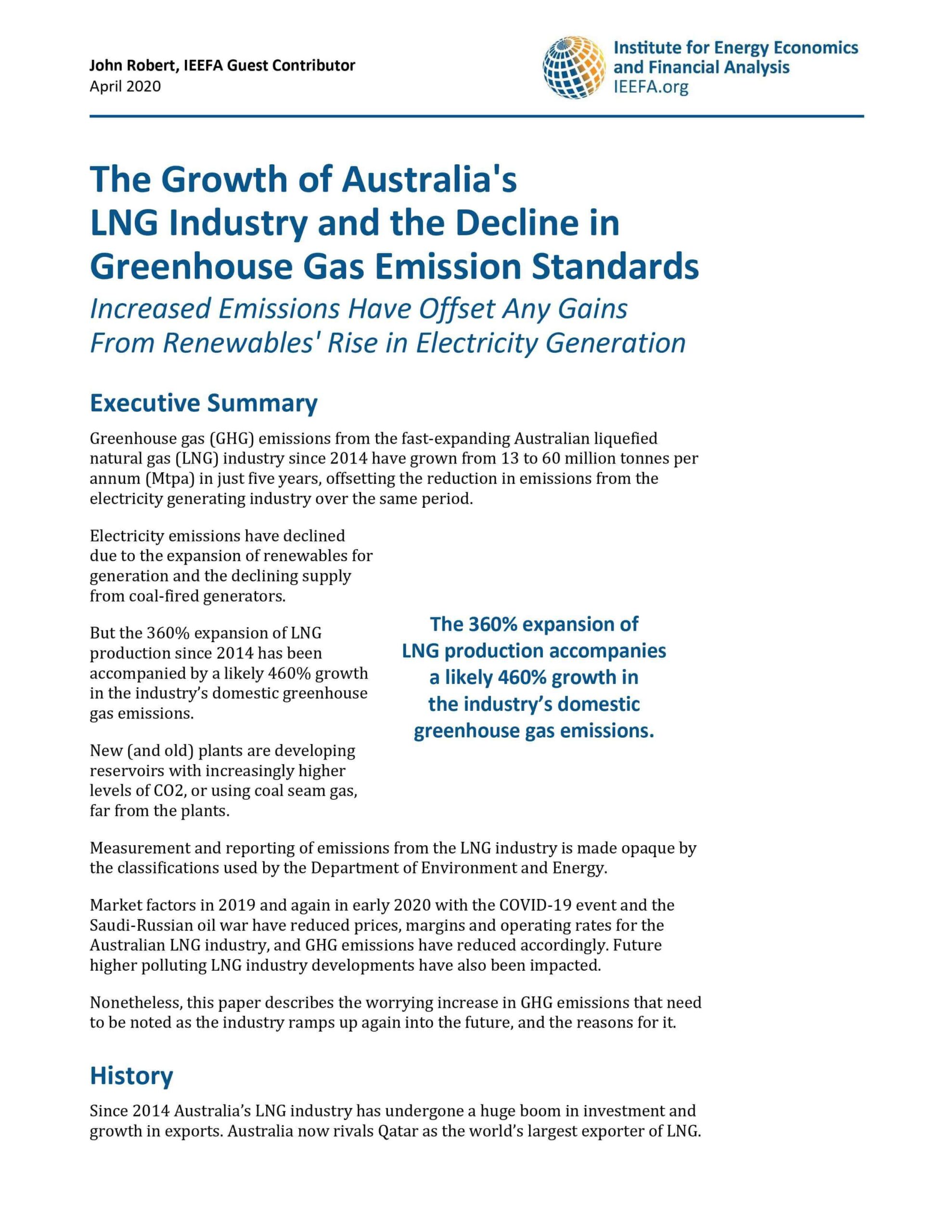
The growth of Australia's LNG industry and the decline in greenhouse gas emission standards: Increased emissions have offset any gains from renewables' rise in electricity generation
Discusses the growth of Australia’s liquefied natural gas (LNG) industry from 2014-2019. Finding significant growth in greenhouse gas (GHG) emissions during this period. The report provides a brief history and context of Australia’s LNG boom, explains technical aspects of the industry and outlines four factors accounting for GHG growth.

Waste and opportunity 2020: Searching for Corporate Leadership - 50 corporations ranked on plastic packaging pollution
The 2020 published report by As You Sow investigates 50 corporations and ranks them based on their performance in leadership and ambition relating to sustainable packaging of their products, while also taking into account their contributions and support to increase recycling rates and engage in producer responsibility efforts.

As You Sow
As You Sow is a leader in creating positive change in corporate decision making by utilising the power of shareholder advocacy to produce environmentally and socially beneficial impacts. Their goals and initiatives are in adherence to sustainable financing principles while implementing inclusive and holistic lenses when engaging with relevant stakeholders.

How markets price ESG: Have changes in ESG scores affected stock prices?
This report takes a statistical look at the impact of historical ESG score shifts on stock prices valuation. It further determines financial performance implications for a broad spectrum of companies based on an ESG valuation curve.

MSCI Inc.
MSCI Inc. is a financial services company that provides services and tools to globally support the management of investment processes. MSCI Inc. builds industry-leading solutions that enable its clients to understand and analyse key drivers of risk and return to ensure effectiveness and transparency across their portfolios.

Implementing the Taskforce on Climate-Related Financial Disclosures (TCFD) recommendations: A guide for asset owners
The guide sets out a practical framework to support asset owners in implementing the Taskforce on Climate-related Financial Disclosures (TCFD) recommendations. The guide focuses on the actions that asset owners can take to improve processes around governance, strategy, risk management and metrics/targets for managing climate risks and opportunities.
Towards sustainable packaging materials: Examining the relative impact of materials in the natural source water and soft drinks value chain
This report examines the impact of packaging materials for natural source water and soft drinks. The materials examined include plastic bottles, aluminium cans, glass bottles and multi-material cartons. To reduce impact, findings highlight that businesses should increase circularity and levels of recycled material for all material types.

University of Cambridge Institute for Sustainability Leadership (CISL)
Cambridge Institute for Sustainability Leadership (CISL) is a global institute developing leadership and solutions for a sustainable economy. It draws on the world leading research and networks of Cambridge University to help business leaders address critical global challenges.
Unlocking Australia's sustainable finance potential
Recommendations on actions by Australian Government and finance sector for unlocking the potential of sustainable finance in Australia. The basis of these recommendations are the European Union's Action Plan on sustainable finance that was adopted by the European Commission in March 2018 and the likelihood of their success in Australia.


