
Library | ESG issues
Governance
The governance pillar in ESG (environmental, social, and governance) refers to the systems, policies, and practices that ensure an organisation is managed responsibly and ethically. It includes issues such as board structure, reporting & disclosures, shareholders & voting, and risk management. Strong governance reduces risks, enhances trust, and supports long-term business sustainability.
Refine
1866 results
REFINE
SHOW: 16


The insurability imperative: Using insurance to navigate the climate transition
This report argues that insurability is a strategic indicator of financial viability in a climate-disrupted economy. It explains how insurance, risk modelling, resilience investment, and policy alignment shape access to capital, asset values, and transition finance, urging leaders to embed insurability into decision-making.
Information integrity about climate science: A systematic review
Systematic review of 300 studies (2015-2025) finds coordinated misinformation and greenwashing by corporate, political, and media actors undermine climate science, eroding trust and delaying policy. Research is Global North–centric. Evidence supports regulation, litigation, coalitions, and education to strengthen information integrity.
Green industrial policy’s unfinished business: A publicly managed fossil fuel wind-down
The report argues that green industrial policy must actively manage a fossil fuel wind-down. It contends that renewables expansion alone is insufficient, calling for public planning, regulation, and ownership to ensure equitable decarbonisation and prevent fossil fuel liabilities shifting to the public.
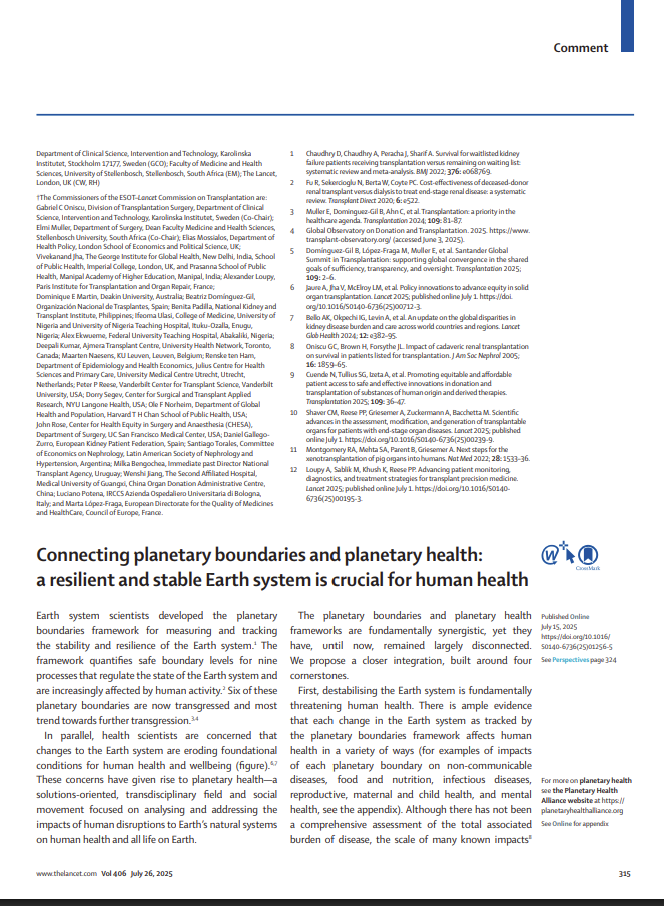
Connecting planetary boundaries and planetary health: A resilient and stable earth system is crucial for human health
The Lancet comment argues that integrating planetary boundaries and planetary health frameworks is essential to protect human health. It outlines health risks from Earth system destabilisation, stresses justice and equity, and calls for coordinated research, policy alignment, and improved monitoring and communication.

Council on Ethics for the Norwegian Government Pension Fund Global
Council on Ethics for the Norwegian Government Pension Fund Global is a government-appointed body advising on ethical standards for sovereign wealth fund investments. It assesses companies against human rights, environmental and governance criteria, and publishes public recommendations on exclusion or observation to support responsible investment by Norway’s Government Pension Fund Global.

Changing markets foundation
Changing Markets Foundation accelerates sustainability market shifts by exposing irresponsible corporate practices and promoting environmentally and socially beneficial solutions. Working with NGOs and research partners, it drives campaigns on climate, plastics, food systems and fashion to influence markets and public policy. It is an independent environmental advocacy nonprofit.

Climate Financial Risk Forum (CFRF)
Climate Financial Risk Forum (CFRF) is a UK financial services industry initiative, jointly established by Financial Conduct Authority (FCA) and Prudential Regulation Authority (PRA) in 2019. CFRF brings senior leaders together to develop practical climate-related financial risk management guidance, tools and case studies for banks, insurers and asset managers.

Parry Field Lawyers
Parry Field Lawyers is a New Zealand-based full-service commercial law firm providing legal advice on property, business, employment, disputes, immigration, trusts, and for-purpose sector matters. It supports charities, social enterprises, and impact organisations with governance and compliance resources, operating across multiple offices since 1948.

Theia Finance Labs (formerly 2° Investing Initiative Germany)
Theia Finance Labs is a non-profit research and innovation organisation focused on climate finance and financial system transformation. It develops open research, tools and methodologies to assess climate alignment, transition risk and systemic change, supporting investors, policymakers and financial institutions to align markets with climate goals and sustainability objectives globally.
Building resilient supply chains: Getting the most out of supplier engagement
The report outlines how climate-related risks threaten supply chains and presents seven practical steps to strengthen resilience through supplier engagement. It stresses clear objectives, data use, prioritisation, incentives and cross-functional collaboration to drive emissions reduction, improve transparency and align procurement with long-term sustainability and risk-management goals.

Moving away from mass destruction:109 exclusions of nuclear weapon producers
The report reviews 109 financial institutions with policies excluding nuclear weapon producers, assessing policy scope and implementation. It finds 55 institutions apply comprehensive exclusions, while others retain gaps or exposures, reflecting growing financial-sector alignment with the Treaty on the Prohibition of Nuclear Weapons.
The use of the Lavender in Gaza and the law of targeting: AI-decision support systems and facial recognition technology
The report analyses Israel’s alleged use of the ‘Lavender’ AI decision-support system and facial recognition in Gaza, assessing compliance with international humanitarian law. It highlights risks from inaccuracy, bias, automation and opacity, concluding that commanders must retain judgement and verification to meet targeting obligations.
Supplement to the target market to include information on sustainability related objectives1 and sustainability factors
This supplement outlines a framework for classifying financial products by sustainability objectives under MiFID II. It defines ESG target markets, minimum exclusions, PAIs, and alignment with SFDR and Taxonomy rules across securities, funds, bonds, and certificates.
Rearm europe, rearm finance: What role for responsible investment in the financing of european defense?
Mirova assesses Europe’s defence rearmament and examines how responsible investors could contribute without undermining ESG principles. It argues for selective financing, strict exclusions, and innovative tools such as defence bonds, while maintaining focus on environmental transition and European sovereignty.
Guidance Handbook
ICMA’s June 2025 Guidance Handbook clarifies practical application of Green, Social, Sustainability and Sustainability-Linked Bond Principles, covering use of proceeds, governance, reporting, verification and market issues. It supports consistent labelling, transparency and market integrity across sustainable debt instruments.

Exponential Roadmap Initiative
Exponential Roadmap Initiative (ERI) is a global, mission-driven organisation accelerating science-aligned climate action. It works with companies, investors and partners to scale climate solutions, assess climate performance, and support pathways to halve global greenhouse gas emissions by 2030 through practical frameworks and collaborative initiatives across business, finance and policy contexts.


