
Library | SASB Sustainability Sector
Capital Markets
Refine
620 results
REFINE
SHOW: 16


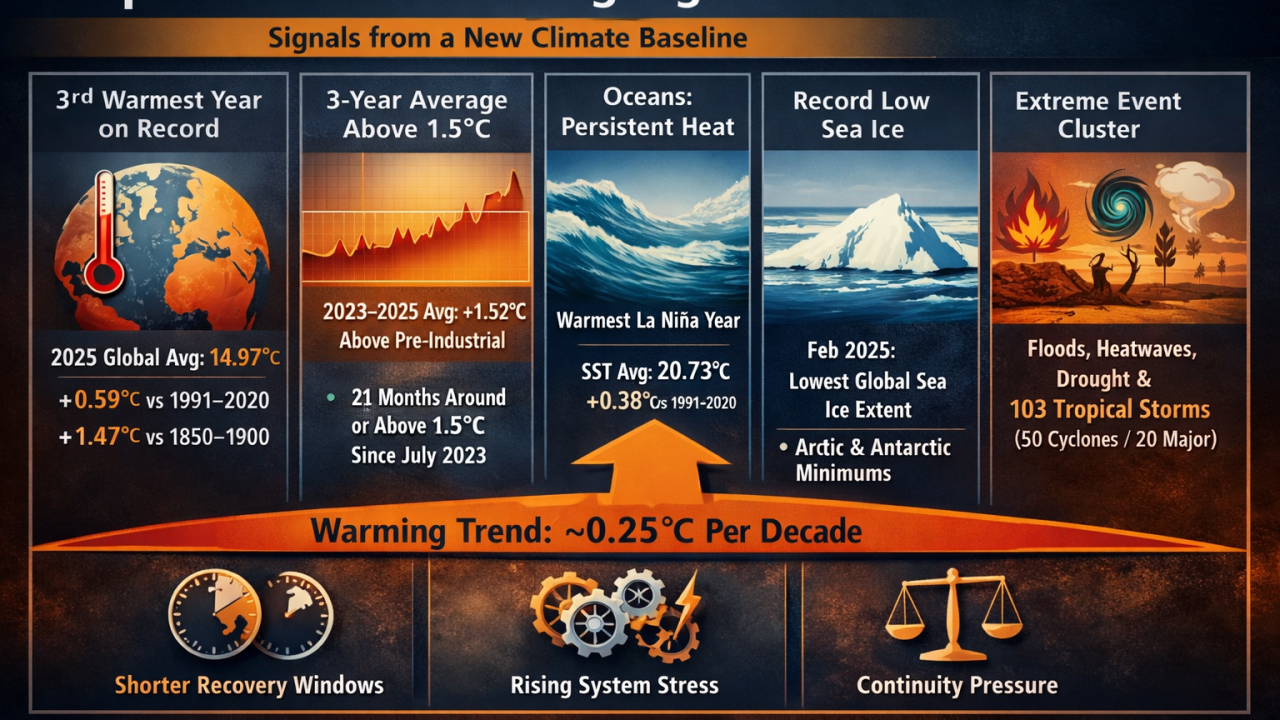
PerilScope: Strategic Deep Dive Copernicus Global Climate Highlights 2025 — From Records to Operating Conditions in the 3°C World SRP® Frame
The article interprets Copernicus’s Global Climate Highlights 2025 as a shift from episodic extremes to a structurally warmer, more volatile baseline. It argues that persistent temperature exceedances, ocean heat, cryosphere decline, and overlapping hazards demand a move from climate risk awareness to disciplined adaptation and continuity planning.

Starting and transitioning into sustainable finance careers
This guide outlines pathways for starting or transitioning into sustainable finance careers. It explains ESG integration, sustainable and impact investing, sector roles, required skills, barriers and transition strategies, supported by Australian context, expert insights and case studies from Pollination and Aware Super.
Global pension transparency benchmark
The Global Pension Transparency Benchmark is a benchmark series initiated in 2021 that assesses how clearly major pension funds disclose information on value-generation for stakeholders. It evaluates public disclosures across four equally weighted factors — governance and organisation, performance, costs and responsible investing — using a structured scoring methodology. The purpose is to promote better transparency and accountability in pension reporting. Finance professionals can use the benchmark to compare disclosure practices, inform improvements in fund reporting and align with evolving global standards.
Nature-based risk assessment: Integrating project-related finance
Guidance from UNEP FI and the Equator Principles on integrating project-related finance into nature-based risk assessments. It outlines frameworks, governance and disclosure expectations to help financial institutions identify, assess and manage biodiversity, water and pollution-related risks at project and portfolio levels.
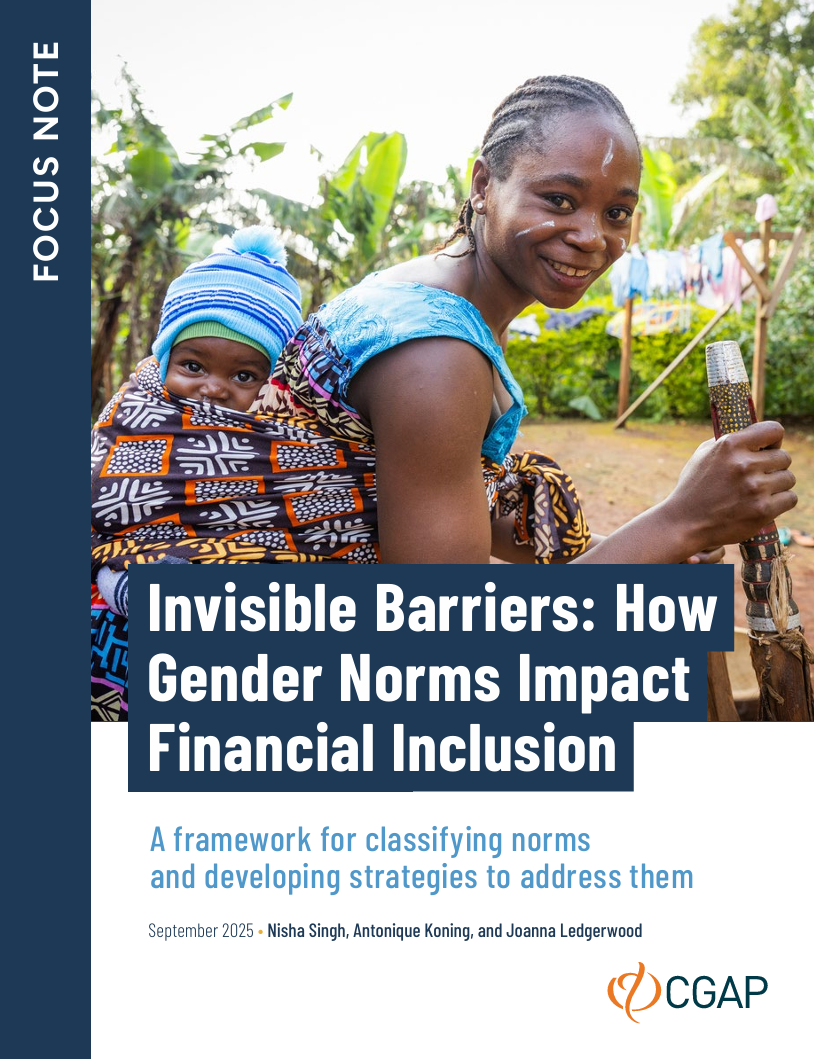
Invisible barriers: How gender norms impact financial inclusion A framework for classifying norms and developing strategies to address them
This CGAP Focus Note presents a framework classifying gender norms by strength and prevalence to address barriers to women’s financial inclusion. Drawing on diagnostics in Rwanda, Tanzania and Uganda, it outlines four intervention strategies for development and market actors to transform financial systems and advance women’s economic empowerment.
China sustainable investment review series
The China Sustainable Investment Review is a recurring research series that provides a structured overview of the development of China’s sustainable investment market. It examines policy evolution, market practices, product types, and ESG integration across financial institutions using publicly available information.
Too-big-to-strand? Bond versus bank financing in the transition to a low-carbon economy
The paper shows bond markets price fossil fuel stranding risk, while syndicated bank loans do not. Firms substitute bonds with bank loans as climate policy risk rises, concentrating exposure in large banks and raising “too-big-to-strand” regulatory concerns.
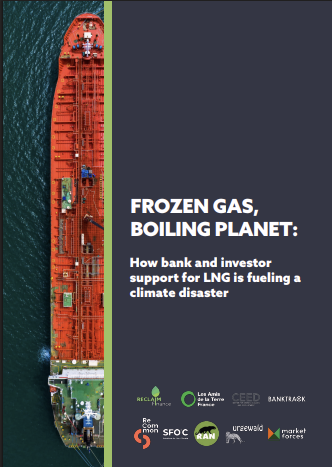
Frozen gas, boiling planet: How bank and investor support for LNG is fueling a climate disaster
The report analyses bank and investor financing of LNG expansion, finding US$213 billion in bank support and US$252 billion in investor exposure since 2021. It concludes this financing drives overcapacity, climate risk and misalignment with 1.5 °C pathways.
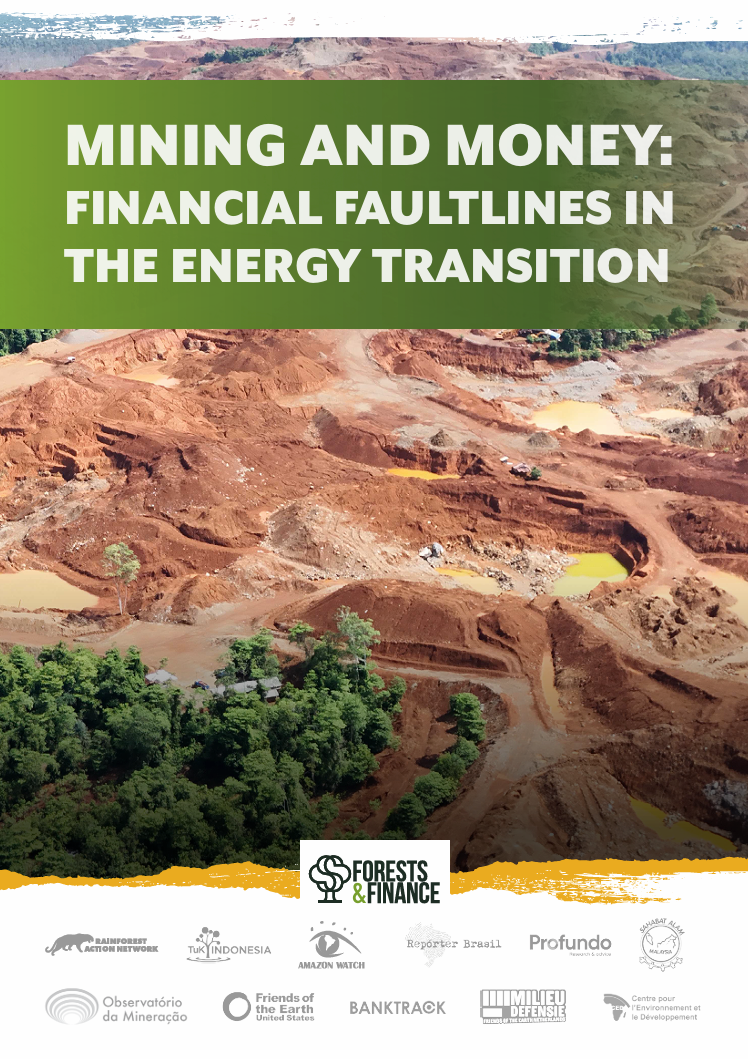
Mining and money: Financial fault lines in the energy transition
This report analyses global financing of transition mineral mining, showing concentrated capital flows, weak financial institution policies, and material environmental and human rights risks. It links bank and investor finance to mining harms across key regions and calls for stronger regulation and safeguards to enable a just energy transition.

Systems-informed stewardship part II: Bringing a systems perspective to stewardship
This article applies a systems lens to stewardship, arguing that fragmented intermediation and entrenched short-term time horizons undermine sustainability outcomes. It calls for recognising these structural barriers as a critical step toward more effective, systems-informed stewardship.

Climate fiduciaries: part III – mind the model gap
The article explores how pension funds rely on imperfect climate models to assess financial risk and whether fiduciary duty requires deeper scrutiny of their assumptions. It highlights emerging legal challenges, model limitations, and the shift toward richer scenarios and climate narratives in investment decision-making.
A path to post-growth pensions: How rethinking retirement savings could help us ensure wellbeing for all
This report examines how pension systems reliant on perpetual economic growth face systemic financial, social and environmental risks. It proposes reorienting pensions towards a post-growth framework, emphasising wellbeing and multicapital outcomes over financial returns alone, and outlines pathways and barriers for pension fund reform.
From promise to performance: Reforming blended finance for scale
This report examines why blended finance has failed to scale in emerging markets. Drawing on expert interviews and analysis, it identifies structural barriers and proposes reforms to improve transparency, risk pricing, liquidity, project pipelines and additionality, aiming to better mobilise private capital.
Nature-related risk and financial implications for investors
This investor briefing examines how nature-related physical, transition and system-level risks translate into financial risks for investors. It outlines macroeconomic and company-level impacts, and describes how institutional investors can integrate nature considerations into investment strategies, stewardship and policy engagement.
Advancing gender equality and women’s empowerment: Target setting guidance for banks
This guidance outlines how banks can set and implement measurable targets to advance gender equality and women’s empowerment across leadership, portfolios, financial inclusion and ecosystems, aligned with the Principles for Responsible Banking and Women’s Empowerment Principles.
Sustainability disclosure landscape report for risk management: Insights from climate-focused case studies
This report reviews sustainability disclosure standards and regulatory uptake, focusing on climate-related risk management. Using case studies, it examines IFRS S1 and S2 implementation, materiality assessments and transition plans, highlighting disclosure gaps, data challenges and practical approaches to improve decision-useful climate risk reporting.


