
Library | SASB Sustainability Sector
Financials
Refine
802 results
REFINE
SHOW: 16



You Built This
This article argues that modern investment strategies fuel economic extraction while often underperforming simpler alternatives. It calls on investors to realign portfolios with productive, community-oriented investments that generate real economic and social value.
Untapped potential: Asset owners and climate policy influence
Assesses major asset owners’ influence on climate policy, finding limited stewardship and advocacy despite significant potential. Most score poorly on climate lobbying oversight and transparency, with few aligning engagement to net zero goals. Highlights gaps in managing asset managers and industry associations, and calls for stronger, coordinated policy engagement.
Australian financial institutions’ views on climate and clean energy opportunities in South and Southeast Asia
Assesses Australian financial institutions’ views on climate and clean energy investment in South and Southeast Asia, highlighting growth potential, limited current exposure, key risks, and barriers. It emphasises blended finance, policy support, and government intervention to mobilise private capital and scale regional investment.
The 12th national risk assessment: Property prices in Peril
First Street argues climate risk is reshaping US housing via higher insurance costs and climate-driven migration, with projected net residential property value losses of about US$1.2 trillion by 2055 and 84% of census tracts facing some negative valuation effects.
Sustainable and responsible investment for central banks
NGFS reports outline how central banks can integrate sustainable and responsible investment into corporate, sovereign and broader portfolio management, using climate metrics, risk and impact frameworks, governance arrangements and practical implementation guidance, while recognising data gaps, methodological limits and trade-offs with mandates and core investment objectives.
Regulating finance for biodiversity: An assessment for the global biodiversity framework
This report assesses how financial regulation in Indonesia, Brazil, China, the EU and the US aligns with Global Biodiversity Framework targets, finding biodiversity integration generally weak and recommending stronger disclosure, due diligence, taxonomies, sanctions and sector-specific rules to redirect finance away from forest-risk activities.
Breaking down silos: Navigating the intersection of environmental and social risks for investors
Examines how environmental and social risks interact to create compounding financial impacts for investors. Presents a systems-based framework and agrifood case study illustrating portfolio volatility, credit risk and supply disruptions. Recommends integrated risk assessment, value-chain finance, stewardship and blended finance to strengthen portfolio resilience.
Mandatory climate reporting in Australia: A practical guide for 2026
Australia’s mandatory climate reporting regime began implementation from 2025, aligned with ISSB IFRS S2 standards. This guide explains regulatory expectations, governance responsibilities, emissions data requirements and practical steps organisations should take in 2026 to establish compliant climate disclosures, integrate climate risks into financial reporting, and prepare for assurance and regulatory scrutiny.
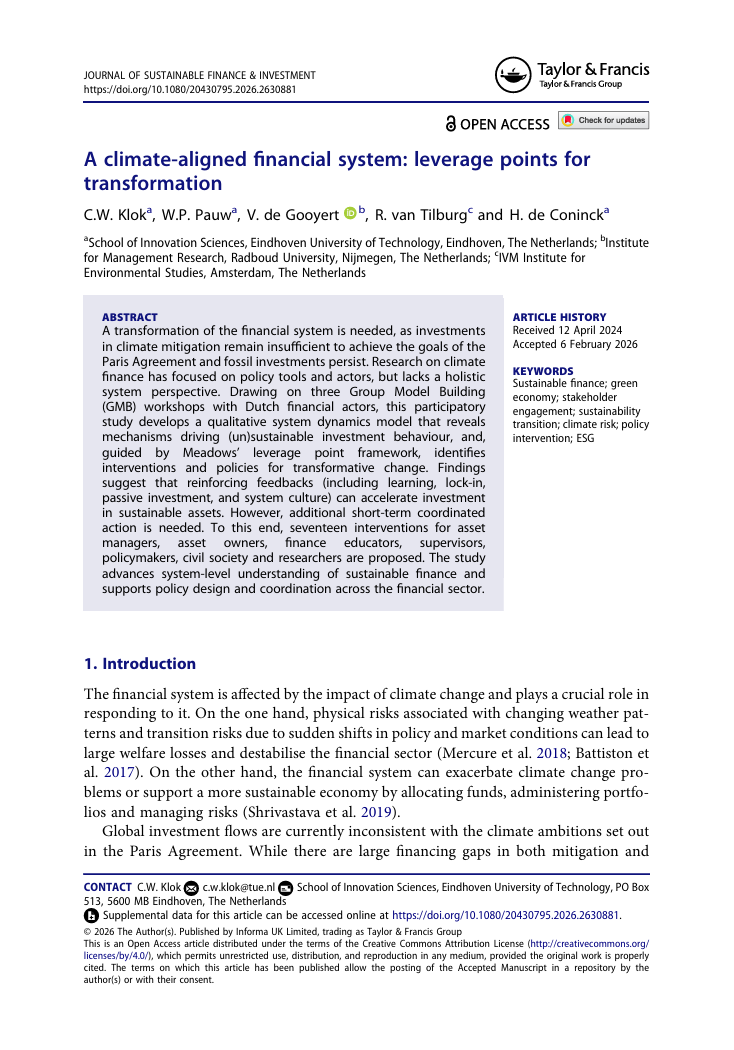
A climate-aligned financial system: Leverage points for transformation
This study models the financial system’s role in climate transition using participatory system dynamics with Dutch financial actors. It identifies reinforcing feedbacks like learning, technological lock-in, finance culture and passive investment and proposes seventeen policy and institutional interventions to redirect capital towards sustainable assets and align finance with Paris Agreement goals.
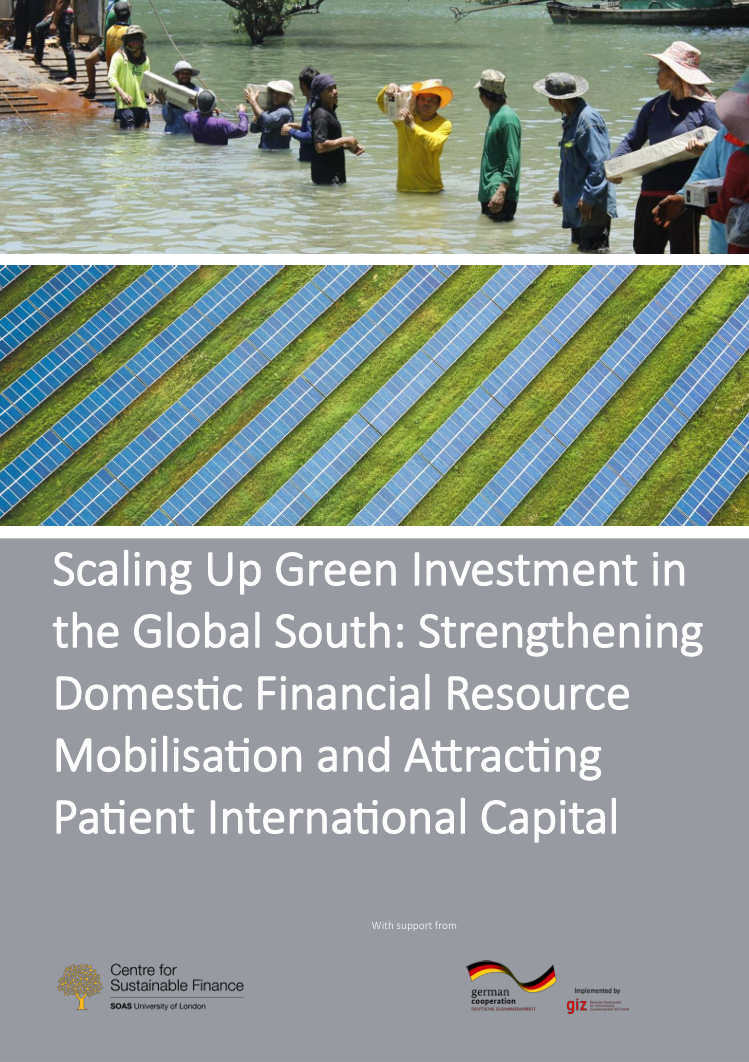
Scaling up green investment in the global south: Strengthening domestic financial resource mobilisation and attracting patient international capital
This report examines why capital flows ‘uphill’ from emerging and developing economies and argues that scaling green investment requires stronger domestic financial resource mobilisation. It recommends developing local currency bond markets, empowering national development banks, reforming multilateral development banks, and establishing a climate finance facility to attract patient international capital.
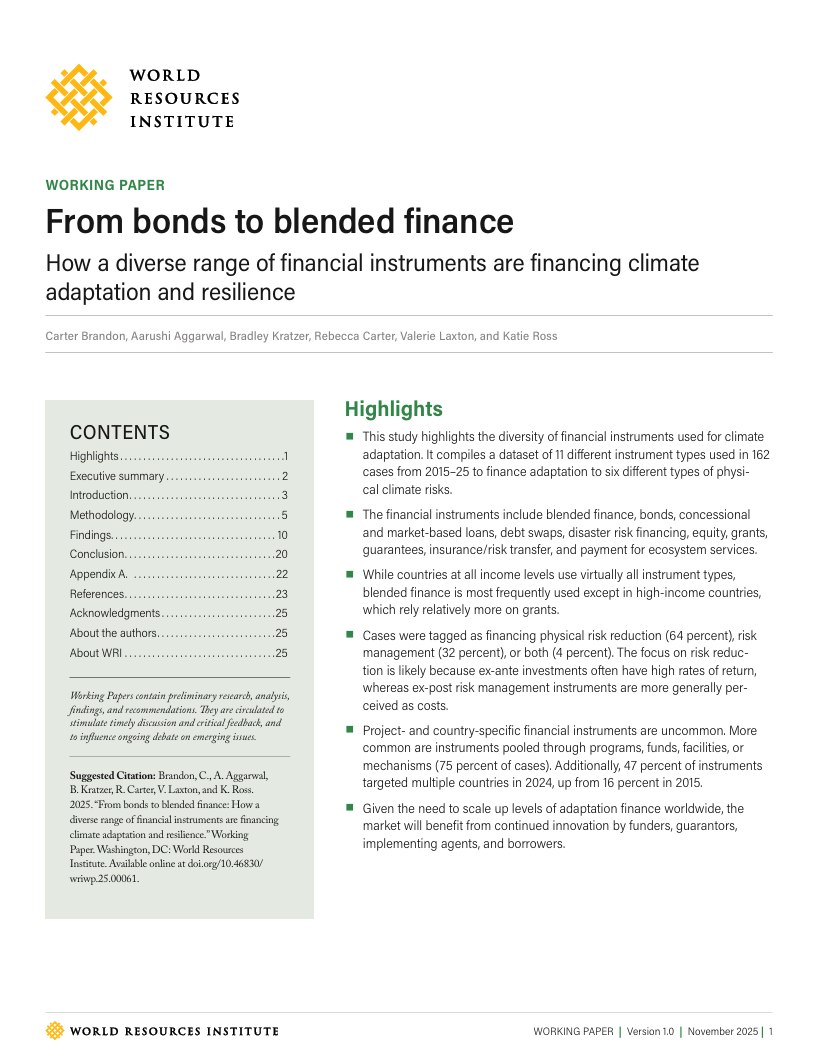
From bonds to blended Finance: How a diverse range of financial instruments are financing climate adaptation and resilience
Analyses 162 cases (2015–2025) of 11 financial instruments financing climate adaptation. Finds blended finance most prevalent, with instruments mainly supporting ex-ante risk reduction. Adaptation finance is largely pooled and increasingly multicountry. Use varies by income level, highlighting growing innovation to mobilise capital for resilience.
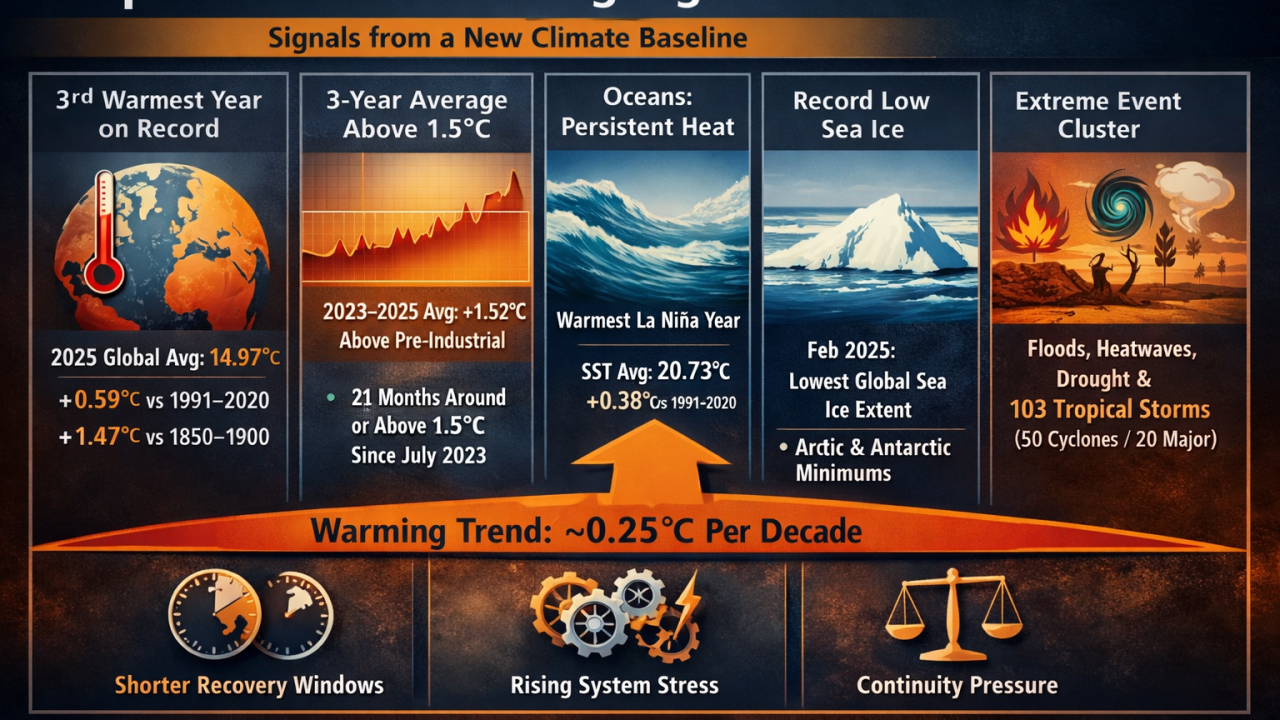
PerilScope: Strategic Deep Dive Copernicus Global Climate Highlights 2025 — From Records to Operating Conditions in the 3°C World SRP® Frame
The article interprets Copernicus’s Global Climate Highlights 2025 as a shift from episodic extremes to a structurally warmer, more volatile baseline. It argues that persistent temperature exceedances, ocean heat, cryosphere decline, and overlapping hazards demand a move from climate risk awareness to disciplined adaptation and continuity planning.

Starting and transitioning into sustainable finance careers
This guide outlines pathways for starting or transitioning into sustainable finance careers. It explains ESG integration, sustainable and impact investing, sector roles, required skills, barriers and transition strategies, supported by Australian context, expert insights and case studies from Pollination and Aware Super.
Global pension transparency benchmark
The Global Pension Transparency Benchmark is a benchmark series initiated in 2021 that assesses how clearly major pension funds disclose information on value-generation for stakeholders. It evaluates public disclosures across four equally weighted factors — governance and organisation, performance, costs and responsible investing — using a structured scoring methodology. The purpose is to promote better transparency and accountability in pension reporting. Finance professionals can use the benchmark to compare disclosure practices, inform improvements in fund reporting and align with evolving global standards.
Nature-based risk assessment: Integrating project-related finance
Guidance from UNEP FI and the Equator Principles on integrating project-related finance into nature-based risk assessments. It outlines frameworks, governance and disclosure expectations to help financial institutions identify, assess and manage biodiversity, water and pollution-related risks at project and portfolio levels.
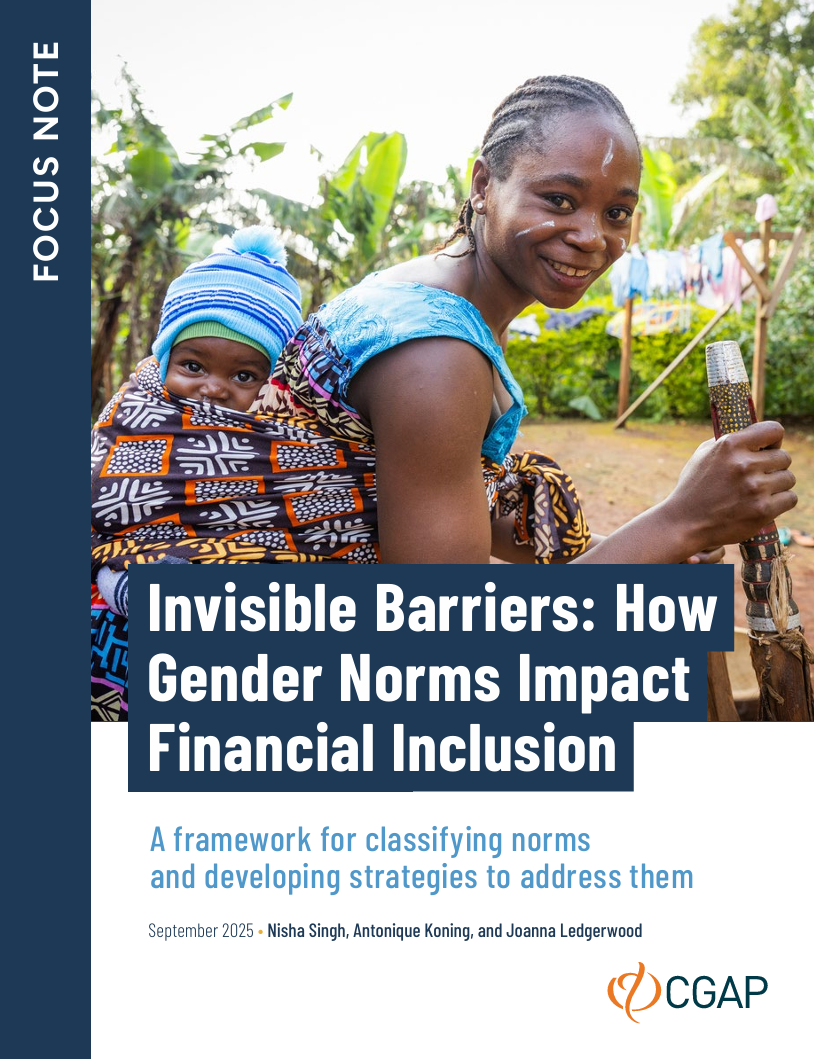
Invisible barriers: How gender norms impact financial inclusion A framework for classifying norms and developing strategies to address them
This CGAP Focus Note presents a framework classifying gender norms by strength and prevalence to address barriers to women’s financial inclusion. Drawing on diagnostics in Rwanda, Tanzania and Uganda, it outlines four intervention strategies for development and market actors to transform financial systems and advance women’s economic empowerment.


