
Library | SASB Sustainability Sector
Financials
Refine
835 results
REFINE
SHOW: 16


The impact of patient capital
This research examines how investor patience influences venture capital strategies and startup outcomes. Using a 2014 Chinese reform and a survey experiment, it demonstrates that longer-horizon investors, such as insurers, lead funds to adopt longer holding periods and earlier-stage investments, significantly improving portfolio innovation and successful exit rates.
Scaling uptake of insurance in the Municipal Climate Resilience Toolkit: Discussion paper
This research explores scaling parametric insurance to enhance municipal climate resilience in emerging markets. It identifies key barriers to uptake, maps the existing support ecosystem, and proposes three priority actions to improve the financial viability and affordability of insurance solutions for subnational governments worldwide.
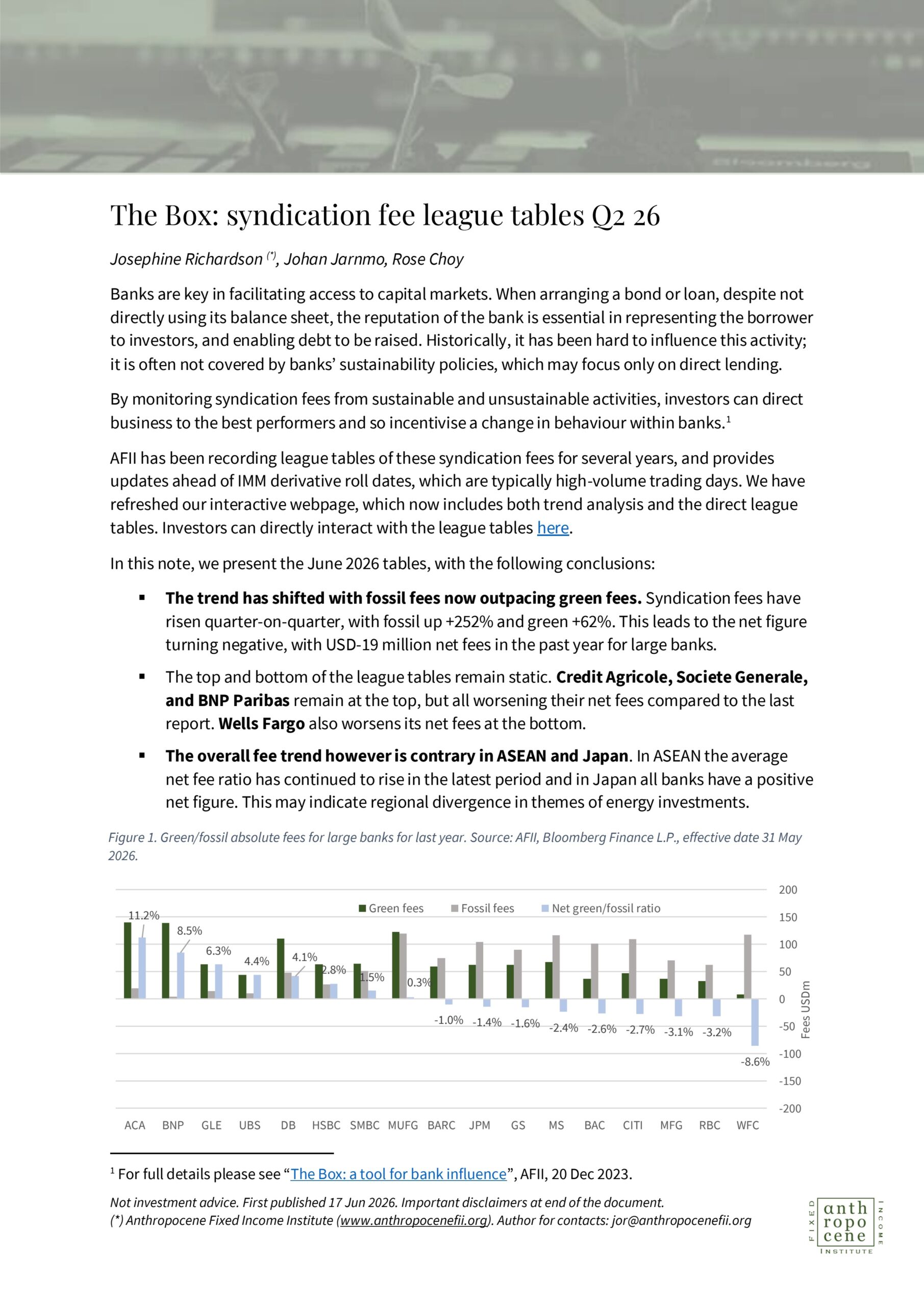
The Box: syndication fee league tables
This benchmark series provides transparency on bank syndication fees, comparing income from sustainable and unsustainable activities. It tracks league tables for global and regional financial institutions, including the ASEAN and Japanese markets. The analysis enables investors to incentivise behavioural change by identifying banks that continue to prioritise fossil fuel financing.
Upgrading financial markets
This field experiment in rural Sierra Leone evaluates upgrading Village Savings and Loan Associations into digital financial service agents. While infrastructure expands access, introducing consumer feedback mechanisms significantly improves service quality, transaction usage, and household shock mitigation. Results demonstrate that accountability is essential for developing functional, scalable financial markets.
Pricing power in the mortgage market: Evidence from GSE fee waivers
This research examines GSE fee waivers for lower-income first-time homebuyers, revealing that lenders pass through less than 40% of these savings. Intermediaries captured over 60% of the $1.5 billion benefit. High-cost loan officers and non-banks show the lowest pass-through, highlighting significant market power and search frictions.
Asset manager capture
This research examines "reverse capture", where government actors pressure large asset managers to advance political agendas. It analyses how expanding presidential power and market concentration enable this dynamic, using the ESG retreat as an illustration. The authors recommend narrowing fiduciary duties to insulate investment stewardship from political interference.
Corporate governance scandals in India’s banking and financial services sector
This research examines corporate governance failures in India’s financial sector, focusing on scandals at YES Bank, IndusInd Bank, and IL&FS. It analyses the impact of 'star' promoters, gatekeeper failures, and regulatory fragmentation, advocating for enhanced standards of care for directors and a wholesale reconsideration of sector-specific governance frameworks.
Managing LLM bias in investing: From detection to mitigation
This report examines implicit and explicit LLM biases in investment management. Through a case study on framing bias across nine OpenAI models, it identifies significant sensitivities in drawdown and client retention scenarios. It concludes that manual prompt restructuring and human-in-the-loop protocols are the most effective mitigation strategies.
Survey of Aotearoa New Zealand investors: Climate policies and actions series
This benchmark series examines the climate-related investment policies and actions of institutional investors in Aotearoa New Zealand. It monitors progress in embedding climate risks into financial decision-making, target setting, and investment in climate solutions, providing transparency and accountability across the local investment sector.
Regulating artificial intelligence in finance: Lessons from Singapore
This research analyses Singapore's multi-layered approach to regulating artificial intelligence in finance. It evaluates frameworks like the FEAT Principles and Project MindForge while identifying risks such as deepfakes and bias. The paper recommends establishing a dedicated regulatory sandbox and shared responsibility frameworks to manage evolving technological and third-party risks.
Bridging climate and credit risk: Current approaches and emerging trends for climate-related credit risk assessment methodologies—insights from a global survey
This report examines findings from a survey of 32 global banks on climate-related credit risk assessment. It highlights progress in probability of default modelling and widespread adoption of NGFS scenarios, while identifying persistent challenges in data reliability, technical expertise, and the quantification of financial impacts on capital requirements.

Three ways to move a company: A typology of best-practice investor engagement
This research examines three distinct models of investor engagement through case studies of BP, Honeywell and Bâloise. It highlights how financial-materiality framing and structural shifts in stewardship, including the fragmentation of 'Big Three' voters and SEC regulatory changes, are reshaping corporate governance and activist strategies for 2026 and 2027.
Charting the path: Foundations for a scalable First Nations investment market in Australia
This research outlines foundations for a scalable First Nations investment market in Australia. It identifies systemic barriers and proposes a theory of change focused on representation, systems alignment, and capital flows. The report recommends embedding cultural authority into governance and utilising blended finance to support First Nations economic self-determination.
Ocean investment protocol: A multi-stakeholder plan to enable funding for the sustainable ocean economy
This report outlines a multi-stakeholder framework to accelerate funding for a sustainable ocean economy. It provides specific recommendations for financial institutions, insurers, and governments to manage systemic risks and mobilise the estimated one trillion dollars in additional finance required by 2030 to meet global climate and biodiversity targets.
Manufactured consent: Stopping the harm from manipulative lead generation
Lead generation in Australia's digital economy has become a significant source of consumer harm, involving the harvesting of contact details for sales pitches. This report examines manipulative practices that manufacture consent to avoid consumer protections, highlighting the $1 billion loss from the First Guardian and Shield Master Funds collapse.
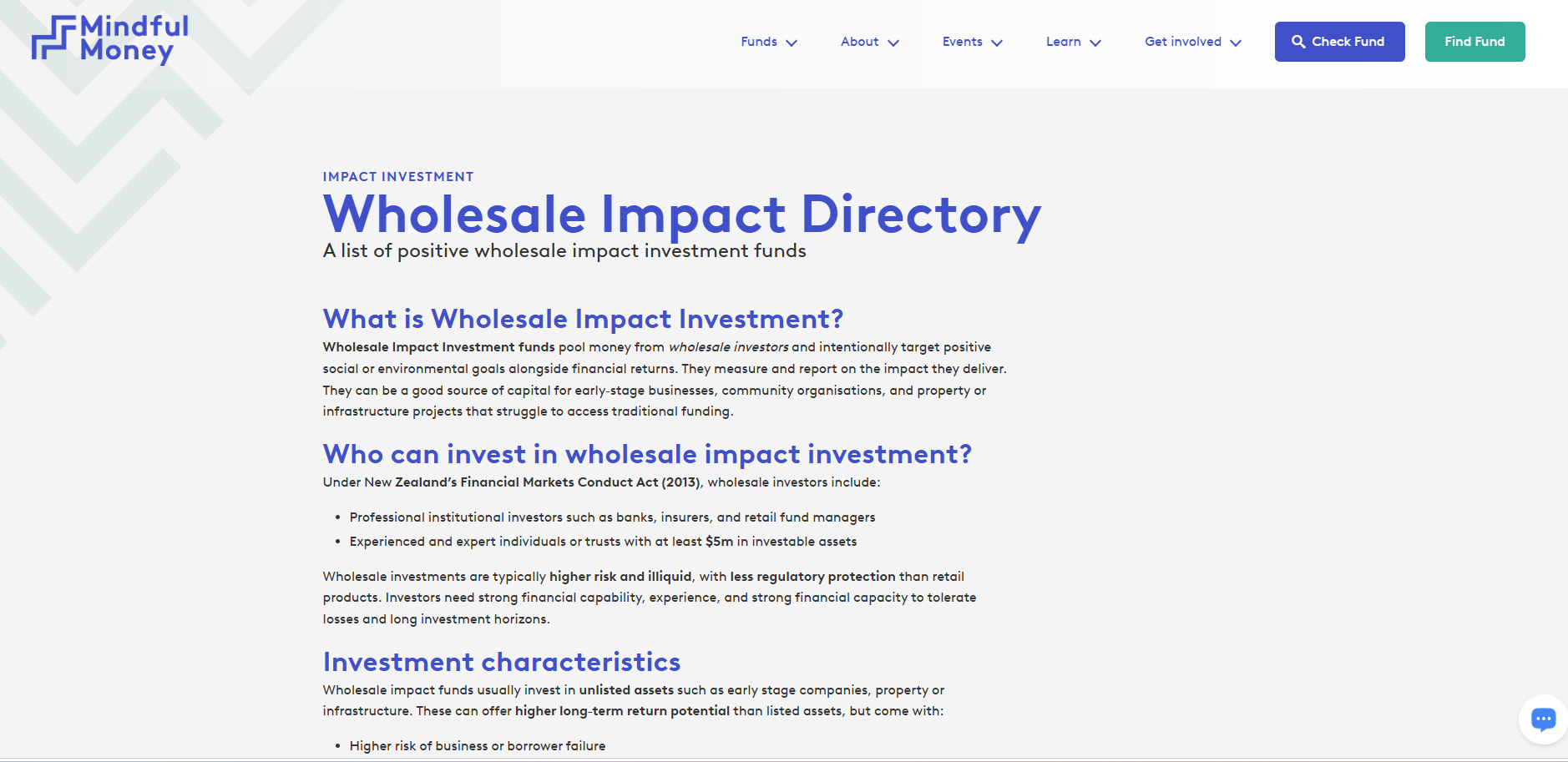
Wholesale Impact Funds Directory
A directory of New Zealand wholesale impact investment funds targeting social and environmental goals. It identifies specialist managers across climate solutions, affordable housing and renewable infrastructure.


