

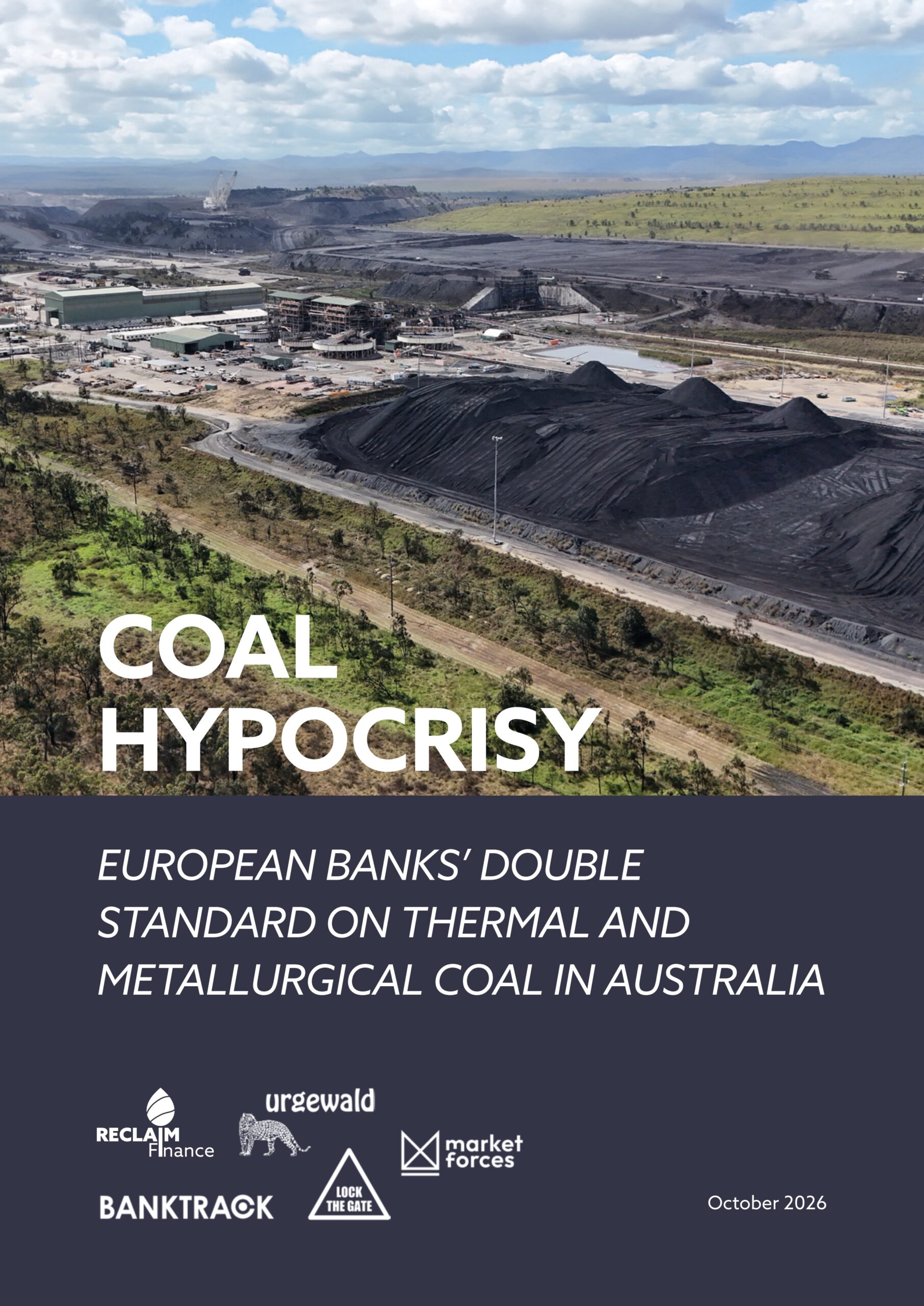
Coal hypocrisy: European banks’ double standard on thermal and metallurgical coal in Australia
Between 2021 and 2025, 19 European banks provided US$30.3 billion to metallurgical coal developers in Australia’s Bowen Basin. This report highlights the inconsistency of banks restricting thermal coal while funding metallurgical coal expansion. It recommends extending exclusion policies to metallurgical projects and corporate financing to align with climate goals.
Please login or join for free to read more.

OVERVIEW
Introduction
Over a decade ago, more than 70 financial institutions, including over 20 major banks, publicly refused to support thermal coal mines in the Galilee Basin in Queensland, Australia. This refusal was based on the significant damage these projects would cause to the climate, the Great Barrier Reef, and Indigenous rights. However, just 150 kilometres away in the Bowen Basin, these same banks are currently financing companies developing metallurgical coal with similar or worse impacts. While most major banks now restrict finance for thermal coal, metallurgical coal remains a significant blind spot in the climate policies of financial institutions. Australia has the largest metallurgical coal expansion pipeline globally, with the Bowen Basin accounting for the bulk of it.
Methodology
This report focuses on metallurgical coal mining expansion in the Bowen Basin and the European banks financing these activities. The analysis is based on financial data from the top 65 global banks and their loans and capital markets activities between 1 January 2021 and 31 December 2025. It specifically examines 11 corporate groups planning expansions listed on Urgewald’s Metallurgical Coal Exit List 2026. Figures reported are unadjusted, corporate-level financing, reflecting that expansion is incompatible with climate goals regardless of the proportion of a company’s business it represents. Of the 65 banks assessed, 44 were found to have financed in-scope metallurgical coal companies, including 19 European banks.
Queensland shows the banks’ double standard on coal
The distinction banks draw between thermal and metallurgical coal is commercial rather than physical. There is no basis in chemistry or physics for treating metallurgical coal as a lesser risk. Between 2021 and 2025, international banks channelled US$105.9 billion to companies planning metallurgical coal expansion in the Bowen Basin. Nineteen European banks provided US$30.3 billion of this total. The biggest financiers include Crédit Agricole (US$4.5 billion), Barclays (US$3.4 billion), Santander (US$3.1 billion), Deutsche Bank (US$3.0 billion), UBS (US$2.9 billion), and BNP Paribas (US$2.5 billion).
Financing is highly concentrated, with nearly three-quarters of the total going to three companies: Glencore (US$36.9 billion), Mitsubishi (US$28.1 billion), and BHP (US$13.6 billion). Although all 19 European banks restrict project finance for thermal coal, and 12 explicitly restrict financing for thermal coal developers to some degree, none have imposed similar restrictions on metallurgical coal developers. Seven of these banks restrict finance to metallurgical coal projects, yet these restrictions are often irrelevant as metallurgical coal is rarely financed project-by-project, but rather through general corporate finance.
Two coal basins: same impacts, different policies
The Bowen Basin produced around 209 million tonnes of coal in 2023–2024, with plans to expand capacity by more than 97 million tonnes per year. If all planned expansions proceed, annual emissions would reach roughly 800 million tonnes of CO2, exceeding the 705 million tonnes estimated for the Galilee Basin at full build-out. Metallurgical coal is more methane-intensive than thermal coal; satellite measurements attributed 1.6 million tonnes of methane to the Bowen Basin alone over 2019-2020. This is equivalent to 134 million tonnes of CO2 per year over a 20-year period.
Environmental impacts extend beyond climate change. Both Bowen and Galilee mines drain into catchments flowing into the Great Barrier Reef lagoon, threatening the UNESCO World Heritage Area with pollution, sedimentation, and flow alteration. Proposed mine lease areas in the Bowen Basin cover 123,000 hectares, including 42,500 hectares of potential koala habitat. Furthermore, the mines are located on the lands of the Barada Barna, Widi, Iman, and Gaangalu peoples, where current cultural heritage protections have been criticised as inadequate. Health impacts for surrounding communities include elevated hospitalisation risks for respiratory and circulatory diseases.
Conclusion and recommendations
The International Energy Agency expects global metallurgical coal demand to decline by 5% between 2025 and 2030, and up to 89% by 2050 under a net-zero pathway. Technologies such as hydrogen-based direct reduced iron (DRI) make a complete phase-out of coal from steelmaking technically feasible by the early 2040s. The report suggests that several flagship Bowen mine projects have yet to reach a final investment decision, meaning bank refusal could still force companies to re-evaluate their plans.
The report provides two primary recommendations for financial institutions. First, they should extend Galilee-era commitments to the Bowen Basin by publicly ruling out direct support for metallurgical coal expansion projects and dedicated infrastructure. Second, banks should adopt a metallurgical coal exclusion at both project and corporate finance levels, ending loans, capital markets services, and advisory services to companies developing new metallurgical coal mines or extensions. Financial institutions are urged to use Urgewald’s Metallurgical Coal Exit List as a reference for identifying companies to exclude.




