
Library | Finance relevance
General / All finance professionals
Refine
1353 results
REFINE
SHOW: 16


Mapping the landscape of net-zero nature-positive finance: A review of definitions and frameworks
This report provides a comprehensive review of definitions and frameworks for net-zero, nature-positive, and climate-nature finance. It identifies alignment areas and implementation gaps, advocating for integrated risk and investment approaches to achieve global sustainability goals under the Paris Agreement and the Kunming-Montreal Global Biodiversity Framework.
Environmental claims, climate promises, and ‘greenwashing’ by meat and dairy companies
This research examines environmental claims from 33 major meat and dairy companies. It finds that 98% of 1,233 identified claims constitute greenwashing. While most claims are climate-related, many are unverifiable future promises lacking scientific evidence. The industry’s sustainability reporting often mimics tactics used by the fossil fuel sector.
Toward transformation in finance: Seeds of nature-positive futures
This research examines "finance for nature seeds" — innovative initiatives aimed at transforming the financial sector to reverse nature loss. By analysing 92 global projects, the study identifies diverse approaches to funding nature stewardship, highlighting current reliance on market-based mechanisms and the potential for inclusive, value-pluralistic financial systems.
The emancipatory potential of biodiversity reporting: Evidence from the United Kingdom and South Africa
This research evaluates the emancipatory potential of biodiversity reporting within the United Kingdom and South Africa. Analysing disclosures from 2018 to 2022, it finds significant increases in reporting intensity. The study presents a principles-based framework to distinguish between compliance-oriented disclosures and transformative, action-oriented environmental reporting.
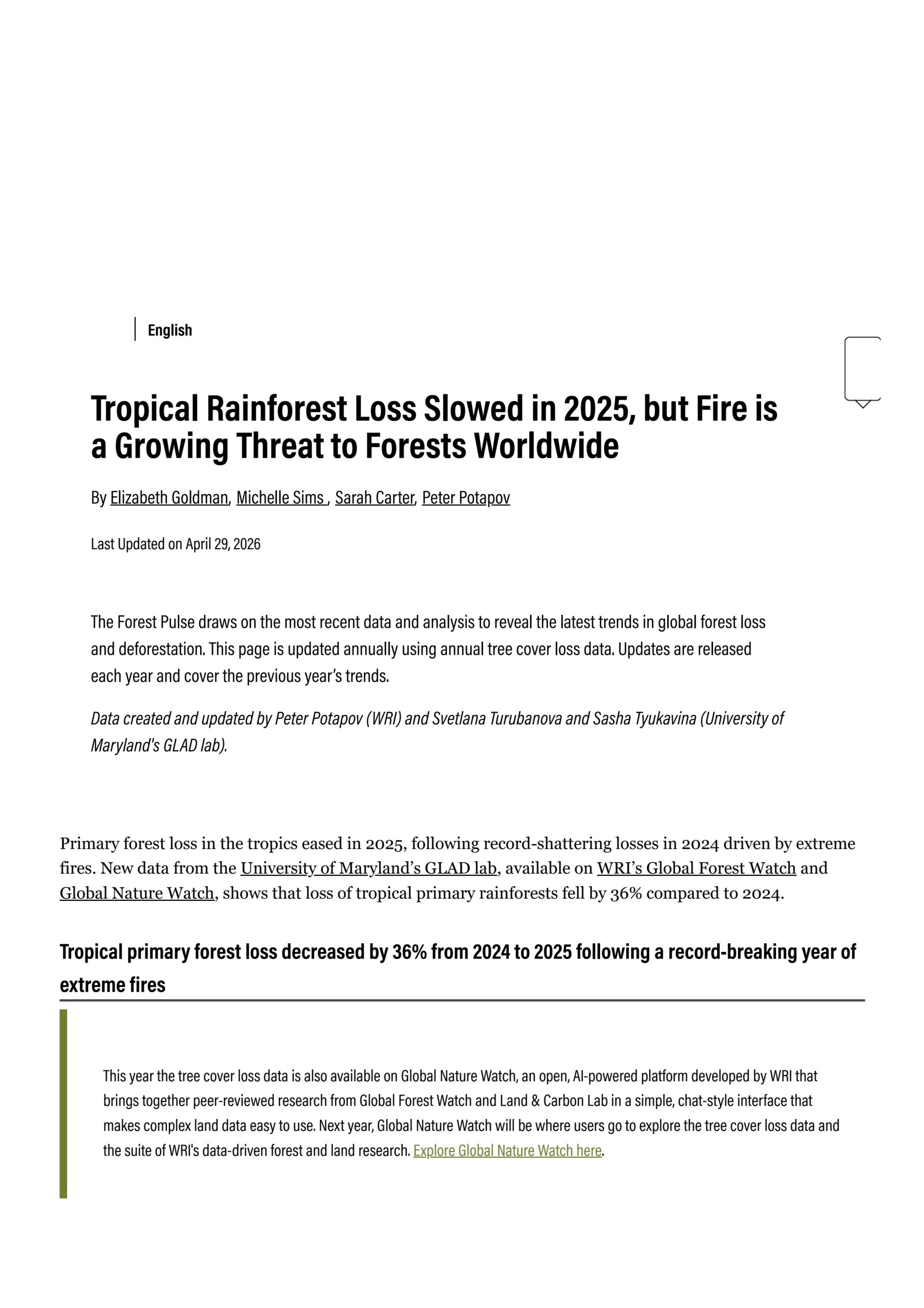
Tropical rainforest loss slowed in 2025, but fire is a growing threat to forests worldwide
Global tropical primary forest loss decreased 36% in 2025, though 4.3 million hectares were destroyed. Significant policy-driven reductions occurred in Brazil, but global deforestation remains 70% above levels required for 2030 targets. Fires drove 42% of global tree cover loss, with severe impacts in Canada and Europe.
Understanding inequality as a macro-financial risk to markets and diversified portfolios
This research identifies economic inequality as a systemic macro-financial risk to markets. It examines how wealth concentration and market power destabilise economies, fuel social instability, and hinder progress on global challenges. The report advocates for new financial analysis tools and disclosure frameworks to integrate social-related risks into investment strategies.
A well-adapted UK: The fourth independent assessment of UK climate risk (CCRA4-IA)
This report assesses the UK’s climate risks to 2050, identifies priority adaptation actions across key sectors, and outlines investment, policy and governance measures to strengthen resilience. It provides evidence-based recommendations to support climate adaptation planning and reduce long-term economic and societal impacts.

Plastic footprint guidelines
The Plastic Footprint Network's guidance document presents a science-based methodology for assessing corporate plastic footprints. Developed by over 100 professionals from 35 organisations, the framework comprises 11 modules covering macroplastics and microplastics, providing practitioners with a step-by-step process for measuring plastic leakage and reporting results.
AI data centers and electricity demand: Taming the energy guzzlers
This paper examines AI data centre electricity demand and its costs for ratepayers and the environment. It finds that Big Tech market capitalisations have risen far above predicted levels since ChatGPT's 2022 launch, while data centres drive up electricity prices and fossil fuel use. Regulatory reforms and innovations are recommended.
Shareholder proposals and corporate governance in a season of regulatory uncertainty
This report analyses the 2025–2026 proxy season following the SEC's suspension of its no-action review process. Shareholders filed approximately 20% fewer proposals; companies filed over 100 fewer exclusion notices. Exclusions disproportionately affected novel and revised proposals, with proponents increasingly turning to litigation and alternative strategies to preserve shareholder rights.
Widening the lens: Scaling climate adaptation and resilience through sustainable finance
This report examines climate adaptation and resilience in sustainable finance, highlighting a significant financing gap in emerging markets and limited formal allocation in labelled debt markets. It argues for a broader lens that recognises resilience outcomes already embedded in policy-driven investments, using Ecuador's sovereign housing framework as a case study.
Ratings insights: Understanding the global green bond index
Sustainable Fitch maps its framework and entity-level ratings to the Bloomberg MSCI Global Green Bond Index, covering 88% of index bonds. While index constituents show stronger framework quality and ICMA alignment than the broader market, many high-quality and transition-relevant bonds sit outside the benchmark due to financial eligibility constraints.
Navigating towards water resilience: An introductory guide for central bankers, financial supervisors and regulators
This WWF Greening Financial Regulation Initiative guide introduces central banks, financial supervisors and regulators to the financial risks posed by the global water crisis. It covers physical, transition and systemic risks, emerging responses from the financial sector, available assessment tools, and policy recommendations for integrating water risks into supervisory frameworks.
Interest rate caps, competition, and strategic borrowing: Evidence from Kenya
This paper examines Kenya's 2016 interest rate regulation, which capped bank lending rates but exempted the digital platform M-Shwari. Using borrower-level administrative data and a structural model, the authors find that the M-Shwari carve-out preserved credit access for high-risk borrowers, while a uniform cap would have eliminated it entirely.
Potential business cases in measuring biodiversity state and impact in agriculture
A joint Mistra FinBio and Svensk Kolinlagring report identifying three business cases linking biodiversity data to agricultural finance: baseline databanks for bank and insurance risk assessment, and an MRV system for biodiversity claims. It highlights the financing gap in regenerative agriculture and outlines potential biodiversity-linked financial products.
Credible climate financing and fossil fuel phase-out commitments are possible but remain marginal amongst major financial institutions
WBA's analysis of 400 major financial institutions finds that transition planning is emerging but capital allocation to low-carbon solutions and fossil fuel phase-out commitments remain marginal. Only two institutions demonstrate robust fossil-fuel restrictions, and low-carbon activities account for an average of just 2.7% of total financed activities globally.


