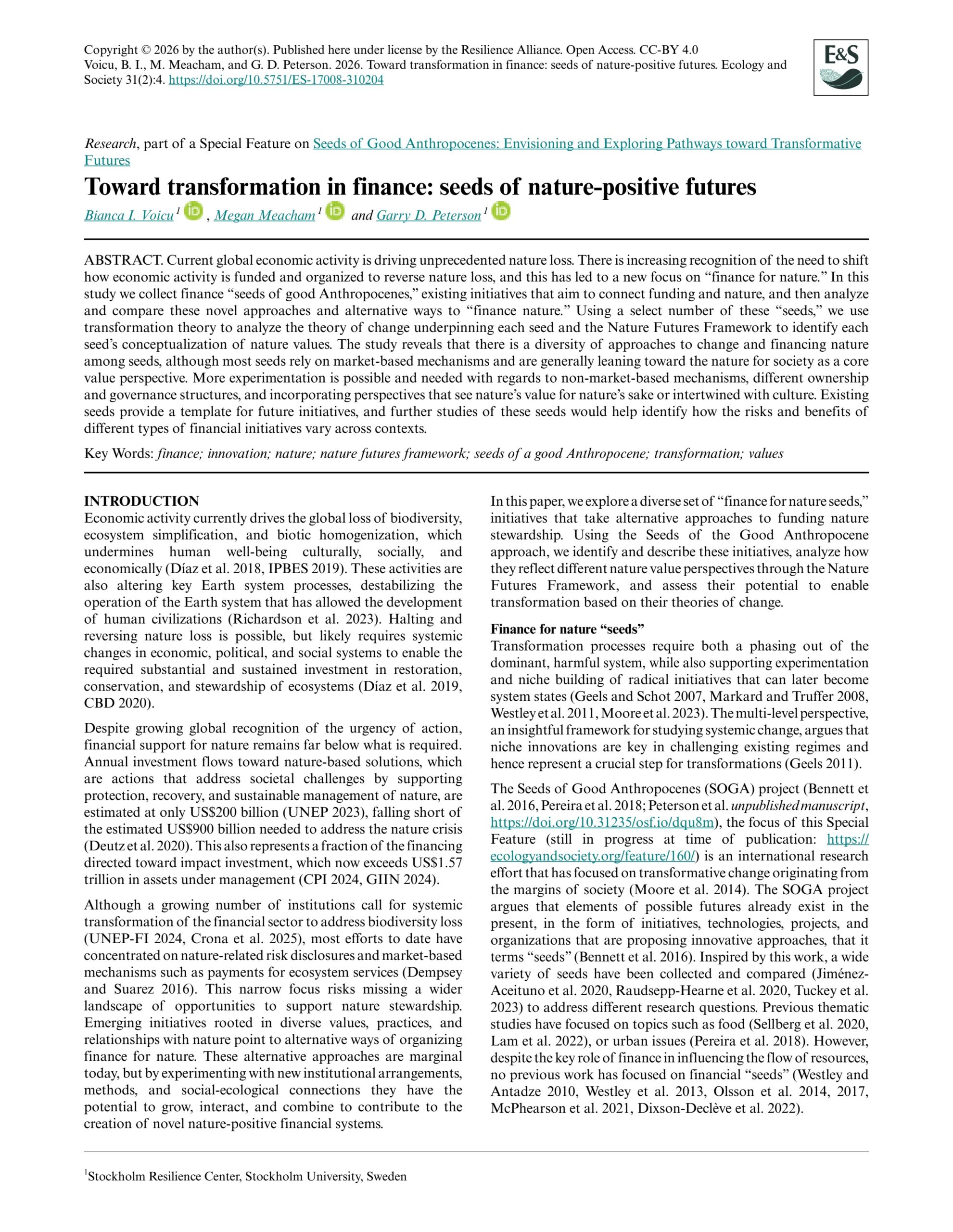
Toward transformation in finance: Seeds of nature-positive futures
This research examines “finance for nature seeds” — innovative initiatives aimed at transforming the financial sector to reverse nature loss. By analysing 92 global projects, the study identifies diverse approaches to funding nature stewardship, highlighting current reliance on market-based mechanisms and the potential for inclusive, value-pluralistic financial systems.
Please login or join for free to read more.

OVERVIEW
Introduction
Current global economic activity is driving unprecedented nature loss and destabilising key Earth system processes. Halting and reversing this trend requires systemic changes in economic, political, and social systems. Despite global recognition of the urgency, financial support for nature remains insufficient. Annual investment flows toward nature-based solutions are estimated at US$200 billion, significantly lower than the US$900 billion needed to address the crisis. Most current efforts focus on risk disclosures and market-based mechanisms, potentially overlooking wider opportunities for nature stewardship.
Finance for nature “Seeds”
This study explores “finance for nature seeds” — innovative initiatives that take alternative approaches to funding nature stewardship. Inspired by the Seeds of Good Anthropocenes (SOGA) project, these seeds represent projects, organisations, or technologies proposing radical approaches to challenge existing regimes. While previous studies have examined food or urban issues, this research is the first to focus specifically on financial seeds that could contribute to novel nature-positive financial systems.
Methods
A mixed-methods approach was used to identify and analyse relevant initiatives. Initial data collection through network sampling and a snowball method identified 117 potential seeds. This sample was refined using specific filtering criteria, resulting in a final sample of 92 potential seeds. From these, 30 seeds were selected for in-depth analysis to balance analytical depth with diversity. The study utilised “theory of change” analysis and the Nature Futures Framework (NFF) to identify how nature values are represented in their strategies.
Results
The 92 potential seeds showed an overrepresentation in Latin America (28) and Europe (17). Market-based mechanisms were the predominant financial instruments, accounting for 43.48% (40 seeds). Other categories included grants (16.30%), enabling activities, and public-private partnerships. The analysis revealed that most seeds aim to fill a market gap, with 66 initiatives proposing new financial products or segments.
Case studies highlight diverse approaches: Heritage Colombia uses a project finance for permanence model to protect 32 million hectares of landscapes; the Mysore Resettlement & Development Agency (MYRADA) empowers marginalised groups in India through participatory watershed management; and Raven Indigenous Capital Partners supports Indigenous businesses via community-driven outcomes contracts. Around 60% of the seeds focus on “Nature for Society” (NS) values, prioritising ecosystem services and sustainable use.
Discussion
The study indicates a general awareness of the multi-tiered complexity inherent in addressing nature loss. Almost half of the seeds proposed solutions implemented within current market structures, such as Terrasos’ habitat banks in Colombia which streamline legal offsetting requirements. However, another third represent collaborative initiatives working with previously marginalised communities to address social injustices. While plurality in values is acknowledged, the uptake in decision-making remains slow, leaning heavily toward instrumental perspectives.
Conclusion
Diverse financial instruments exist to support nature stewardship, ranging from direct investments to community-led partnerships. Although market-driven models remain most common, over a third of the initiatives focus on local community engagement, particularly involving Indigenous populations. Evidence suggests that promoting different ownership structures and inclusive strategies can enrich the options for nature-positive futures. Future research should evaluate the scalability and long-term impact of these initiatives across varied regional contexts.