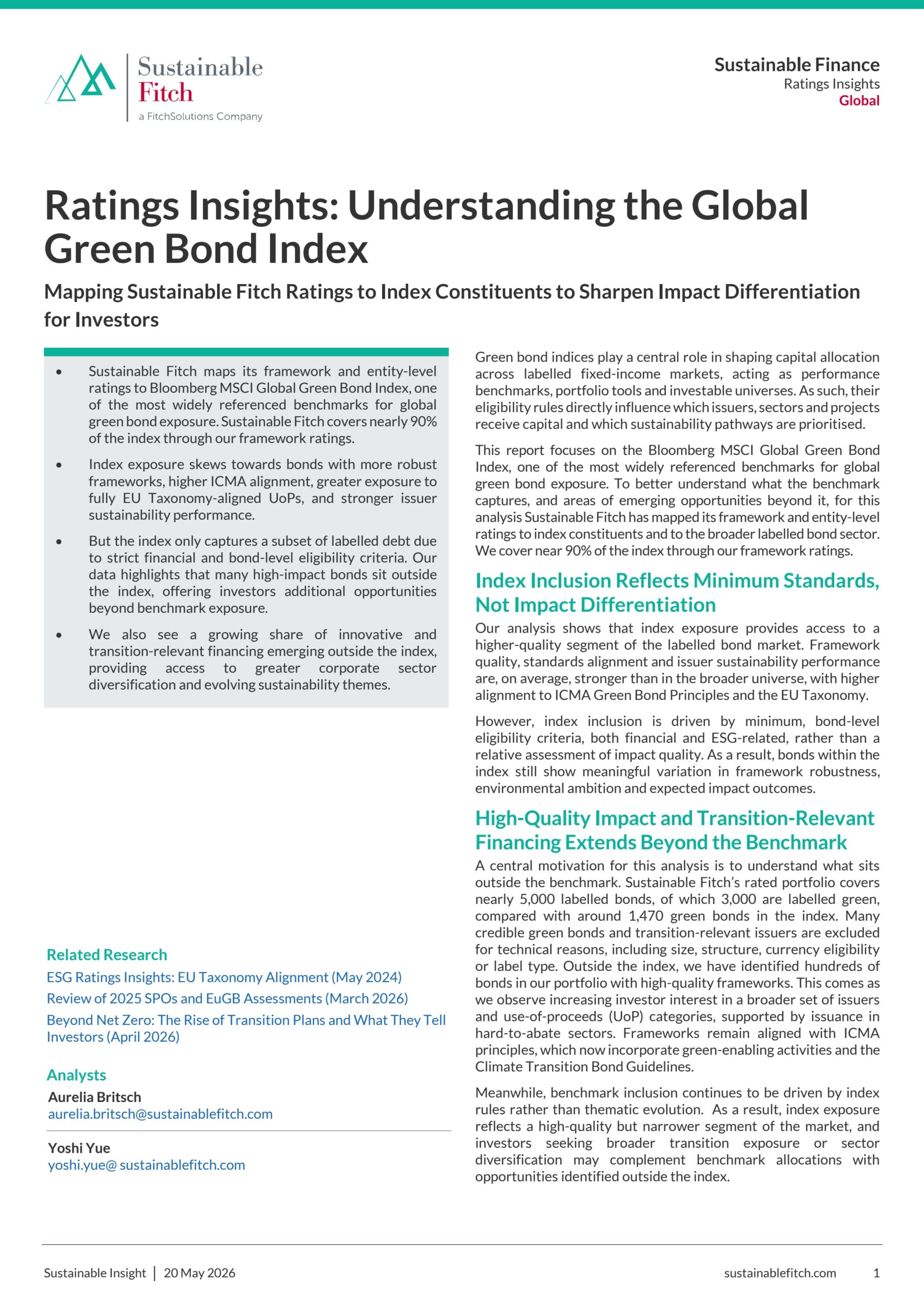
Ratings insights: Understanding the global green bond index
Sustainable Fitch maps its framework and entity-level ratings to the Bloomberg MSCI Global Green Bond Index, covering 88% of index bonds. While index constituents show stronger framework quality and ICMA alignment than the broader market, many high-quality and transition-relevant bonds sit outside the benchmark due to financial eligibility constraints.
Please login or join for free to read more.

OVERVIEW
Understanding a benchmark global green bond index
The Bloomberg MSCI Global Green Bond Index is one of the most widely referenced benchmarks for global green bond exposure. It uses a two-step approach: bonds must first qualify under the Bloomberg Global Aggregate framework (investment grade, plain-vanilla, eligible currencies, minimum issue size) before being assessed for green eligibility at the bond level. Index inclusion signals compliance with minimum financial, structural and labelling standards — it does not assess relative framework quality, depth of impact reporting or broader issuer sustainability performance.
Mapping Sustainable Fitch data to index constituents
Sustainable Fitch mapped its framework-level and entity-level ratings to individual index constituents. As of January 2026, the index comprised 1,726 bonds issued by 564 entities (p.3). Sustainable Fitch covers 88% of index bonds at the framework level, representing 1,517 bonds, and 62% of issuers at the entity level (p.3). The lower entity coverage reflects the index’s heavy tilt towards SSA issuers, for which Sustainable Fitch does not provide entity-level ratings.
Stronger framework quality for bonds in the index
Index constituents exhibit stronger framework quality than the broader Sustainable Fitch portfolio. The average framework score for index bonds is 80, compared with 77 for labelled bonds covered by Sustainable Fitch (p.3). Within the index, 12% of bonds achieve a framework rating of ‘1’ (excellent) and 86% achieve a rating of ‘2’ (good) (p.3).
Stronger alignment with international standards
Among index bonds, 98% are aligned with the ICMA Green Bond Principles, compared with 95% across the broader Sustainable Fitch-rated universe (p.3). Some bonds are included in the index despite not being fully ICMA-aligned under Sustainable Fitch’s more granular, quality-driven methodology.
Higher exposure to EU Taxonomy-aligned bonds
18% of Sustainable Fitch-covered index bonds have use-of-proceeds (UoP) fully aligned with the EU Taxonomy, compared with 9% in the broader Sustainable Fitch portfolio (p.4). This is partly because 76% of Sustainable Fitch-covered index bonds are issued by EMEA entities, a region that typically leads in taxonomy alignment due to longer market experience and stricter regulation (p.4).
Index skews towards stronger issuer profiles
Within the index, 64% of covered entities receive an entity rating of ‘2’ (good), compared with most entities in the broader universe rated ‘3’ (average) (p.5). The average entity score for index issuers is 65, versus 61 for the broader universe (p.5). At the sector level, supranationals, banks, telecommunications, utilities and insurance exhibit the highest average GSS scores within the index.
Finding high-impact bonds outside the benchmark index
Sustainable Fitch’s rated universe covers close to 5,000 labelled bonds, including around 3,000 green bonds, compared with about 1,470 bonds in the index as of January 2026 (p.5). Many bonds are excluded for technical reasons unrelated to sustainability quality, such as minimum issue size, investment-grade requirements or currency constraints.
Outside the index, Sustainable Fitch identifies 18 bonds with a framework rating of ‘1’ and 500 with a rating of ‘2’, with close to 300 of those sitting at the upper limit of the granular Framework Scores (p.6). The broader universe also offers greater sector diversity in transition-relevant sectors — around 6% of bonds outside the index are issued by entities in natural resources, metals and mining, alongside exposure to chemicals, construction materials and energy (p.6).
Sustainability bonds, which fall outside the index’s scope, represent a growing share of new labelled issuances. The report notes that robust and credible transition plans can expand the investment opportunity set beyond core index allocations.