
Library | Finance relevance
General / All finance professionals
Refine
896 results
REFINE
SHOW: 16


The building blocks supporting open finance
This working paper explores how open finance can drive financial inclusion by reducing costs, improving access, and providing better-suited products for underserved populations. Key building blocks—digital accounts, fast payments, and diverse financial providers—are essential for achieving open finance's potential, with case studies from Brazil and India highlighting successful implementation pathways.

The demand for a fair international financial architecture
The report explores the Global South's calls for reforming the international financial system. It highlights six key outcomes: improved representation, faster response times, increased funding scale, sustainable financing, enhanced global solidarity, and fostering economic self-reliance. The report underscores the urgency of reforming global financial institutions to address disparities.

Good Jobs First
Good Jobs First (GJF) is a nonprofit organisation dedicated to promoting accountability and transparency in economic development. By analysing public subsidies and incentives, GJF helps communities understand the impact of corporate subsidies on local economies. Their tools and resources support informed decision-making for sustainable economic growth and responsible investment.

How cheap talk in climate disclosures relates to climate initiatives, corporate emissions, and reputation risk
The report examines the relationship between corporate climate disclosures, cheap talk, and actual climate initiatives. It highlights how voluntary disclosures often suffer from superficiality, while targeted climate actions reduce cheap talk. Findings suggest cheap talk correlates with higher emissions and reputation risks, offering insights into the credibility of climate commitments.

OpenSecret's federal lobbying tool
OpenSecrets' Federal Lobbying tool offers insights into lobbying activities within the US government. It tracks spending by companies, industries, and interest groups, providing finance professionals with data on how lobbying efforts may influence legislation and policy, helping inform decision-making on regulatory and governance issues.

Modern slavery UK benchmark reports
The CCLA Modern Slavery UK Benchmark is an annual benchmark series assessing how major UK-listed companies disclose and act on modern slavery risks in their operations and supply chains, supporting investor engagement and improved corporate practice on human rights due diligence.

Action Exchange
Action Exchange connects professionals and organisations to collaborate on tackling complex sustainability challenges. The platform facilitates partnerships, sharing resources and expertise to drive impactful solutions across various sectors. It supports meaningful, action-oriented progress towards environmental and social goals.
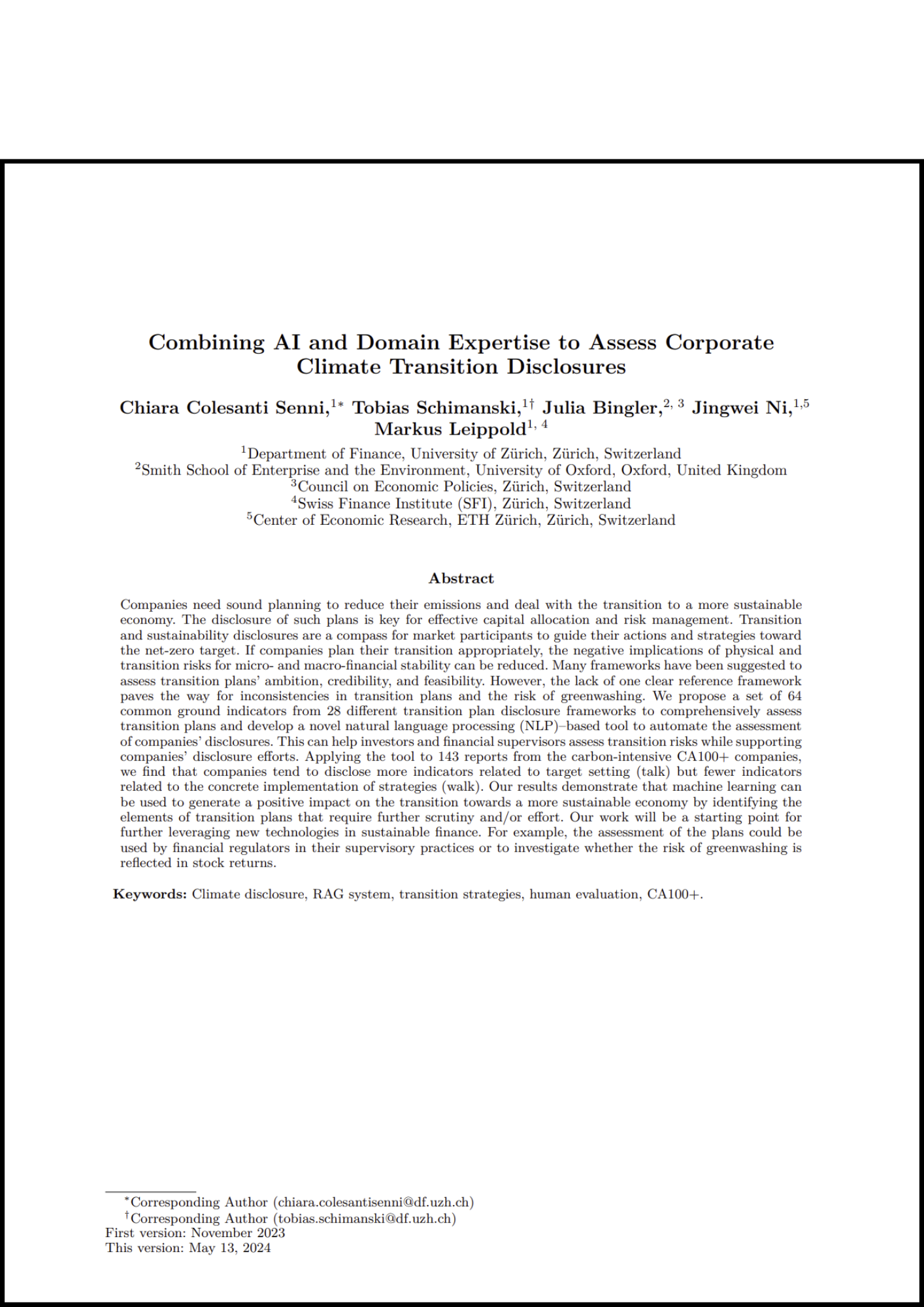
Combining AI and domain expertise to assess corporate climate transition disclosures
This paper introduces an assessment framework for corporate disclosures on climate transition strategies. It identifies 64 indicators from 28 frameworks, develops a natural language processing (NLP) tool to automate disclosure assessment, and analyses disclosures of carbon-intensive companies. The findings reveal that companies often prioritise reporting targets over concrete implementation actions.

An introduction to key ecological concepts, financial opportunities, and risks underpinning aspirations for nature positive
The report introduces key ecological concepts critical to achieving a nature-positive future. It outlines the financial opportunities and risks involved, emphasising the need for collaboration between ecologists and business professionals to effectively implement nature-positive strategies. The report also highlights the challenges and complexities in aligning ecological goals with financial instruments.

Global Alliance for Improved Nutrition (GAIN)
Global Alliance for Improved Nutrition (GAIN) is an international organisation focused on tackling malnutrition and improving nutrition worldwide. GAIN works with partners to create sustainable, scalable solutions, improving access to nutritious food. Their initiatives target vulnerable populations, aiming to enhance health and well-being through better nutrition.

Johns Hopkins University (JHU)
Johns Hopkins University (JHU) is a leading research university known for pioneering advances in various fields, including medicine, science, and engineering. JHU offers diverse academic programs and fosters a collaborative environment for students and researchers. Discover world-class education and groundbreaking research at Johns Hopkins University.

Work Health Index
The Work Health Index tool measures workplace health and wellbeing across various sectors. It provides organisations with insights into their performance, highlighting areas for improvement and enabling data-driven strategies to enhance employee wellbeing and productivity.

2024 good practice guide
This guide provides essential guidelines for companies and investors to enhance human rights due diligence, particularly in supply chains. It emphasises transparency, risk assessment, and responsible purchasing practices to combat forced labour. The guide also offers practical examples and benchmarks, helping stakeholders align with global standards and improve corporate disclosures.

Natural Capital Protocol
The Natural Capital Protocol provides a step-by-step guide for businesses to measure, value, and integrate natural capital into their operations. Divided into 9 stages, this comprehensive guide offers a practical approach to assess material risks and opportunities, communicate with stakeholders, and make informed decisions towards sustainable business practices.

The high-integrity sustainable aviation fuels handbook
The handbook provides introduction to sustainable aviation fuels (SAF) and guidance for the development and deployment SAF. It emphasises the need for robust sustainability criteria, transparent accounting systems and a life-cycle assessment approach to ensure significant emissions reductions compared to conventional jet fuel. It also offers policy recommendations to support the growth of SAF in the aviation industry.
A new economy: Exploring the root causes of the polycrisis and the principles to unlock a sustainable future
The report examines the systemic flaws of the current economic model, highlighting ecological, social, and geoeconomic crises. It proposes transitioning to a regenerative economy based on principles of sufficiency, circularity, systems thinking, equity, and redefining value to achieve sustainable and equitable growth.


