
Library | Sustainable Finance Practices
ESG Integration and analysis
Tools, methodologies, and frameworks for embedding ESG factors into financial analysis, valuation, credit assessment, underwriting, and portfolio management, while separating out broader strategic elements.
Refine
537 results
REFINE
SHOW: 16


3D investing: Implications for net zero
The report evaluates 3D investing, extending mean–variance optimisation to include sustainability. It shows how integrating forward-looking climate metrics enables portfolios to balance risk, return, and decarbonisation, supporting alignment with Paris-aligned net-zero pathways under realistic investment constraints.
CSRD: A guide to the physical risk requirements
This guide explains Corporate Sustainability Reporting Directive physical risk requirements, detailing scope, timelines and ESRS E1 disclosures. It outlines how organisations must identify, assess and report climate-related physical risks, financial impacts and adaptation actions, with a focused application to real estate portfolios.
Public Library of Science (PLOS)
PLOS (Public Library of Science) is a non-profit open access scientific publisher dedicated to advancing open science and accessible research publishing. It publishes peer-reviewed open access journals spanning life, health, sustainability and technology research, enabling free online access to scientific findings globally.

Climate X
Climate X is a climate risk analytics company providing asset-level physical climate risk data and scenario analysis. It supports financial institutions, insurers and corporates with decision-making, stress testing and regulatory alignment using proprietary climate models and geospatial intelligence.

Merian Research
Merian Research is a commercial research and advisory firm providing risk analysis, due diligence and open-source intelligence. It supports corporates, investors and law firms with strategic insights on reputational, political and operational risks across global markets.

Mindful Money
Mindful Money is a New Zealand–based charity promoting ethical investing and financial transparency. It provides independent research, fund comparison tools and investor advocacy to help people understand where their money is invested, supporting responsible investment, ESG integration and accountability across KiwiSaver and managed funds.

Impact Frontiers
Impact Frontiers is a finance-focused NGO advancing impact investing practice.It helps asset owners, asset managers and advisors integrate social and environmental impact into investment decision-making through frameworks, research, case studies and peer learning programmes, supporting impact measurement, management and capital allocation across public and private markets.

Sustainable Finance Roundup December 2025: Nature, Regulation, and the Hardening of Risk
This month’s sustainable finance roundup traces the shift from ambition to enforcement, as climate and nature risks become financial, regulatory and legal realities. It covers Australia’s environmental law reforms, the embedding of climate and nature risk through prudential supervision, disclosure and shareholder pressure, and insurer warnings on the limits of insurability. It also highlights how markets are responding to deforestation and biodiversity risk, and how litigation and regulation are reshaping governance and long-term financial resilience.
Investing in tomorrow: A guide to building climate-resilient investment portfolios
This guide outlines how investors can integrate physical climate risks into listed equity and debt portfolios, strengthen portfolio resilience, and mobilise capital for adaptation through asset allocation, due diligence, engagement, and collaboration across policy, finance and the real economy.

Making money talk nicely: Biodiversity impact assessment for investors
This study compares eight biodiversity impact assessment tools used by investors. It finds low consistency in company rankings due to non-standardised methods, weak transparency and limited validation, concluding that reliance on single tools risks mispricing nature-related financial risk and calling for improved disclosures and spatially explicit approaches.
Combined climate stress testing of supply-chain networks and the financial system with nation-wide firm-level emission estimates
This study utilises comprehensive Hungarian firm-level data to stress-test the economy and banking system against carbon pricing shocks. While direct impacts at €45/t appear minimal, supply chain contagion significantly amplifies losses, potentially by 4000% if essential inputs cannot be substituted. This highlights critical risks in systemic supply network dependencies.
Corporate sustainability and scandals
The report analyses global listed firms from 2010–2022 and finds that stronger alignment with UN Sustainable Development Goals is associated with fewer, less severe corporate scandals, especially in highly scrutinised sectors such as energy and utilities, offering investors predictive insight beyond conventional ESG ratings.
Leveraging physical climate risk data
The report outlines data requirements for assessing physical climate risks, highlighting gaps in hazard, exposure, vulnerability, and adaptation information. It reviews emerging tools, stresses limitations in insurance and asset-level data, and recommends capacity building, collaboration, and improved data systems to enhance financial sector climate-risk analysis.
Assessment of the biodiversity impacts and dependencies of globally listed companies
The report assesses biodiversity impacts and ecosystem service dependencies of 2,369 globally listed companies using multiple footprinting tools. It finds impacts highly concentrated among few firms, driven mainly by climate change, pollution and land use, with food, energy and chemicals sectors prioritised for investor engagement.
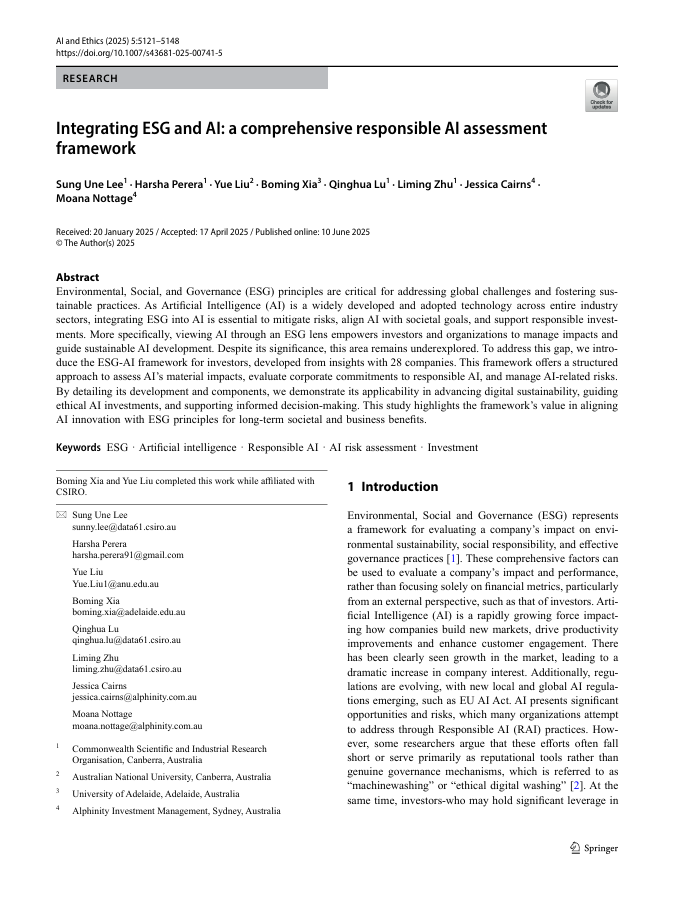
Integrating ESG and AI: A comprehensive responsible AI assessment framework
The report introduces an ESG-AI framework enabling investors to assess AI-related environmental, social, and governance risks. Drawing on insights from 28 companies, it provides use-case materiality analysis, governance indicators, and deep-dive assessments to support transparent, responsible AI evaluation and investment decisions.
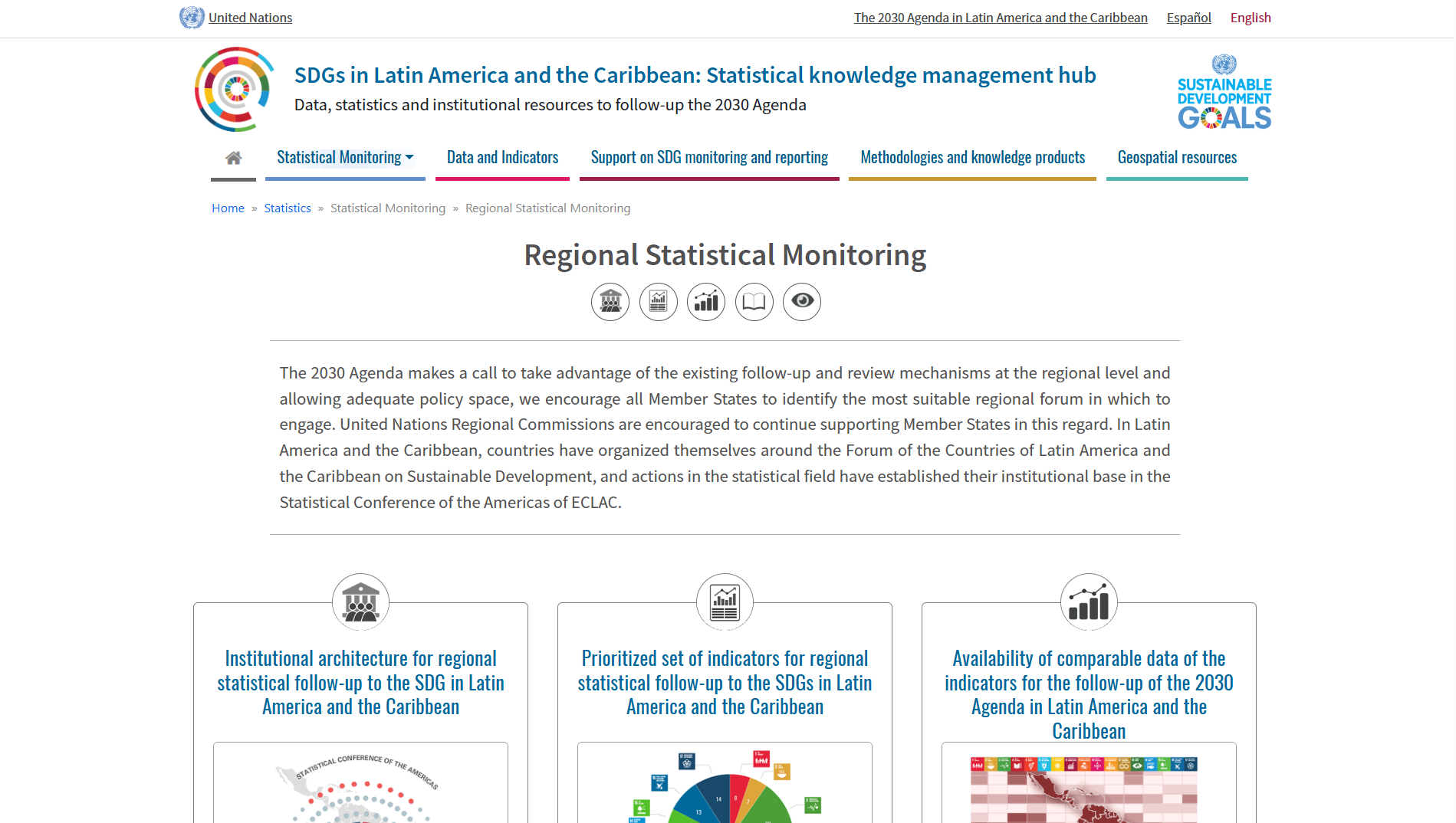
SDGs in Latin America and the Caribbean: Statistical knowledge management hub
The tool Regional Statistical Monitoring on the Economic Commission for Latin America and the Caribbean (ECLAC) portal aggregates comparable regional data on Sustainable Development Goals (SDG) indicators — combining global databases with regional-specific statistics and trend projections — to track progress towards the 2030 Agenda for Sustainable Development in Latin America and the Caribbean.


