
Library | Sustainable Finance Practices
Industry standards and guidance
Voluntary standards, non-legislative frameworks, methodologies, and best-practice guidance that support financial institutions in achieving sustainability objectives.
Refine
182 results
REFINE
SHOW: 16


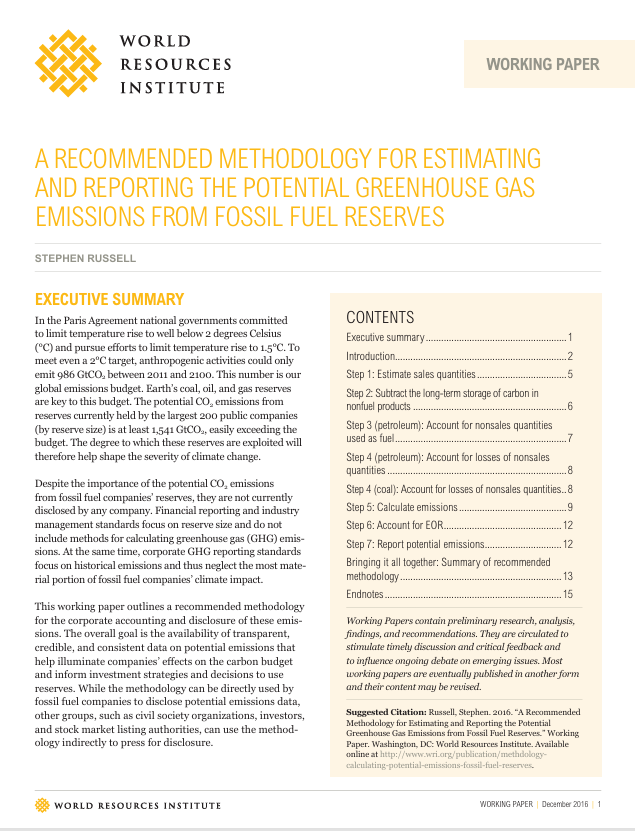
A recommended methodology for estimating and reporting the potential greenhouse gas emissions from fossil fuel reserves
This working paper presents a methodology for fossil fuel companies to estimate and disclose potential greenhouse gas emissions from their reserves. It outlines seven steps for calculating emissions, addressing combustion, leakage, and storage factors, with the aim of improving transparency and enabling comparison across companies and alignment with climate targets.
GHG protocol agricultural guidance: Interpreting the corporate accounting and reporting standard for the agricultural sector
The GHG protocol agricultural guidance provides a framework for agricultural companies to develop greenhouse gas (GHG) inventories aligned with the Corporate Standard. It offers sector-specific methodologies to account for direct and indirect emissions, carbon stock changes, and unique agricultural factors such as land use change and biological processes. The guidance enhances consistency, transparency, and usability of agricultural GHG data for decision-making and reporting.
How can we advance climate action on boards?
The report explores how board directors perceive and advance climate action. While most recognise its importance and opportunity, competing priorities and knowledge gaps hinder progress. Local Chapters of the Climate Governance Initiative are shown to support action through resources, training, and peer networks across varied global contexts.
The greenhouse gas protocol: Land use, land-use change, and forestry (LULUCF) guidance for GHG project accounting
The land use, land-use change, and forestry (LULUCF) guidance for GHG project accounting provides structured methods to quantify and report greenhouse gas (GHG) reductions from reforestation and forest management projects. It supplements the GHG Protocol for Project Accounting, detailing baseline procedures, monitoring, and risk mitigation approaches specific to land-based carbon projects.

Product life cycle accounting and reporting standard
The GHG Protocol Product Life Cycle Accounting and Reporting Standard provides a globally consistent framework for companies to quantify and publicly report greenhouse gas emissions and removals associated with individual products across their life cycle. It enables informed emissions reduction strategies and supports performance tracking, supplier engagement, and product differentiation.

Mitigation goal standard: An accounting and reporting standard for national and subnational greenhouse gas reduction goals
This report outlines a standardised framework for governments to design, assess, and report on greenhouse gas mitigation goals. It defines principles, methodologies, and accounting requirements to support consistent and transparent emissions tracking and goal evaluation at national and subnational levels.

The greenhouse gas protocol: A corporate accounting and reporting standard
The Greenhouse Gas Protocol Corporate Standard provides a framework for businesses to quantify and report greenhouse gas emissions. It establishes standardised accounting principles, categorises emissions by scope, and offers guidance for setting organisational and operational boundaries. The Standard promotes transparency, consistency, and comparability in corporate GHG inventories.

RIAA policy platform: Sustainable finance for a thriving Aotearoa New Zealand 2023 and beyond
This report outlines RIAA’s policy platform to strengthen sustainable finance in Aotearoa New Zealand. It recommends a national strategy, clearer ESG disclosures, taxonomy alignment with global standards, anti-greenwashing measures, Māori inclusion, human rights protections, and alignment with biodiversity and the Sustainable Development Goals.

GHG protocol scope 2 guidance: An amendment to the GHG protocol corporate standard
This report updates the GHG Protocol Corporate Standard by introducing dual reporting for Scope 2 emissions—requiring both location-based and market-based methods. It defines Scope 2 accounting principles, emission factor hierarchies, and quality criteria for contractual instruments, aiming to improve transparency, accuracy, and comparability across energy markets.

Corporate value chain (scope 3) accounting and reporting standard: Supplement to the GHG protocol corporate accounting and reporting standard
The Corporate Value Chain (Scope 3) Accounting and Reporting Standard provides a consistent framework for measuring and reporting indirect greenhouse gas (GHG) emissions across a company’s value chain. It outlines 15 categories of Scope 3 emissions, offers guidance on boundary setting, data collection, and reporting, and aims to improve transparency, enable emissions reduction, and support strategic decision-making.

University of Adelaide
The University of Adelaide, established in 1874, is Australia's third-oldest university and a member of the prestigious Group of Eight. Ranked among the top 100 globally, it offers a diverse range of undergraduate and postgraduate programs. Located in Adelaide, South Australia, the university is renowned for its research excellence and vibrant campus life.
Australian sustainable finance taxonomy (Version 1 - 2025)
The Australian Sustainable Finance Taxonomy (2025) provides a framework classifying economic activities aligned with environmental sustainability goals, particularly climate mitigation. It includes performance-based criteria for key sectors such as agriculture, mining, energy, construction, and transport, facilitating sustainable capital allocation, consistent reporting, and transition planning, thus supporting Australia’s transition to a net-zero emissions economy.
RIAA Policy Platform 2025: Harnessing sustainable finance for a thriving Australia
The RIAA Policy Platform 2025 outlines nine policy priorities and two principles to align Australia’s finance system with sustainability goals. It recommends regulatory reforms, improved data, Indigenous inclusion, and stronger accountability to mobilise capital for a net zero, nature-positive economy that supports long-term economic resilience and societal wellbeing.

Australian Sustainable Finance Capability Framework: Updated pilot version
The updated Australian Sustainable Finance Capability Framework outlines key competencies for roles in sustainable finance across Australia. It integrates First Nations perspectives, focuses on social and environmental sustainability, and guides skill development in areas such as strategy, risk management, and reporting to support sector-wide capability uplift.
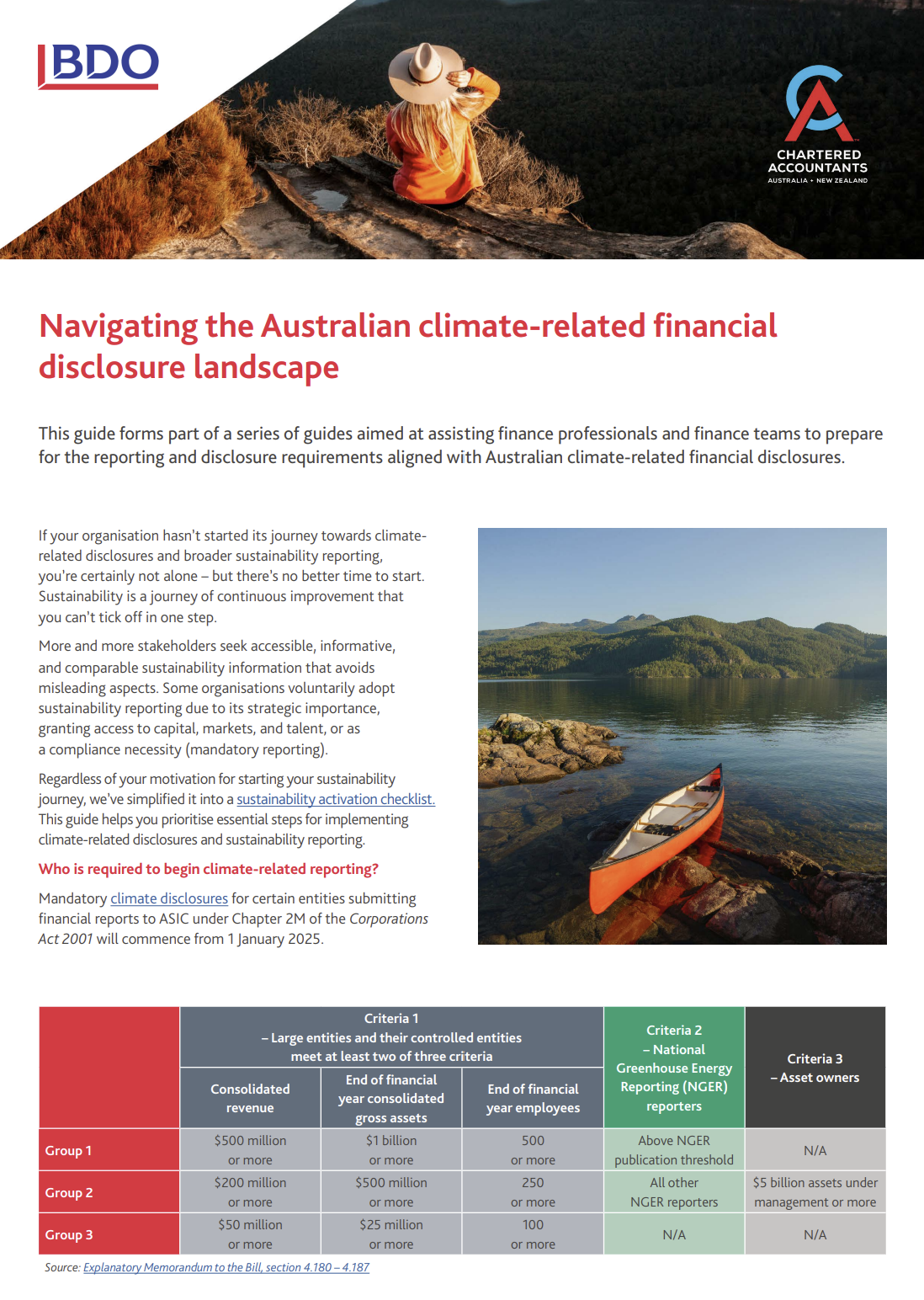
Navigating the Australian climate-related financial disclosure landscape
This guide outlines Australia’s new climate-related financial disclosure requirements commencing in 2025. It defines reporting thresholds, timelines, and compliance pathways for entities based on size and emissions reporting status, and details implementation steps aligned with AASB and IFRS standards for climate and sustainability reporting.

Critical mineral series: Sustainability considerations for investors in copper mining
This report examines copper’s role in the energy transition, highlighting growing demand, environmental and human rights risks, and evolving global regulations. It evaluates mining companies’ sustainability performance using biodiversity, governance, and modern slavery metrics, offering insights for responsible investment aligned with international standards and long-term ESG considerations.


