
Library | Sustainable Finance Practices
Industry standards and guidance
Voluntary standards, non-legislative frameworks, methodologies, and best-practice guidance that support financial institutions in achieving sustainability objectives.
Refine
283 results
REFINE
SHOW: 16


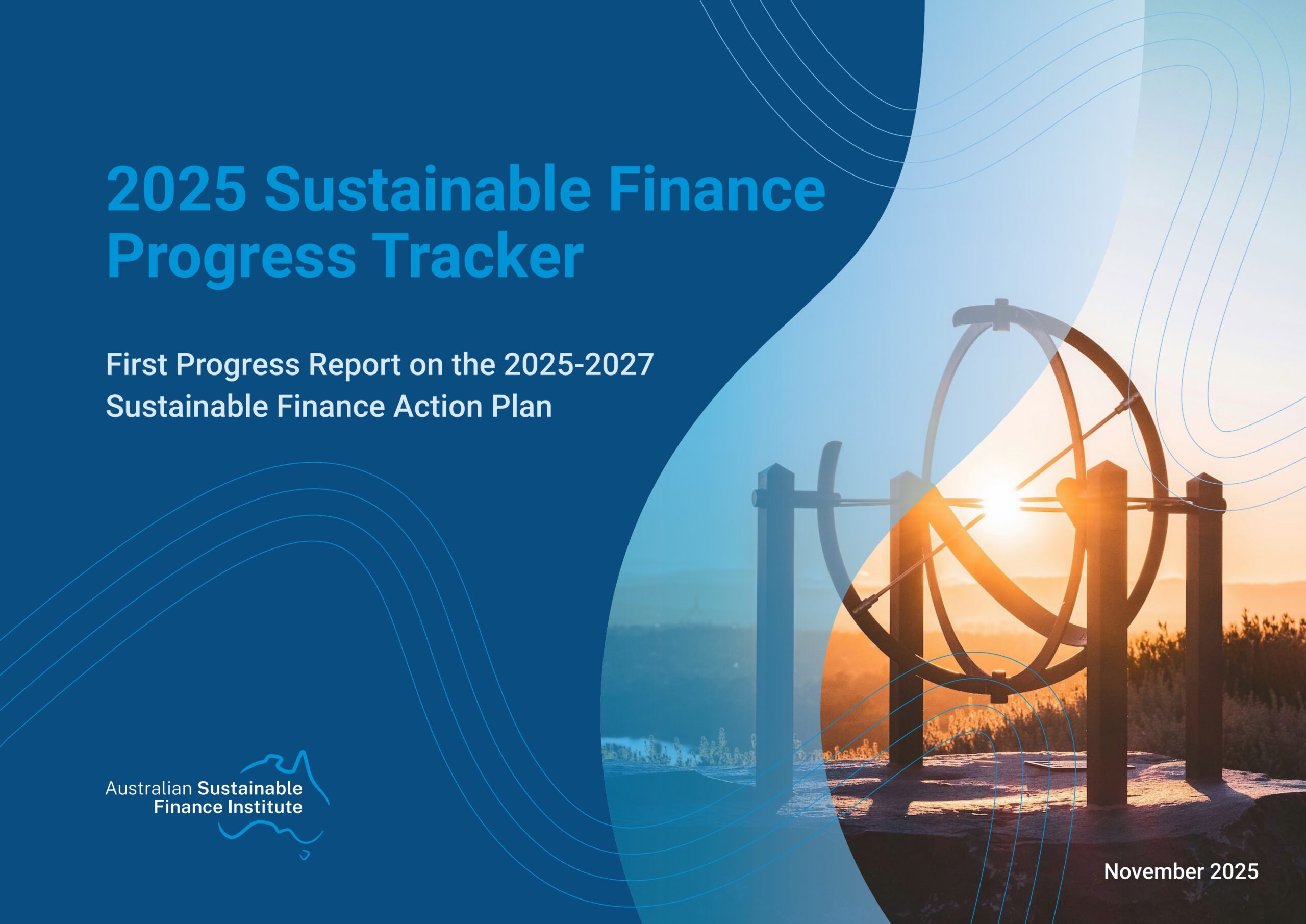
Sustainable finance progress tracker series
Annual progress report assessing Australia's sustainable finance agenda across 26 priority actions in eight domains under the 2025-2027 Sustainable Finance Action Plan.
Sustainable investment funds: Design, implementation, monitoring and communication of sustainability attributes
PAS 7342:2025 sets out specifications for designing, implementing, monitoring and communicating sustainability attributes of sustainable investment funds. It provides requirements to support clear objectives, governance, evidence, disclosures and labelling, aiming to reduce greenwashing and improve consistency in fund communication.
Sustainability disclosure landscape report for risk management: Insights from climate-focused case studies
This report reviews sustainability disclosure standards and regulatory uptake, focusing on climate-related risk management. Using case studies, it examines IFRS S1 and S2 implementation, materiality assessments and transition plans, highlighting disclosure gaps, data challenges and practical approaches to improve decision-useful climate risk reporting.
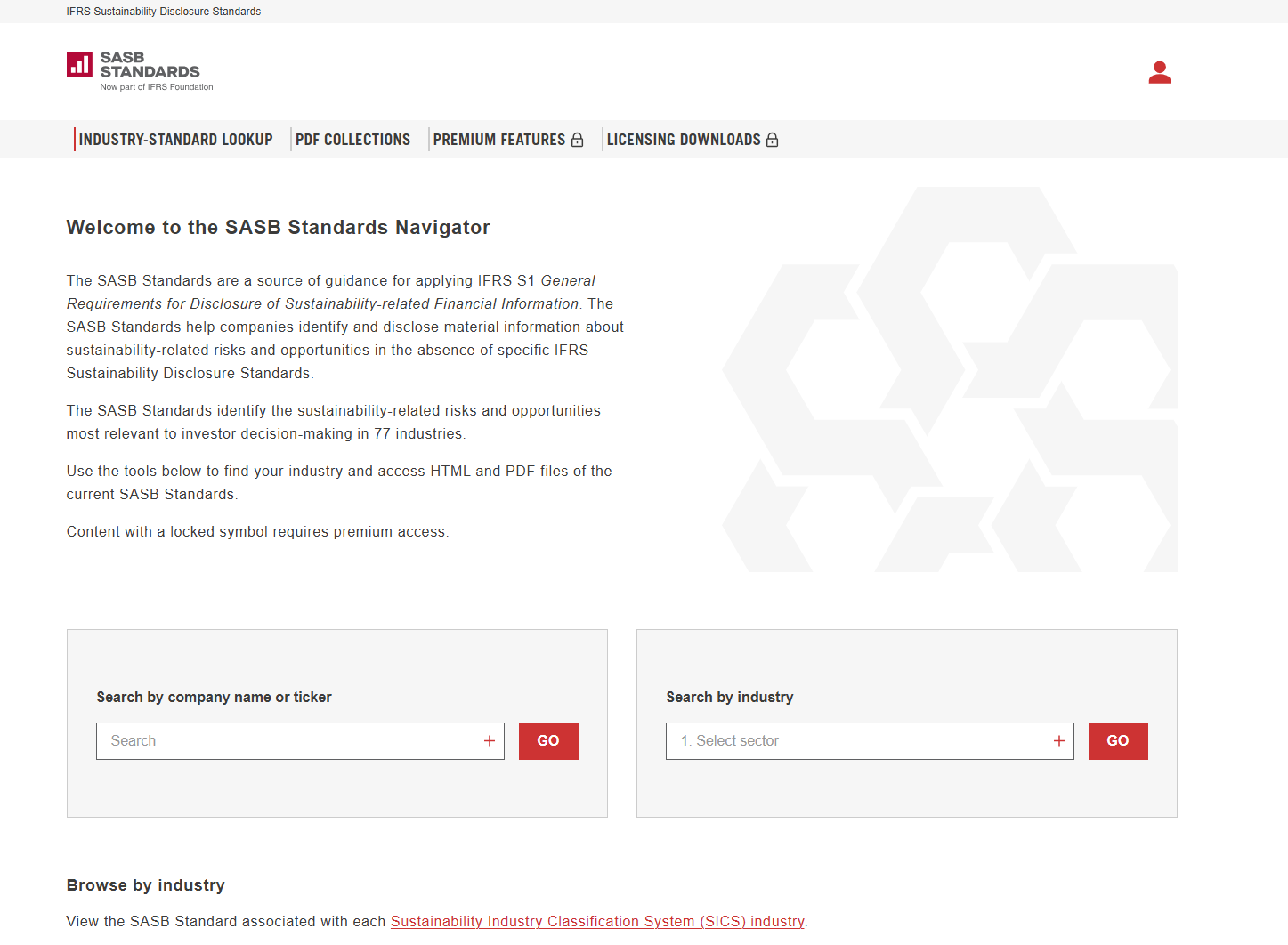
SASB Standards Navigator
The SASB Standards Navigator is an online database that enables users to explore industry-specific sustainability disclosure standards. It allows comparison of topics, metrics, and guidance across industries to support consistent ESG analysis and corporate reporting aligned with investor needs.
IFRS S1: General requirements for disclosure of sustainability-related financial information
IFRS S1 sets general requirements for sustainability-related financial disclosures, requiring entities to report material sustainability risks and opportunities affecting cash flows, access to finance and cost of capital, using consistent governance, strategy, risk management, and metrics disclosures.
AASB S1: General requirements for disclosure of sustainability-related financial information
AASB S1 is a voluntary Australian standard setting general requirements for sustainability-related financial disclosures. It outlines objectives, materiality, governance, strategy, risk management, and metrics to inform users about risks and opportunities affecting cash flows, access to finance, and cost of capital.

Net Zero Asset Managers Initiative (NZAM)
Net Zero Asset Managers Initiative (NZAM) is a global investor initiative supporting asset managers committed to net zero greenhouse gas emissions. NZAM provides guidance, accountability frameworks, and public target disclosures, helping align investment portfolios with climate goals and support the transition to a net zero economy across global financial markets.

International Sustainability Standards Board (ISSB)
International Sustainability Standards Board (ISSB) develops global sustainability disclosure standards for capital markets.Operating under IFRS Foundation, ISSB issues IFRS S1 and IFRS S2, supporting consistent, comparable ESG and climate reporting.Used by regulators, investors and companies to align sustainability information with financial reporting across jurisdictions worldwide and regulatory frameworks.

Open Geospatial Consortium (OGC)
Open Geospatial Consortium develops and promotes open standards for geospatial and location-based data. Open Geospatial Consortium (OGC) supports interoperability across climate, environment, urban planning and risk analysis by enabling consistent sharing, integration and use of spatial data across public and private sectors worldwide.

Nature Enters the Boardroom: Why Directors Are Paying Attention
Drawing on Australia’s first national study of board-level engagement with nature, this article shows how directors are treating nature as a material governance and financial issue. It highlights how boards are extending climate governance systems to manage nature-related risks, adopt frameworks like TNFD, and build resilience and long-term value despite policy uncertainty.
TNFD: Nature Transition Plans
The TNFD Nature Transition Plans tool provides guidance for integrating nature-related goals, actions, governance and disclosures into organisational transition planning. It supports alignment with the Global Biodiversity Framework and helps organisations assess, plan and communicate responses to nature-related dependencies, impacts, risks and opportunities.
Assessing the credibility of a company’s transition plan: framework and guidance
This report presents a harmonised framework to assess the credibility of corporate climate transition plans. It defines core plan elements, assessment principles, and a four-step process to evaluate ambition, feasibility, consistency, governance, and financial alignment with Paris-aligned decarbonisation pathways.

IFRS Foundation
IFRS Foundation is an independent, not-for-profit organisation that develops globally accepted accounting and sustainability disclosure standards.It oversees IFRS Accounting Standards and IFRS Sustainability Disclosure Standards, supporting transparency, comparability and trust in global capital markets for investors, companies and regulators worldwide.
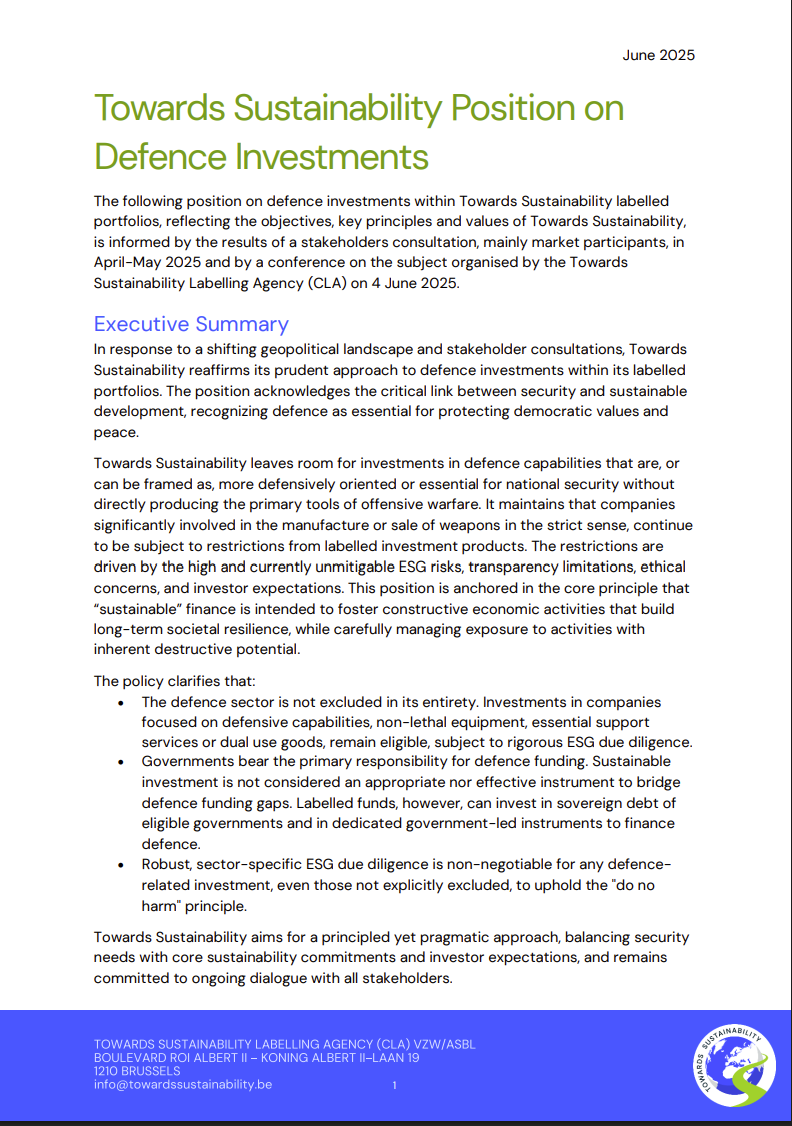
Towards sustainability position on defence investments
The report sets a pragmatic policy on defence investments for Towards Sustainability-labelled funds, permitting defensive, non-lethal and dual-use activities with strict ESG due diligence, while excluding weapons producers. It affirms defence funding as primarily a government responsibility.

ADS group: UK defence ESG charter
The UK Defence ESG Charter sets a voluntary, sector-wide framework for defence companies, covering climate transition, societal impact, and governance and ethics. It promotes decarbonisation, supply chain responsibility, skills development, ethical conduct, and collaboration, while allowing signatories to retain individual ESG strategies.
Agreement on international responsible investment in the insurance sector: ESG investment framework for the theme: Controversial weapons and the trade in weapons with high-risk countries
The framework guides insurers in managing ESG risks from controversial weapons and weapons trade with high-risk countries. It outlines international standards, investment screening criteria and due diligence processes, including risk assessment, voting, engagement and exclusion. It also provides guidance on monitoring, accountability and public reporting.


