
Library | Sustainable Finance Practices
Strategy and Organisational change
Guidance on embedding sustainability into organisational strategy, leadership, governance, culture, and systems to drive long-term transformation.
Refine
167 results
REFINE
SHOW: 16


Good practice toolkit: Strengthening modern slavery responses
This toolkit provides guidance on improving business practices under Australia's Modern Slavery Act. It emphasises effective stakeholder and supplier engagement, human rights due diligence, and the use of digital technologies. The toolkit includes practical examples and recommendations for businesses, governments, and civil society to better combat modern slavery.
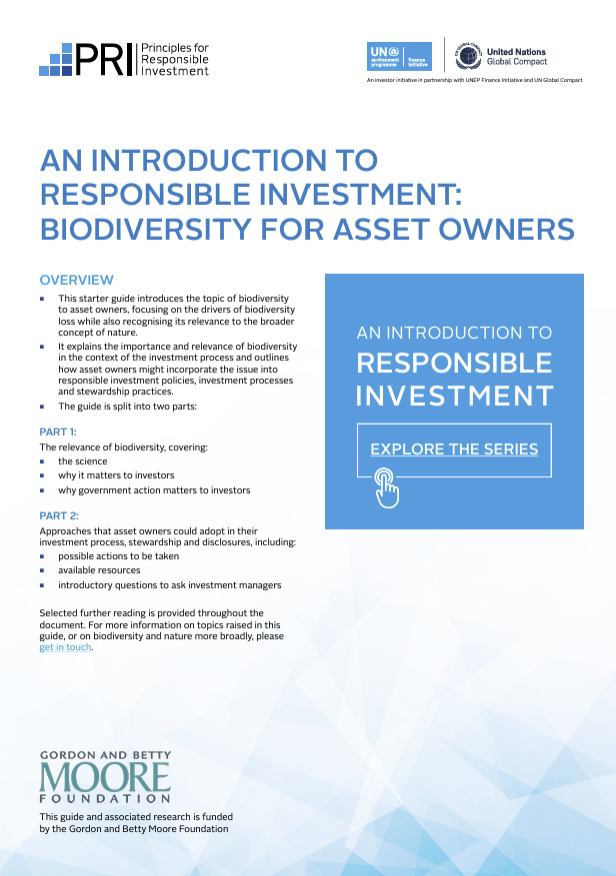
An introduction to responsible investment: Biodiversity for asset owners
This introductory guide for asset owners explores the financial risks and opportunities associated with biodiversity loss. It explains the relevance of biodiversity to investment processes and outlines how asset owners can incorporate biodiversity considerations into their responsible investment policies, stewardship practices, and disclosures.

The Authenticity Advantage
This benchmark report highlights the link between authentic sustainability and improved business outcomes in Australian organisations. The report introduces the Authenticity Index™, measuring commitments, culture, and communication, demonstrating that high-scoring businesses experience better talent acquisition, productivity, retention, innovation, resilience, and profitability.
World Economic Forum's global risks report series
The Global Risks Report is a long-running report series published by the World Economic Forum that examines emerging global risks across environmental, social, economic, geopolitical and technological domains. It provides a forward-looking assessment to support risk awareness, strategic planning and decision-making by finance professionals and policymakers.

Inside out inclusion: How to make better decisions and create an amazing team culture by valuing and including different viewpoints, styles and people
This report presents an inside-out inclusion model for improving team culture and decision-making. It covers how to improve self-awareness, value people, work together, make decisions, and adapt and grow. The model is backed by frameworks, tools, and reflection exercises.

Corporate resilience and response to COVID-19
This paper explores COVID-19's impact on corporate resilience and the effectiveness of corporate responses. Analysis of 2,000 companies shows that firms that invested in stakeholder relations performed better. The study reveals machine learning-linked big data provides new means to measure corporate responses and crisis management.

Global compact local networks: Accelerating national SDG implementation
The report emphasizes the role of responsible business in advancing the Sustainable Development Goals (SDGs) and highlights the importance of local networks in mobilizing a global movement of companies committed to advancing the SDGs through capacity-building, awareness-raising, and collaboration.

Making global goals local business: A new era for responsible business
This report highlights the need for private sector involvement in achieving the Sustainable Development Goals (SDGs) of the 2030 Agenda. It showcases the progress made so far by various companies and organisations and the role they play in building a better world through responsible business practices.

A little less conversation, a little more action: 10 lessons learned from 10 years of helping investors to tackle climate
This report presents 10 lessons for investors on tackling climate change. Through this summary, the authors offer insights on methodologies for climate scenario analysis, the intersection of reporting and acting, an effective climate voting process, the role of regulators in transparent carbon neutral investments, among other topics.

Navigating a new era of business and human rights
This book highlights the intersection of corporate practices and human rights. It explores evolving challenges, regulatory landscapes, and the importance of collaborative, ethical business conduct. Key themes include transparency, state roles, and the human rights-based approach, offering insights for stakeholders to navigate this complex field.

Business reporting on the SDGs: An analysis of the goals and targets 2022
This report offers a comprehensive overview of the Sustainable Development Goals and how businesses can align their practices with these goals through transparent disclosures and disclosures reporting. This 2022 edition provides actionable steps for businesses to contribute to sustainable development.

Catalysing bank climate action: Lessons from the inside
This report shares insights from the Climate Safe Lending Fellowship, a programme for banking professionals committed to accelerating the decarbonisation of their institutions. The report offers practical approaches and tools used by climate intrapreneurs to help their banks transition toward climate-safe banking.

Converging on climate lobbying: Aligning corporate practice with investor expectations
This report details the importance of climate lobbying for the long-term interests of institutional investors. It covers recommendations for future engagement and case studies, and is primarily aimed at investment professionals. The report does not have any specific focus on discussing a list of companies, rather, it is an investor initiative that advocates for climate lobbying practices and investor expectations for companies globally.

New pathways to achieve social and environmental goals: How leading corporations use impact investing to align capital and purpose
This report examines how leading corporations use impact investing to pursue environmental and social goals. It contains case studies of companies such as PayPal and Schneider Electric, showcasing their impact investing practices and strategies.

Future-fit business benchmark: Methodology guide
The Future-Fit Business Benchmark Methodology Guide provides a free tool to help companies pursue a vision of a flourishing future. With 23 break-even Goals, 24 positive pursuits, and complementary indicators, it offers science-based guidance on how to transform business operations, procurement practices, and products in pursuit of future-fitness.

Don't #@!% the planet
This guide is created to share the experience of building a net-zero sustainability program. The guide is presented in two parts, and includes Atlassian's materiality assessment, the steps they took to reduce emissions, and their efforts to push beyond net-zero.


