Insights | | Stakeholder Engagement Toolbox

Stakeholder Engagement Toolbox

7 November 2025

The Stakeholder Engagement Toolbox helps finance professionals design and oversee credible stakeholder engagement. It includes common goals relative to several sustainable finance practices, supported by practical actions and relevant resources. The purpose is to strengthen governance, transparency, and accountability, as well as support ESG integration and responsible decision-making.

AUTHORS

Sophia Khana - Research Associate (Goal & action development)
Jhon Hilario - Research Associate (Resource collation)
Victoria Whitaker - Industry Mentor
Emmalene Wysocki - Editor & Project Manager

Why stakeholder engagement matters in sustainable finance

Stakeholder engagement is a core component of sustainable finance because it enables financial institutions and boards to identify, assess, and manage social and environmental risks that may not be visible through internal analysis, company disclosures, or quantitative data alone. Effective engagement helps surface real-world impacts, inform risk judgement, and support long-term value creation.

How stakeholder engagement shows up in practice

In practice, stakeholder engagement informs investment due diligence, ongoing risk assessment, and active ownership. It can provide early warning of emerging issues, reveal gaps between corporate policies and outcomes, and support more informed engagement with investee companies. Engagement may occur directly or through credible intermediaries, depending on context, access, and risk exposure.

Why it creates responsibilities for financial actors

International frameworks such as the UN Guiding Principles on Business and Human Rights (UNGPs, 2011) create clear expectations for companies to identify and address adverse impacts on affected stakeholders. For financial actors, these expectations translate into responsibilities for oversight, due diligence, and stewardship through governance, investment decision-making, and engagement with investee and financed entities. Weak stakeholder engagement can undermine effective risk management and contribute to material financial, legal, and reputational risks, as reflected in international guidance such as the IFC Performance Standards.

What this toolbox covers

This toolbox is organised around key sustainable finance practices, including governance and directors’ duties, ESG analysis and integration, active ownership, impact measurement and verification, and industry standards and guidance. For each practice, it sets out a focused set of goals and practical actions to support effective management of this issue.

Governance and directors’ duties

This section focuses on the responsibilities of boards and directors in overseeing this issue, strengthening accountability, and integrating sustainability considerations into strategy, risk oversight, and long-term value creation.

Strengthen board competence and accountability for affected-stakeholder impacts

Actions extracted from: Engaging affected stakeholders: The emerging duties of board members

Actions:

1. Build human-rights fluency across the board

Provide directors with structured training and expert briefings to deepen understanding of human-rights principles and affected-stakeholder vulnerabilities. This supports informed decision-making and ensures the board can recognise and respond to salient risks (pp. 6–7, 14).

2. Integrate relevant expertise into board composition

Recruit directors with experience in human rights, stakeholder engagement, or lived-experience insight. This helps the board anticipate harms, strengthen oversight, and reflect the diversity needed for responsible governance (pp. 6–7).

3. Assess board performance on human-rights oversight

Include human-rights considerations in annual board-effectiveness reviews. Embedding these criteria signals accountability and helps identify capability gaps that may hinder effective stewardship (p. 14).

Ensure the board actively engages with key ESG stakeholders as part of effective oversight

Actions extracted from: A practitioner’s perspective – from obstacles to outcomes: Enhancing effectiveness in stewardship and engagement

Actions:

1. Ensure clear objectives for ESG-specific stakeholder engagement are defined and reviewed at board level

Structure engagement objectives that link stakeholder input to real-world outcomes. Applying this principle can strengthen legitimacy, align engagement with organisational purpose, and prevent “engagement-washing” (pp. 8–9).

2. Oversee regular dialogue with key stakeholders through board briefings, delegated engagement, or selective direct board participation

Design engagement processes centred on purposeful, two-way communication. Use this as a prompt to review how your current engagement practices support trust, mutual understanding, and ESG alignment (pp. 12, 14–15).

3. Review engagement KPIs and outcomes as part of board oversight of stewardship effectiveness

Develop measurable ESG engagement KPIs linked to targeted outcomes. Practitioners can use this approach to track progress, enhance transparency, and demonstrate meaningful contribution toward stewardship goals (pp. 11, 17–18).

Establish clear governance roles and responsibilities for stakeholder engagement and accountability

Actions extracted from: AA1000 Stakeholder Engagement Standard

Actions:

1. Assign stakeholder oversight to a board committee

Assign oversight of stakeholder engagement to a designated board committee. This embeds engagement within governance structures and decision-making processes, integrating stakeholder input into strategy and operations (p. 12).

2. Define management’s role vs. board’s role in engagement

Define clear roles for management and the board in stakeholder engagement. This ensures coordinated governance, with management leading operational engagement and the board providing oversight and strategic direction (pp. 12, 33).

3. Disclose governance roles in annual reports

Disclose stakeholder engagement governance roles in annual or sustainability reports. This promotes transparency and accountability, showing how oversight supports credible engagement and assurance processes (pp. 34–35).

Ensure the board oversees credible stakeholder grievance and accountability mechanisms

Actions extracted from: Stakeholder engagement: A good practice handbook for companies doing business in emerging markets

Actions:

1. Require management to set up accessible grievance channels

The resource highlights that grievance mechanisms must be accessible, understandable, and culturally appropriate. Use this guidance to require management to establish channels such as hotlines, local meetings, or liaison officers to ensure inclusive access and awareness (pp. 69-74).

2. Review regular reports on grievances and resolutions

The resource emphasises maintaining grievance logs and regular reporting to build trust. Apply this principle by requiring management to provide periodic reports on complaints received, actions taken, and resolutions achieved (pp. 70-76, 166).

3. Ensure mechanisms meet fairness, transparency, and cultural relevance standards

The resource notes that fairness and transparency require clear procedures, third-party mediation, and culturally appropriate communication. Use this insight to ensure grievance mechanisms respect local contexts and provide equitable participation in resolution processes (pp. 70-73, 77).

Integrate stakeholder perspectives into strategy, risk oversight, and long-term value creation

Actions extracted from: Elevating stakeholder voices to the board: A guide to effective governance

Actions:

1. Include stakeholder input in board discussions and decision-making

Review stakeholder perspectives in board papers and allocate time for stakeholder presentations. Integrating ESG-relevant insights into board deliberations strengthens strategic alignment and accountability (pp. 8, 22–24, 26).

2. Expand director training to cover ESG and stakeholder engagement principles

Embed stakeholder and ESG expertise into board skill matrices and induction programs. Strengthening director capability in ESG governance supports informed oversight and responsible stewardship (pp. 9, 14–15).

3. Establish stakeholder advisory committees or panels to inform ESG priorities

Form advisory groups including stakeholder representatives and director observers. Creating structured forums enhances the board’s access to diverse ESG insights for decision-making and long-term sustainability (pp. 22–25).

ESG Analysis & Integration

This section focuses on how this issue is identified, assessed, and integrated into investment decision-making, credit analysis, and underwriting, including the use of ESG analysis, screening approaches, and asset allocation decisions.

Identify and prioritise material ESG risks and opportunities using stakeholder-informed insights

Actions extracted from: Linking stakeholder engagement to profitability through sustainability-oriented innovation: A quantitative study of the minerals industry

Actions:

1. Collect stakeholder insights on sector risks

Integrate external stakeholder knowledge into ESG risk identification to align with investor expectations and uncover innovation opportunities that enhance long-term financial performance. Stakeholder engagement provides access to technological, market, and social risk intelligence, strengthening the firm’s social license to operate (pp. 3, 6).

2. Consult affected groups on ESG hotspots

Engage communities, NGOs, and local stakeholders in identifying ESG-sensitive areas and high-impact risks. Two-way consultation enhances social license to operate, supports proactive risk mitigation, and reinforces responsible investment and sustainable finance principles (pp. 3–4, 11–12).

3. Compare stakeholder risk assessments with internal models

Validate internal ESG risk analysis against stakeholder-informed assessments to improve accuracy, transparency, and investor confidence. Benchmarking external and internal perspectives strengthens credibility in ESG disclosures and supports data-driven decision-making (pp. 6–7, 9).

Strengthen ESG risk assessment by incorporating affected-stakeholder perspectives

Actions extracted from: Handbook on BRI Stakeholder Engagement for Financial Institutions

This handbook can be used as a starting point when approaching stakeholder engagement for the first time, or as a refresher when revising an existing engagement strategy.

Actions:

1. Establish grievance mechanisms to surface risks early

Strengthen ESG risk assessment by institutionalising grievance mechanisms that capture stakeholder concerns in real time. Embedding these systems improves early risk identification, mitigation, and oversight of environmental and social impacts (pp. 12–13, 28).

2. Involve stakeholders across full project lifecycle management

Engage stakeholders throughout project phases—from design to decommissioning—to build trust and detect risks early. Continuous participation enhances compliance, transparency, and alignment with international responsible finance standards (pp. 9, 11–12, 36–37).

3. Embed stakeholder engagement procedures within ESMS frameworks

Integrate stakeholder consultation, grievance handling, and disclosure into Environmental and Social Management Systems. Institutionalising engagement within ESMS ensures consistency, accountability, and robust risk governance across financial operations (pp. 27–29, 32–33).

Integrate material ESG risks and opportunities into investment, credit, and underwriting decisions

Actions extracted from: Nature investor toolkit: Understanding nature-related risks and opportunities and supporting investors to assess, engage and take action

Actions:

1. Conduct materiality assessments involving key stakeholder groups

Identify and manage nature-related risks and opportunities by engaging affected stakeholders, including Indigenous Peoples and Local Communities. Incorporating their knowledge through FPIC principles enhances materiality assessments and strengthens responsible investment practices (pp. 11–13, 22).

2. Apply sector and location-specific ESG metrics

Use sectoral and geospatial tools such as ENCORE, IBAT, and WWF Water Risk Filter to assess environmental dependencies. Combining these metrics provides granular ESG risk mapping and improves portfolio-level prioritisation (pp. 13–15).

3. Align analysis with global frameworks (TCFD, GRI, TNFD)

Integrate disclosure and monitoring practices consistent with TCFD, GRI, and TNFD frameworks. Alignment ensures transparent, comparable, and credible ESG reporting that supports investor confidence and regulatory compliance (pp. 29–30, 37).

Active Ownership

This section focuses on how investors use engagement, voting, and escalation to influence investee, borrower, or policyholder practices on this issue, as part of effective stewardship and long-term value creation.

Strengthen stewardship effectiveness through alignment with stakeholder perspectives

Actions extracted from: The future of investor engagement: A call for systematic stewardship to address systemic climate risk

Actions:

1. Align stewardship strategies with systemic climate risk frameworks

Improve stewardship effectiveness by aligning investor engagement with stakeholder-driven climate goals. Integrating systemic climate risk frameworks enables investors to address cross-sector risks, support just transition efforts, and enhance long-term resilience (pp. 4–7).

2. Co-develop engagement strategies targeting climate change policy and value chain transformation

Collaborate with stakeholders, regulators, and companies to shape policy and sectoral change. Joint engagement uncovers shared challenges, accelerates decarbonisation, and aligns stewardship with system-level climate objectives (pp. 17–22).

3. Identify systemic economic, technological, and/or regulatory hurdles obstructing decarbonisation processes

Analyse structural barriers such as policy gaps, cost constraints, and technology limits. Understanding these systemic factors enables investors to advocate for reforms that advance 1.5 °C-aligned pathways (pp. 9–13, 19).

Collaborate with other investors to amplify affected-stakeholder voices

Actions extracted from: ESG and responsible institutional investing around the world: A critical review

Actions:

1. Join investor coalitions advocating for stakeholder priorities

Collaborate through investor coalitions, working groups, and joint campaigns to elevate stakeholder concerns and influence corporate behaviour. Collective action enhances credibility, policy impact, and alignment with responsible investment principles (pp. 13, 27).

2. Participate in PRI working groups on stakeholder themes

Engage in PRI Collaboration Platform initiatives that unite investors around shared ESG priorities. Pooling engagement resources strengthens company performance, mitigates the free-rider problem, and drives more effective active ownership (pp. 34, 40, 48).

3. Coordinate engagement campaigns with peers

Benchmark and align engagement efforts with peer investors to reinforce consistent ESG expectations and improve performance outcomes. Coordinated campaigns amplify influence and foster best-in-class standards across industries (p. 39).

Monitor and communicate stewardship outcomes to relevant stakeholders

Actions extracted from: ESG shareholder engagement and downside risk

Actions:

1. Collect data on engagement progress

Track and disclose stewardship outcomes using structured data collection and milestone tracking. Recording engagement stages—from concern raised to action taken—enhances transparency, accountability, and progress measurement toward ESG goals (pp. 484–485, 488–489).

2. Select the most effective engagement types for reducing downside risk

Prioritise environmental and climate-related engagements that demonstrate the highest success rates in mitigating downside risk. Focusing on impactful themes strengthens both financial resilience and stakeholder confidence (p. 485).

3. Track progress against stakeholder-defined goals

Measure engagement success by achieving milestones such as acknowledgment and action (M2–M3). Linking these outcomes to stakeholder priorities demonstrates meaningful impact and improved ESG risk performance (p. 494).

Impact Measurement & Verification

This section focuses on measuring, monitoring, and verifying the environmental, social, and financial outcomes associated with this issue, and on strengthening the credibility and decision-usefulness of impact claims.

Verify impact data and outcomes with relevant stakeholders and partners

Actions extracted from: Handbook on BRI Stakeholder Engagement for Financial Institutions

Actions:

1. Validate data through community feedback

Verify impact data by engaging communities through feedback loops tailored to local contexts. Co-creating assessment frameworks and addressing concerns transparently strengthens credibility, accountability, and alignment with responsible finance standards (pp. 11–12, 34–35).

2. Involve stakeholders in verification processes

Enable stakeholders to participate in verifying project performance through structured consultations and grievance mechanisms. Shared monitoring enhances transparency, ensures effective mitigation, and promotes continuous ESG improvement (pp. 36–37).

3. Disclose limitations of verification

Communicate verification boundaries clearly, including data gaps, confidentiality constraints, and methodological limitations. Transparent disclosure fosters stakeholder trust and reinforces integrity in impact reporting (pp. 10, 12–13, 30).

Define clear impact objectives informed by stakeholder perspectives

Actions extracted from: Access bank: Driving inclusive growth through responsible banking

Actions:

1. Set sustainability targets through portfolio review that reflect stakeholders’ concerns

Develop impact objectives by reviewing products and services alongside feedback from clients, employees, community groups and investors. Integrating these insights into portfolio priorities strengthens alignment with societal needs and supports transparent, stakeholder-relevant decision-making.

2. Conduct external verification and stakeholder-inclusive ESG screening

Use independent reviewers and stakeholder-informed ESG criteria to validate targets and assess eligible projects. Combining external assurance with inclusive screening enhances credibility, ensures materiality, and supports consistent, comparable verification practices.

3. Integrate stakeholder input into product design, programme delivery and reporting

Apply ongoing feedback from customers, communities, NGOs and internal teams to refine impact objectives and performance criteria. Incorporating this input into programme updates and annual reporting promotes continuous improvement and reinforces transparency and accountability.

Co-develop meaningful impact indicators with partners aligned to stakeholder needs

Actions extracted from: Poverty Footprint

Actions:

1. Establish a formal multi-stakeholder partnership

Form a structured partnership with a trusted CSO and agree on shared objectives for defining poverty-related impacts. Building trust, jointly setting goals, and creating a governance process ensures inclusive dialogue and collaborative oversight of the assessment (pp. 25–29).

2. Apply the “5 by 5 Poverty Framework” to co-define indicators

Use the framework’s five poverty dimensions and five corporate practice areas to jointly prioritise topics and select impact indicators. Working through the 5×5 model with partners enables meaningful, stakeholder-aligned metrics that reflect real community needs (pp. 39–40).

3. Co-author and disclose findings and recommendations

Develop a transparent public report with partners that presents findings, lessons, and agreed recommendations. Schedule periodic progress reviews to validate performance against selected indicators and demonstrate shared accountability (pp. 60–65).

Industry Standards & Guidance

This section focuses on relevant international standards, voluntary frameworks, and industry guidance that inform expectations and good practice for financial institutions in managing this issue.

Align ESG practices and disclosures with relevant international standards and stakeholder expectations

Actions extracted from: OECD guidelines for multinational enterprises on responsible business conduct

Actions:

1. Review stakeholder expectations against UN/OECD guidance

Align responsible business practices with stakeholder expectations by referencing UN and OECD standards on human rights, disclosure, and due diligence. Embedding these principles enhances transparency, comparability, and regulatory confidence (pp. 10–13, 14–17, 25–29).

2. Map engagement processes to ISSB/GRI standards

Ensure engagement and reporting processes align with global ESG frameworks such as ISSB, GRI, and TCFD. Integrating stakeholder engagement outcomes into disclosure practices strengthens credibility and alignment with science-based targets (pp. 21–26, 33–40).

3. Disclose global alignment progress

Report on progress toward alignment with international ESG goals, including due diligence, remediation, and climate-related commitments. Providing accessible, transparent, and assured disclosures builds stakeholder trust and investor confidence (pp. 21–26, 33–40).

Use recognised standards to strengthen credibility and stakeholder confidence

Actions extracted from: Valuing Better Engagement: An economic framework to quantify the value of stakeholder engagement for infrastructure delivery

Actions:

1. Quantify engagement value and disclose results

Strengthen stakeholder confidence by applying recognised engagement valuation frameworks. Quantifying benefits such as cost savings, risk reduction, and avoided contingencies demonstrates transparency, accountability, and tangible ESG outcomes (pp. 6–8, 24–25).

2. Track stakeholder trust levels over time

Monitor trust-building through transparent, inclusive, and integrity-based engagement practices. Mapping progress against the IAP2 Public Participation Spectrum provides a structured benchmark for assessing trust maturity and collaboration (pp. 13, 15, 17).

3. Apply a framework for valuing engagement

Use defensible, repeatable frameworks that quantify engagement outcomes and link stakeholder satisfaction to performance incentives. Combining economic valuation with KPIs or KRAs embeds accountability and recognises engagement as a measurable business value driver (pp. 20–23, 26).

Benchmark practices against peers using stakeholder-informed insights

Actions extracted from: The Global GHG Accounting and Reporting Standard for the financial industry

Actions:

1. Compare engagement against peers

Benchmark ESG and climate performance using standardized emission intensity metrics such as economic, physical, and weighted average carbon intensity (WACI). Normalized metrics enable peer comparison and inform stakeholder dialogue on climate transition progress (pp. 21–22).

2. Use stakeholder surveys for benchmarking

Apply stakeholder-driven tools like CDP and TCFD questionnaires to gather comparable data across portfolios and sectors. Survey-based benchmarking enhances transparency, supports accountability, and aligns with global disclosure practices (pp. 24–26).

3. Identify leaders and laggards

Assess data quality to distinguish verified, high-performing institutions from those relying on proxies or incomplete information. Reporting verified emissions data demonstrates leadership, builds stakeholder confidence, and strengthens responsible investment credibility (pp. 21–22, 42, 122).

Covered resources

A practitioner's perspective - from obstacles to outcomes: Enhancing effectiveness in stewardship and engagement
WHEB Asset Management
This report identifies barriers to effective investor stewardship and engagement, highlighting challenges such as unclear definitions, resource constraints, and ineffective reporting. It outlines practical solutions from WHEB, recommending clearer alignment of engagement objectives with client mandates and prioritising measurable outcomes over activity metrics to deliver long-term client value.
Research
31 October 2024

OECD guidelines for multinational enterprises on responsible business conduct
Organisation for Economic Co-operation and Development (OECD)
This guide provides voluntary standards for responsible business, covering areas such as human rights, environmental impact, anti-corruption, and stakeholder engagement. It emphasises on climate goals, technology due diligence, and transparency in lobbying and reporting, supporting sustainable development and fair business practices globally.
Research
29 September 2011

Elevating stakeholder voices to the board: A guide to effective governance

Australian Institute of Company Directors
This guide offers Australian directors valuable insights on elevating stakeholder perspectives to the board, emphasising a broader view of corporate interests. It explores stakeholder governance, effective practices, and the advantages of integrating voices from employees, customers, suppliers, and the community into board-level decision-making.
Research
26 April 2021

Nature investor toolkit: Understanding nature-related risks and opportunities and supporting investors to assess, engage and take action

Responsible Investment Association Australasia (RIAA)
The toolkit helps investors identify, assess, and manage nature-related risks and opportunities in their portfolios. It provides guidance on how to engage with stakeholders, evaluate investment impacts on nature, and explore emerging tools for nature-positive outcomes. The toolkit also highlights strategies to mitigate risks and seize nature-related investment opportunities.
Research
13 September 2024

The future of investor engagement: A call for systematic stewardship to address systemic climate risk
United Nations Environment Programme Finance Initiative (UNEP FI)
This report provides a call to action for investors to engage in systematic stewardship to address systemic climate risk. It explores limitations of corporate engagement and presents alternative opportunities for engagement such as sector and value chain engagement, policy engagement, and asset manager engagement.
Research
5 May 2023

ESG and responsible institutional investing around the world: A critical review
CFA Institute
This report reviews global ESG and responsible investing practices, focusing on definitions, regulation, climate finance, and institutional investor roles. It evaluates evidence from academic research and PRI data, highlighting investor influence, governance, and engagement strategies, while noting challenges around ratings, greenwashing, and measuring real outcomes.
Research
20 May 2020

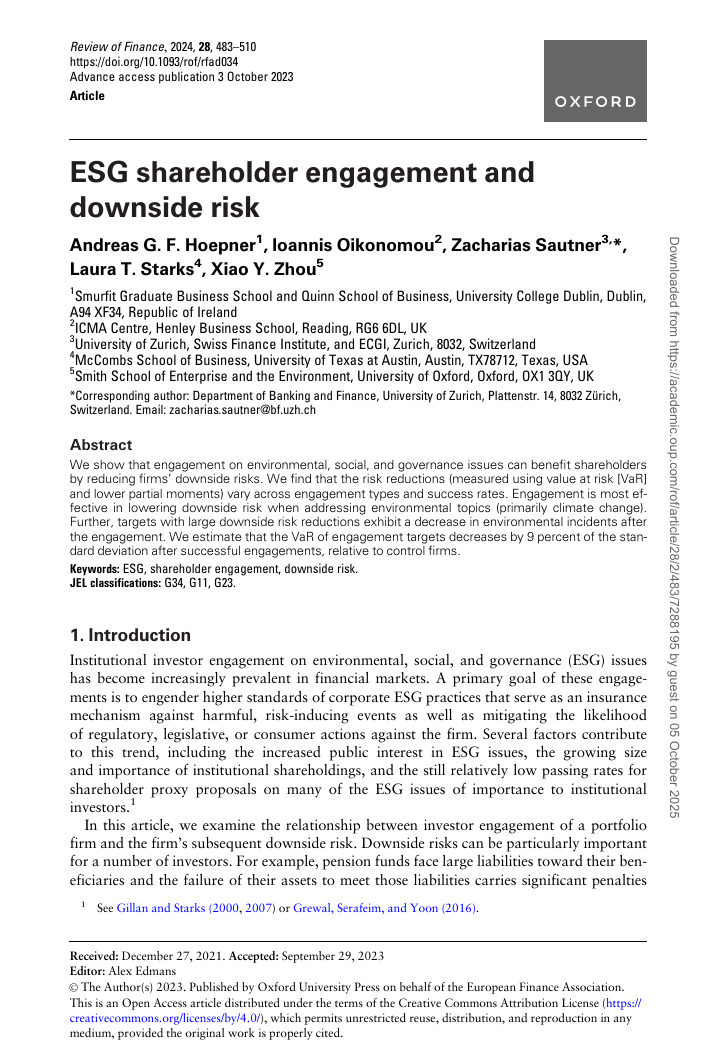
ESG shareholder engagement and downside risk

Oxford university press
This study analyses whether investor engagement on environmental, social, and governance (ESG) issues reduces firms’ downside risk. Using data from 1,443 engagements with 485 global firms (2005–2018), it finds that successful engagements, particularly on environmental and climate issues, significantly lower downside risk and related environmental incidents.
Research
6 March 2024

The Global GHG Accounting and Reporting Standard for the financial industry series

Partnership for Carbon Accounting Financials
The Global GHG Accounting and Reporting Standard for the Financial Industry by Partnership for Carbon Accounting Financials (PCAF) provides a framework for measuring and disclosing greenhouse gas emissions. It helps financial institutions enhance transparency, assess climate risks, and support sustainable investment decisions, promoting accountability and impactful environmental actions.
Benchmark/series
17 November 2022

Stakeholder engagement: A good practice handbook for companies doing business in emerging markets

International Finance Corporation
This guide offers a comprehensive framework for involving stakeholders in development projects. They aim to achieve effective communication, transparency, and inclusive participation, ensuring that the concerns and interests of all stakeholders, including vulnerable groups, are considered. This promotes better project outcomes, reduces risks, builds trust, and fosters sustainable and equitable development.
Research
16 May 2007

Five-step approach to stakeholder engagement

Business for Social Responsibility (BSR)
This is a comprehensive toolkit developed to help companies understand and respond to existing and emerging societal concerns through stakeholder engagement. It is based on the long experience of the authors and interviews with member companies and BSR employees.
Research
27 April 2019

Engaging affected stakeholders: The emerging duties of board members

World Economic Forum
This report provides guidance for corporate boards on effectively engaging stakeholders to uphold human rights. It outlines strategies for meaningful engagement, addressing stakeholder concerns, and integrating human rights considerations into corporate governance and decision-making processes.
Research
11 May 2022

If you would like to suggest highly relevant resources to include in this Toolbox, please submit your ideas to our Content suggestion form. Be sure to mention it is for this toolbox in the comments box at the end of the form.

Join or sign in to use Alma, Altiorem’s AI Agent. While the Altiorem library is free, Alma is exclusive to paying subscribers.