

Stakeholder Engagement: Goals and actions bank
The Stakeholder Engagement goals and actions bank helps finance professionals design and oversee credible stakeholder engagement. It includes common goals relative to several sustainable finance practices, supported by practical actions and relevant resources. The purpose is to strengthen governance, transparency, and accountability, as well as support ESG integration and responsible decision-making.

AUTHORS

Why stakeholder engagement matters in sustainable finance
Stakeholder engagement is a core component of sustainable finance because it helps financial institutions and boards identify, assess, and manage environmental, social and governance risks that may not be visible through internal analysis, company disclosures, or quantitative data alone. Engagement can surface real-world impacts, highlight emerging risks, and support more informed judgement and long-term value creation.
How stakeholder engagement shows up in practice
In practice, stakeholder engagement informs investment due diligence, ongoing risk assessment, and active ownership. It can provide early warning of emerging issues, reveal gaps between corporate policies and outcomes, and strengthen engagement with investee companies. Engagement may occur directly or through credible intermediaries, depending on the issue, context, and exposure.
Why it creates responsibilities for financial actors
International standards and frameworks on responsible business conduct, environmental risk, and governance set clear expectations for identifying, assessing, and addressing adverse impacts on affected stakeholders.
For financial actors, this translates into responsibilities for governance, due diligence, and stewardship across investment decision-making and engagement with investee and financed entities. Weak stakeholder engagement can undermine effective risk management and contribute to material financial, legal, and reputational risks.
What this resource covers
This resource is organised around key sustainable finance practices, including active ownership, ESG analysis and integration, governance and directors’ duties, impact measurement and verification, and industry standards and guidance. For each practice, it sets out clear goals and practical actions to support effective stakeholder engagement.
How to use this resource
The goals and actions in this resource are illustrated using specific ESG issues, reflecting the focus of the underlying resources in the library. These examples are illustrative and should not be read as limiting stakeholder engagement to particular themes (such as climate or human rights).
Finance professionals can use this resource to design and strengthen stakeholder engagement for material environmental, social, or governance risks and opportunities, adapting approaches as appropriate to the issue, sector, and context.
Active Ownership
This section provides guidance on how investors can use active ownership as a stewardship practice to influence investee behaviour and decision-making, with stakeholder engagement informing priorities, engagement strategies, and escalation across ESG issues.
ESG Analysis & Integration
This section provides guidance on ESG analysis and integration as practices through which stakeholder perspectives are used to identify, assess, and incorporate ESG risks and impacts into investment decision-making, credit assessment, and underwriting.
Governance and directors’ duties
This section provides guidance on governance and directors’ duties as the structures and responsibilities through which boards and senior leaders oversee stakeholder-related ESG risks, strengthen accountability, and integrate stakeholder considerations into strategy and risk oversight.
Impact Measurement & Verification
This section provides guidance on impact measurement and verification as practices for assessing, tracking, and validating outcomes linked to stakeholder impacts, supporting credible impact claims and informed decision-making.
Industry Standards & Guidance
This section provides guidance on international standards, voluntary frameworks, and industry guidance that shape expectations for stakeholder engagement and responsible conduct across ESG issues.
Covered resources

A practitioner's perspective - from obstacles to outcomes: Enhancing effectiveness in stewardship and engagement
OECD guidelines for multinational enterprises on responsible business conduct
Elevating stakeholder voices to the board: A guide to effective governance

Nature investor toolkit: Understanding nature-related risks and opportunities and supporting investors to assess, engage and take action

The future of investor engagement: A call for systematic stewardship to address systemic climate risk
ESG and responsible institutional investing around the world: A critical review
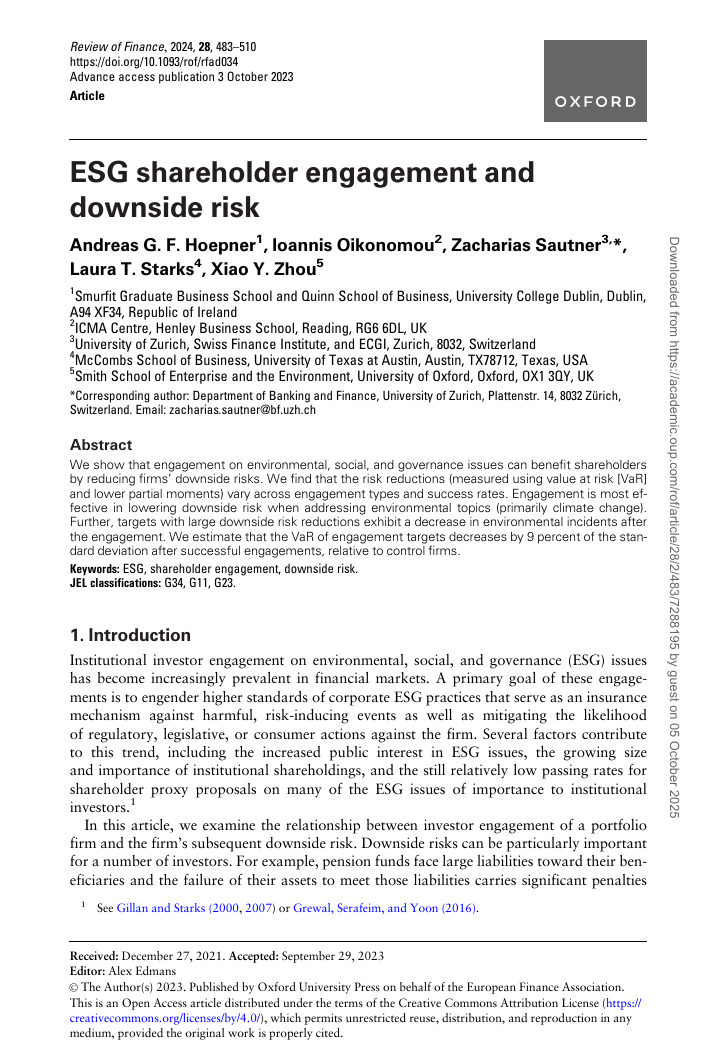
ESG shareholder engagement and downside risk

The Global GHG Accounting and Reporting Standard for the financial industry series

Stakeholder engagement: A good practice handbook for companies doing business in emerging markets

Five-step approach to stakeholder engagement


