Overview
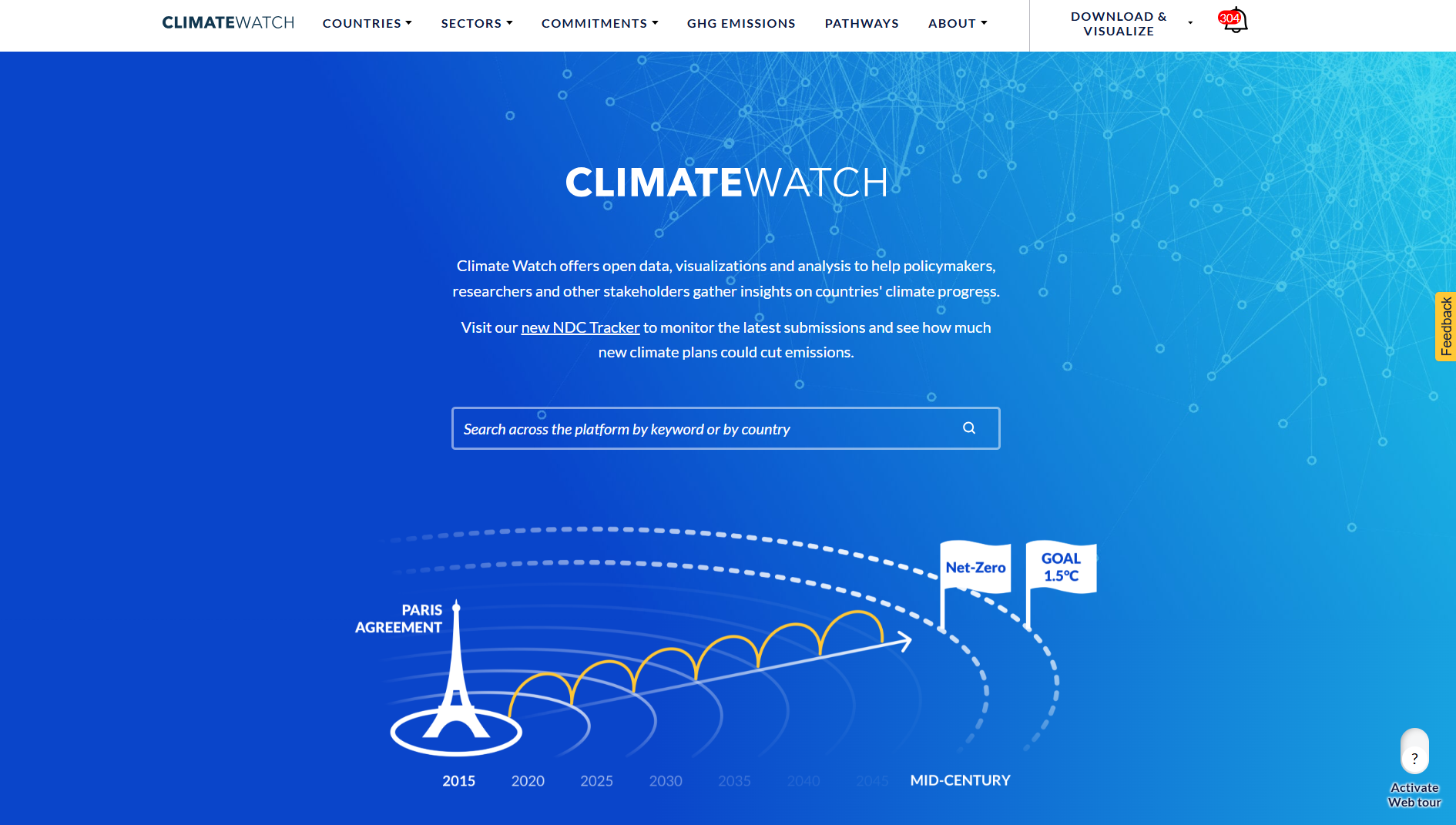
Climate Watch is an open-data online platform offering comprehensive global and national-level climate information. It aggregates historical greenhouse-gas (GHG) emissions, future emissions scenarios, and countries’ climate commitments under the Paris Agreement. Finance professionals may find it relevant as it provides transparent, comparable data useful for assessing climate-related risks, long-term environmental trends, and sustainability-related metrics.
Organisation behind the tool
Climate Watch is developed and maintained by the World Resources Institute (WRI) in collaboration with partners, as part of the broader NDC Partnership.
What the tool does
Provides global and national-level historical data on GHG emissions by sector, gas type, country or region. Offers data on countries’ formal climate commitments — including Nationally Determined Contributions (NDCs), long-term strategies (LTS), and net-zero pledges. Allows exploration and comparison of future emissions and economic-environmental scenarios, based on different policy, economic or technological assumptions. Features country profiles, sectoral profiles (e.g. energy, agriculture), and tools for comparing multiple countries across metrics. Enables users to download raw data, build custom visualisations, and export data sets for further analysis.
Target audience
The primary users of Climate Watch include policymakers, researchers, climate analysts, and media. It is also relevant to stakeholders in government, NGOs, academia, and the broader public interested in climate data, sustainability and emissions tracking.
Relevance to finance professionals
- Risk assessment – Offers data to evaluate exposure to climate-related hazards and long-term environmental transitions, which may impact asset value, sovereign risk or regulatory compliance.
- ESG analysis – Provides quantitative metrics on greenhouse-gas emissions and national climate commitments that can support environmental reporting and ESG disclosures.
- Market and commodity insights – Enables analysis of sectoral emissions trends (e.g. energy, agriculture), supporting assessments of commodity supply chains, carbon-intensive sectors, or transition risks.
- Investment context – Facilitates long-term scenario analysis and macroeconomic modelling to inform sustainable investments, green financing decisions, or stress-testing portfolios against climate-driven transition pathways.