

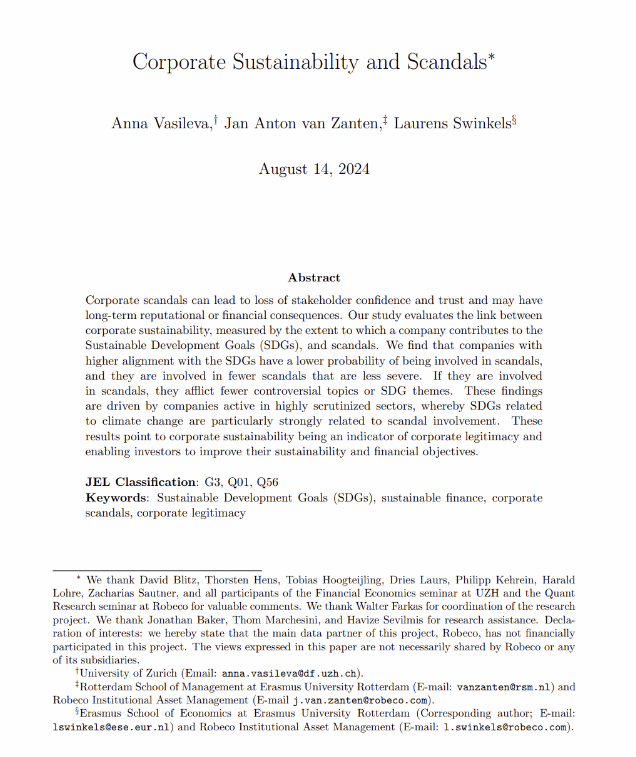
Corporate sustainability and scandals
The report analyses global listed firms from 2010–2022 and finds that stronger alignment with UN Sustainable Development Goals is associated with fewer, less severe corporate scandals, especially in highly scrutinised sectors such as energy and utilities, offering investors predictive insight beyond conventional ESG ratings.
Please login or join for free to read more.

OVERVIEW
Introduction
The report examines whether corporate sustainability is associated with future corporate scandals. Using the Sustainable Development Goals (SDGs) as a measure of sustainability, it argues that firms contributing positively to sustainable development are less likely to face scandals. The study positions sustainability as an indicator of corporate legitimacy, which may reduce scrutiny and unethical behaviour. This question is relevant for investors seeking to manage financial risk while meeting sustainability objectives.
Data
The analysis covers 7,705 listed firms across more than 50 countries, spanning 2010–2022. Corporate sustainability is measured using Robeco’s SDG scores, which range from −3 (strong negative impact) to +3 (strong positive impact). Two measures are used: a Total SDG Score (including controversies) and a Core SDG Score (excluding controversies). Corporate scandals are identified using RepRisk data, capturing both frequency and characteristics such as severity, reach, topic breadth, and SDG violations. Approximately 45% of firm-year observations involve at least one scandal, with severe scandals accounting for around 20–25% of total cases.
Empirical strategy
The study links SDG scores in year t to scandals in year t+1. Regression models assess multiple outcomes, including the probability of a scandal, the number of scandals, severe scandals, and measures of severity and topic breadth. Controls include firm size, profitability, leverage, capital expenditure, intangibles, employment, sector, country, and year effects. Probit and Poisson models are used as standard approaches, with ESG scores from MSCI included to test whether SDG alignment adds explanatory power beyond conventional ESG metrics.
Corporate sustainability and scandals
The results show a strong negative relationship between SDG alignment and future scandals. Each one-point increase in the Total SDG Score reduces the odds of a scandal by around 5.8%, equivalent to an approximate two percentage point decline in scandal probability. The number of scandals falls by about 11% per SDG point, while severe scandals decline by roughly 17%. Even when using the Core SDG Score, which excludes past controversies, the effects remain statistically significant, though smaller.
Higher SDG scores are also associated with lower scandal severity, fewer violated topics, and fewer SDG-related violations. By contrast, conventional ESG scores show weak or inconsistent relationships with scandal outcomes, and in some models are positively related to scandal likelihood, suggesting limited predictive usefulness.
At the individual SDG level, SDG 1 (No Poverty), SDG 7 (Affordable and Clean Energy), and SDG 13 (Climate Action) consistently show negative associations with both related and unrelated scandals. This indicates that contributions to these goals reduce overall scandal risk, not only climate- or labour-related controversies.
Sector analysis highlights that the predictive power of SDG scores is strongest in highly scrutinised sectors, particularly Energy and Utilities. In these sectors, a one-point increase in SDG score is linked to materially lower scandal probability and frequency, reflecting differences between fossil fuel activities and cleaner energy operations. The findings suggest that within-sector differentiation using SDG alignment may be more effective than broad sector exclusion.
corporate sustainability…
Robustness
The results remain stable across alternative model specifications, alternative ESG data providers, and stricter fixed effects. Including sector-by-country effects and substituting ESG measures does not materially change the negative relationship between SDG alignment and scandals, reinforcing the robustness of the findings.
Conclusion
The report concludes that corporate sustainability, measured through SDG alignment, is a meaningful predictor of fewer and less severe corporate scandals. SDG-based measures provide information beyond traditional ESG ratings and are particularly relevant in sectors subject to high public scrutiny. For investors, SDG alignment offers a practical tool to manage downside risk while supporting sustainability objectives, and to tilt portfolios within sectors rather than relying solely on exclusion strategies.




