

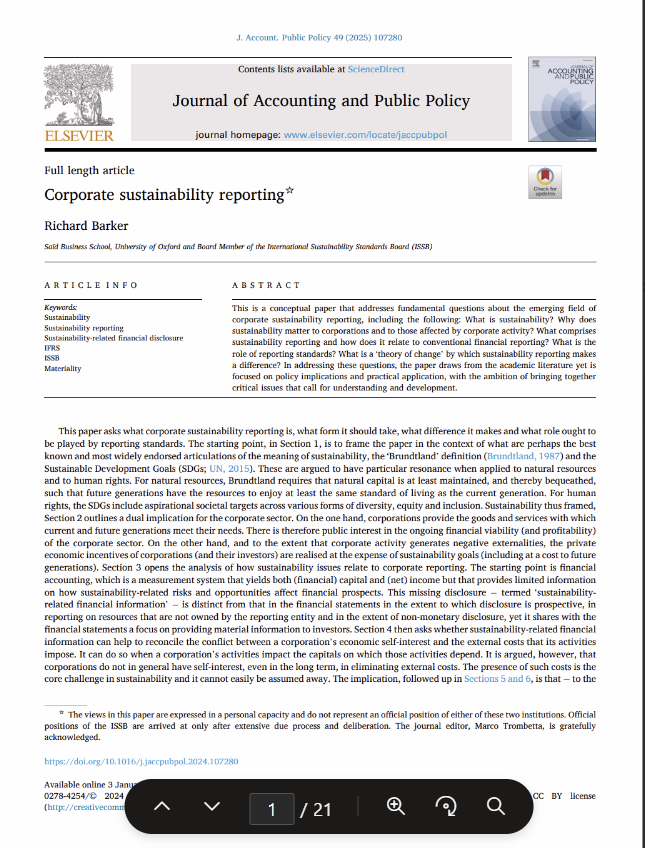
Corporate sustainability reporting
This conceptual paper examines corporate sustainability reporting, distinguishing investor-focused sustainability-related financial disclosure from broader impact reporting. It argues investor interests are imperfectly aligned with societal goals and concludes that complementary financial and impact reporting standards are needed to support accountability, capital allocation and sustainability transition.
Please login or join for free to read more.

OVERVIEW
What is sustainability?
The paper defines sustainability using the Brundtland definition and the UN Sustainable Development Goals (SDGs). It distinguishes two core dimensions: environmental sustainability, focused on maintaining natural capital so future generations can meet their needs; and social sustainability, centred on respecting human rights and progressing societal goals such as equity, health and inclusion. Natural capital is identified as critically depleted due to climate change, biodiversity loss and resource overuse, reflecting systemic market failures and externalities. Intellectual and manufactured capital are generally cumulative and less central to sustainability concerns, while human and social issues are better understood through a rights-based lens rather than capital maintenance.
The corporation in a sustainable economy
Corporations have a dual role in sustainability. They generate goods, services, employment and tax revenues, making financial viability and profitability necessary conditions for societal wellbeing. However, corporate activity often imposes external costs on society and future generations. The paper argues that sustainability places three demands on corporations: continued economic value creation; avoidance of natural capital depletion; and contribution to societal progress aligned with the SDGs. These demands can conflict, as private economic incentives do not reliably internalise environmental and social costs.
Information for investors: Financial accounting and sustainability-related financial disclosure
Financial accounting focuses on historical performance and capital maintenance and provides limited insight into future sustainability-related risks and opportunities. Sustainability-related financial disclosure addresses this gap by reporting on governance, strategy, risk management, metrics and targets relevant to financial prospects. Such disclosures are forward-looking, include resources beyond those controlled by the entity, and rely heavily on non-monetary indicators, such as greenhouse gas emissions, as proxies for financial risk. The paper highlights that these disclosures are more judgement-based and heterogeneous than financial statements, but remain material to investor decision-making.
Is reporting to investors sufficient?
The paper challenges the assumption that investor-focused reporting alone can deliver sustainability outcomes. It distinguishes between dependency, which considers how sustainability issues affect corporate financial performance, and impact, which examines how corporate activities affect people and the environment. While impacts can feed back into financial risk, many external costs do not. Long-term evidence shows a strong correlation between economic growth and rising atmospheric CO₂ concentrations, indicating that market incentives have historically favoured growth alongside natural capital depletion. Sector examples, including livestock and beef production, demonstrate severe environmental impacts coexisting with sustained profitability. The paper concludes that investor interests are not fully aligned with societal interests, even over long time horizons.
Implications for standard setting
Because sustainability-related financial disclosure meets only a subset of societal information needs, the paper argues for complementary impact reporting. Investor-oriented reporting filters information through business relevance and financial materiality, excluding many impacts that matter to other stakeholders. Impact reporting, grounded in public policy objectives, science-based targets and the SDGs, is better suited to address market failures and inform government action. Mandatory standards are justified to ensure comparability, reduce selective disclosure and limit greenwashing. The paper suggests thematic standards for impacts and industry-based standards for investor-focused disclosures.
The reporting system: A theory of change
Three reporting models are assessed: investor-only reporting; separate investor and stakeholder reports; and a hybrid model combining financial reporting with an impact report. The paper favours the hybrid approach, arguing it improves transparency, highlights misaligned incentives and better serves investors, stakeholders and policymakers. By revealing sustainability issues not yet priced by markets, this approach supports long-term resilience and helps align corporate behaviour, capital allocation and public policy in the transition to a sustainable economy.




