

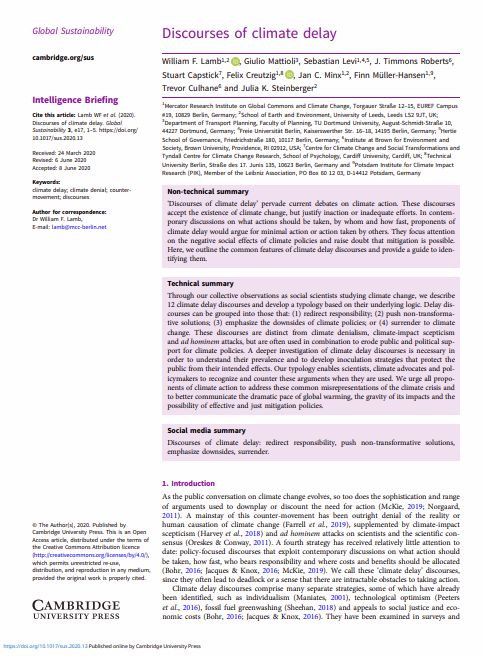
Discourses of climate delay
The report identifies twelve “climate delay” discourses that accept climate change yet justify inaction. It groups them into four strategies—redirecting responsibility, promoting non-transformative solutions, emphasising policy downsides, and surrendering to inevitability—and offers a typology to recognise and counter these arguments.
Please login or join for free to read more.

OVERVIEW
Introduction
The report analyses a shift from outright climate change denial towards “discourses of climate delay”, which accept climate change but justify insufficient or postponed action. Drawing on social science literature, media analysis and policy debates, the authors identify how such discourses undermine public and political support for timely mitigation while appearing reasonable or pragmatic.
Redirect responsibility
This chapter examines discourses that shift responsibility away from immediate, collective action. Examples include individualism, which emphasises personal behaviour over systemic change, and whataboutism, which highlights other countries’, sectors’ or actors’ higher emissions to justify inaction. The “free rider” excuse argues that unilateral action is futile if others do not act. While these arguments reflect real coordination challenges, the report finds they often set unrealistic preconditions for action and delay near-term mitigation opportunities.
Push non-transformative solutions
Here, the report outlines discourses that promote solutions insufficient to meet climate targets. Technological optimism assumes future innovations will deliver emissions reductions without strong policy intervention, often overstating the speed or scale of technological change. Fossil fuel solutionism frames fossil fuels as part of the climate solution, despite evidence that new high-emitting infrastructure is incompatible with limiting warming to 1.5°C. Other strategies include “all talk, little action”, where ambitious targets substitute for concrete policies, and “no sticks, just carrots”, which rejects regulatory measures in favour of voluntary or market-based approaches. Collectively, these discourses deflect attention from transformative change.
Emphasize the downsides
This section focuses on arguments that stress the social and economic costs of climate action while downplaying the costs of inaction. Appeals to social justice and well-being frame mitigation as a threat to jobs, prosperity or living standards, particularly for lower-income groups. The report notes that such concerns are legitimate but become delay discourses when they ignore co-benefits such as improved public health or employment opportunities, or when they exaggerate disruption. Policy perfectionism further delays action by arguing that only fully acceptable policies should proceed, without parallel efforts to build public support.
Surrender
The final category includes discourses that suggest mitigation is no longer feasible. “Change is impossible” frames transformative change as politically or socially unrealistic, while doomism claims it is already too late to prevent severe climate impacts. These narratives can induce resignation and shift focus towards adaptation alone. The authors argue that such discourses overlook historical evidence of rapid socio-economic transformation and the remaining potential for effective mitigation.
Conclusion
The report concludes that discourses of climate delay are sophisticated, often combining partial truths across categories to weaken momentum for action. While the paper does not quantify their prevalence or impact, it stresses the need for further research and for proactive responses. The authors suggest that recognising these discourses can help scientists, policymakers and advocates counter misinformation, improve public deliberation, and communicate that rapid, just and effective climate mitigation remains both possible and desirable.




